Humans living on other planets has long been a topic of discussion, but one almost exclusively reserved for hard science fiction novels, beginning with the publication of Lucian’s Verae Historiae (“True Histories”), which is considered the first science fiction novel, in the second century (Georgiadou and Larmour 1998; Doody 1996, 26). As technology has progressed and made traveling to other worlds a slightly less distant possibility, some groups are now advocating that moving to another planet should be considered as a serious option for humanity’s long term survival, especially when considering how to best tackle the global challenge of climate change (Tabas 2020). Although less of a ‘solution’ and more of an ‘in emergency break glass’ escape option, there has nevertheless been a surprising amount of discussion on whether the future of humanity lies in the stars, both in the technical talk of researchers and space companies, and in the more public view of popular media.
Opinions on space travel in popular media vary wildly, from a Times Magazine article explaining Stephen Hawking’s belief that humans must move to another planet within 100 years (Zorthian 2017), to a CBC podcast claiming that colonising a planet is a terrible idea (Chattopadhyay 2024). Brad Tabas (2020) coined the term “post-planetary culture” to describe the people who, like Steven Hawking, believe that humanity is destined to live on planets beyond Earth. People who share this ideology prioritize research and technology necessary to escape Earth over climate action here at what we currently consider ‘home’. Many private billionaires, such as Jeff Bezos and Elon Musk, agree with this culture, and have gone so far as to form private space companies with the goal of multiplanetary existence. The second item on the SpaceX homepage, after an announcement of their most recent rocket launch, is a picture of Mars, with the title “Making Life Multiplanetary” (SpaceX 2026). Similarly, the website of Blue Origin (Jeff Bezos’ space company) states their intentions to go to space for the “benefit of humanity” right at the top of their home page (Blue Origin 2026). Critics such as Tabas (2020) and Shaw (2022) have even suggested that it is in these billionaires’ best interests for them to focus on leaving Earth and allow climate change to continue. The drastic climate action necessary to stop global warming would require people to buy fewer new items, ultimately resulting in these billionaires making less money (Shaw 2022). By expanding to other planets, the current capitalist economy that relies on rapid consumption of resources could continue, depleting reserves of materials on other planetary bodies once the ones on Earth were gone (Shaw 2022). In the long term, expanding to other planets is not an inherently bad idea, as Earth could be made unliveable by events unrelated to climate change, such as asteroid strikes (Zorthian 2017). However, getting humanity on another planet would be an incredibly massive undertaking, and as a result should not be our first (and definitely not our only) approach for ensuring humanity’s well-being in our changing climate.
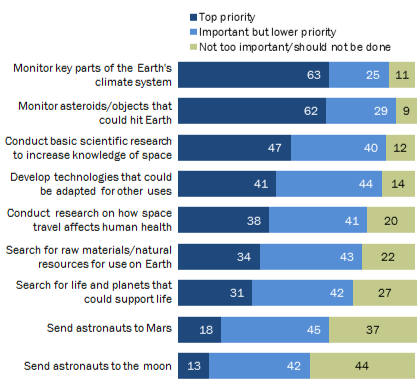
Although prominent businessmen may be enthusiastic to leave Earth behind, according to a survey by the Pew Research Center (Funk and Strauss 2018), the majority of Americans are less convinced, with only 42% of respondents saying they would want to orbit the Earth as a space tourist, let alone leave the Earth for another planet. When asked to rank NASA priorities, the three topics related to living on planetary bodies other than Earth were considered the least important (see Figure 1). A Canadian survey (Coletto and Bennett 2026) about the Canadian space program did not have a specific question about traveling to other planets, but the majority of Canadians thought it was important to participate in space missions and expand Canada’s space program for economic and sovereignty reasons. The Canadian survey did not discuss long-term space travel to other planets.
In summary, new space-based technologies open up a potential “Get out of Jail Free Card” for dealing with climate change, helping ensure the long term survival of the human species, but building the infrastructure necessary to move humanity to another planet would be an enormous undertaking that is impossible in the immediate future. Before humankind abandons the Earth, trusting space technology that is still in development while searching for another planet to destroy, we should take the time to consider some other, less complicated ways to combat climate change. In light of the extremely complex future of space travel, maybe reducing our reliance on fossil fuels, shifting to a circular economy, and reducing our overall carbon footprint is a safer bet.
References:
Chattopadhyay, Piya, host. 2024. The Sunday Magazine. “The case against colonizing space.” CBC, July 14, 2024. Podcast, 15 min., 3 sec. https://www.cbc.ca/listen/live-radio/1-57-the-sunday-magazine/clip/16081365-the-case-colonizing-space.
Coletto, David, and Kelly Bennett. 2026. “Abacus Data Poll: 68% Of Canadians Think Canada Should Have Sovereign Launch Capabilities.” Abacus Data. July 16, 2026. https://abacusdata.ca/canadians-think-canada-should-have-sovereign-launch-capabilities/.
Doody, Margaret Anne. 1996. The True Story of the Novel. Rutgers University Press. https://www.rutgersuniversitypress.org/the-true-story-of-the-novel/9780813524535.
Funk, Cary , and Mark Strauss. 2018. “Majority of Americans Believe It Is Essential That the U.S. Remain a Global Leader in Space.” Pew Research Center. June 6, 2018. https://www.pewresearch.org/internet/2018/06/06/majority-of-americans-believe-it-is-essential-that-the-u-s-remain-a-global-leader-in-space/.
Georgiadou, and Larmour. 2018. Lucian’s Science Fiction Novel True Histories: Interpretation and Commentary. BRILL. https://brill.com/display/title/2484.
Shaw, Debra Benita. 2022. “The Way Home: Space Migration and Disorientation.” New formations: a journal of culture/theory/politics, 107 (2022): 118-138.https://muse.jhu.edu/article/881496.
SpaceX. 2026. “SpaceX.” SpaceX. 2026. https://www.spacex.com/.
Tabas, Brad. “Hatred of the Earth, Climate Change, and the Dreams of Post-Planetary Culture.” Ecozon@ 11, no. 1 (2020): 63–79. https://doi.org/10.37536/ECOZONA.2020.11.1.3188.
Zorthian, Julia. 2017. “Stephen Hawking: We Have 100 Years to Colonize a New Planet.” Time. May 4, 2017. https://time.com/4767595/stephen-hawking-100-years-new-planet/.


Leave a Reply
You must be logged in to post a comment.