Vaccine hesitancy has been present far earlier than what was seen a few years ago during the COVID-19 pandemic. Since the creation of the first vaccine in the 1800s, members of the public have protested the use of vaccines (Jacobson et al. 2015). When Edward Jenner began to promote vaccination with cowpox against smallpox, people were outraged by the advertised use of an animal infection as an injection for humans. This outrage fueled misinformation, including a well-known piece of propaganda about the vaccine’s effects (Figure 1).
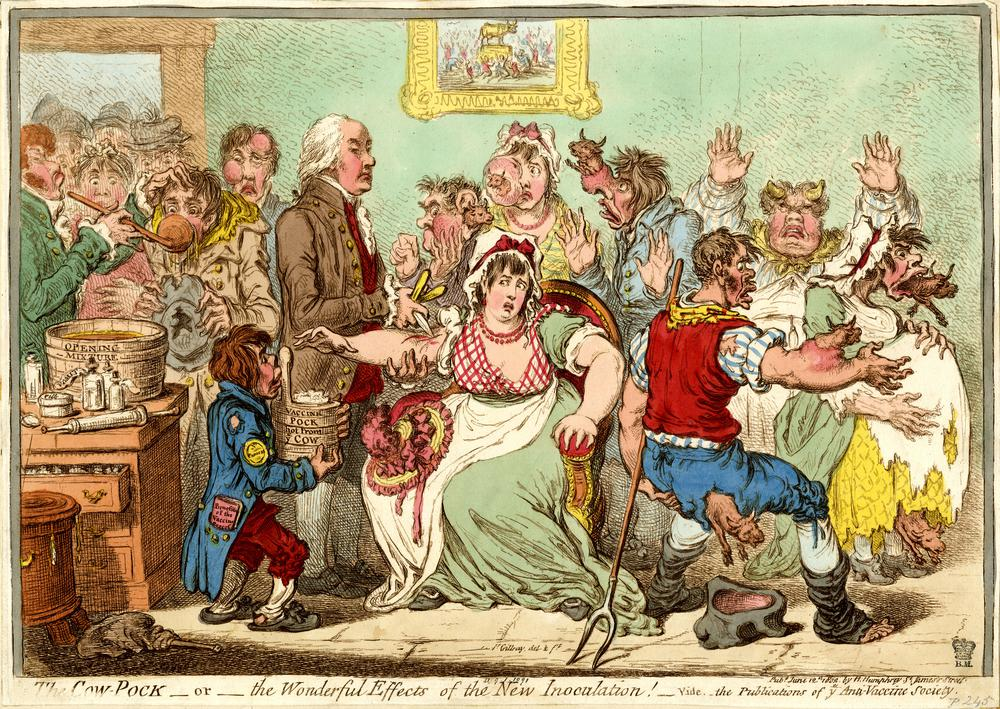
Figure 1: A piece depicting individuals gaining animal physiology after being vaccinated with the up-and-coming smallpox vaccination. The image is named “The Cow Pock – or – the Wonderful Effects of the New Inoculation.” The piece depicts Edward Jenner himself administering the vaccine (Gillray 1802).
Understanding the history of vaccine hesitancy and the fear it may originate from is necessary to further examine how to reduce hesitancy across different communities. The results of vaccine hesitancy are being seen locally in the US and Canada. In late 2024, an outbreak of measles occurred in Canada, originating in a community in New Brunswick, and then further spreading across the country. By late August 2025, over 4800 cases were found across Canada, with Ontario, Manitoba, and Alberta being the most impacted. As of November 2025, Canada has lost its measles-free status after a confirmed period of over 12 months with sustained endemic transmission (Zhou 2026).
The majority of the measles cases reported were in individuals who were not vaccinated or did not state their vaccination status. Although the measles vaccine has been well-established and in use for the past five decades, there has been a decline in immunization uptake. This decline led to further problems as the typical threshold for immunization is 95%. This defines the percentage of the population that is required to be vaccinated to support herd immunization (limited transmission of disease due to the majority of individuals having immunity to the disease). Comparing the ideal number, 95%, to the current percentage of vaccinated two-year-olds in Alberta, 80.4% as of December 2024, the difference is evident. Vaccine hesitancy, originating from different ideologies, plays a part in this reduction (Zhou 2026).
Tackling the hesitancy surrounding immunizations is not a simple task. Every decision may come from a unique reason, whether it is a religious belief, fear, misinformation, or lack of information. One of the big sources of misinformation across the world is social media. Social media is arguably the most accessible form of information spread modernly, making it a platform extremely vulnerable to misinformation (Tuckerman et al. 2022). Media consumers commonly see a spread of misinformation across social media, with topics touching on vaccine uptake. Since patterns in social media are built to reflect consumer concerns, they then supply more points of concern to validate and build on potential fears.
As there are many causes of this hesitancy, there is not one universal solution. To increase education and awareness on vaccines, evidence-based and context-specific communication is extremely important. Additionally, since hesitancy is not solely based on lack of education, it is equally, if not more, important to engage with individuals on their concerns about immunizations through discussion. If those who may be frozen in fear have the opportunity to be heard and have their fears validated, an outcome of them being open to vaccination is more likely (Tuckerman et al. 2022). By understanding the spectrum of causes of vaccine hesitancy and taking the time to understand public concerns along with working on communicating the beneficial impacts of immunizations, hesitancy can hopefully be reduced.
References
Gillray, James. 1802. The Cow-Pock-or-the Wonderful Effects of the New Inoculation! June 12. Hand-coloured satirical etching, 250 x 355 mm. The British Museum, 1851,0901.1091.https://www.britishmuseum.org/collection/object/P_1851-0901-1091?selectedImageId=146958001.
Jacobson, Robert M., Jennifer L. St. Sauver, and Lila J. Finney Rutten. 2015. “Vaccine Hesitancy.” Mayo Clinic Proceedings 90 (11): 1562–68.https://doi.org/10.1016/j.mayocp.2015.09.006.
Matkin, A., K. Simmonds, and V. Suttorp. 2014. “Measles-Containing Vaccination Rates in Southern Alberta.” Canada Communicable Disease Report 40 (12): 236–42.https://doi.org/10.14745/ccdr.v40i12a03.
Tuckerman, Jane, Jessica Kaufman, and Margie Danchin. 2022. “Effective Approaches to Combat Vaccine Hesitancy.” The Pediatric Infectious Disease Journal 41 (5): e243–45.https://doi.org/10.1097/INF.0000000000003499.
Zhou, Yanqiu Rachel. 2026. “The Entangled Temporalities of a Forgotten Disease: Making Sense of the 2025 Measles Resurgence in the U.S. and Canada.” Social Science & Medicine 395 (April): 119089.https://doi.org/10.1016/j.socscimed.2026.119089.


Leave a Reply
You must be logged in to post a comment.