The Haunting on REM Street

Imagine waking up at 3 a.m to find a shadowy figure standing in the corner of your bedroom. You try to scream, but nothing comes out. You try to move, but your body refuses to cooperate. At this moment, you might be thinking that you need an exorcist. However, before jumping to conclusions, you might want to see a neurologist instead. What just happened was likely sleep paralysis.

This eerie experience known as sleep paralysis, is something most children fear. However, that daunting figure may be more of a neurological phenomenon than a supernatural one.

To understand why our brains turn bedtime into a horror movie, we first need to look at what happens while we sleep.
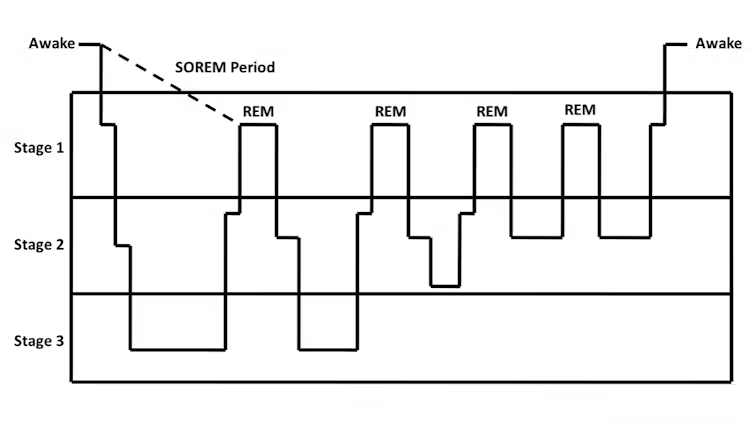
Figure 1. Hypnongram showcasing the progression through the stages of non-rapid eye movement sleep and rapid eye movement sleep across multiple sleep cycles (Denis 2015).

Every night, your body cycles through three stages of non-REM sleep. After returning to stage one, your body enters a period of REM sleep (Denis 2015). During this stage, brain activity increases and you begin to experience your most vivid dreams. While the brain generates these dreams, the body enters a state of REM atonia, a temporary paralysis affecting most voluntary skeletal muscles. This process is regulated by two inhibitory neurotransmitters in the central nervous system: GABA and glycine, which reduce the activity of motor neurons. This prevents you from physically acting out most of your dreams (Jalal 2018). When you begin to wake up, the body gradually regains awareness and movement, however, when awareness is gained before voluntary movement that is when sleep paralysis occurs.  

So where might this mysterious presence come from? One possible explanation involves the body schema, an internal representation of your body’s position and movement. This system relies on brain regions such as the superior parietal lobule and the temporoparietal junction. These regions help integrate sensory information to construct the brain’s representation of your body (Taylor 2026).

However, during sleep paralysis, the usual relationship between movement and sensory feedback may be disrupted. Your central nervous system sends efferent signals to your limbs, but due to the temporary paralysis, your brain does not receive the expected afferent signals back. According to one hypothesis proposed by Jalal and Ramachandran, this mismatch may distort the brain’s representation of the body. This causes it to project its internal body map, known as the homunculus, into the surrounding environment (Jalal and Ramachandran 2017).
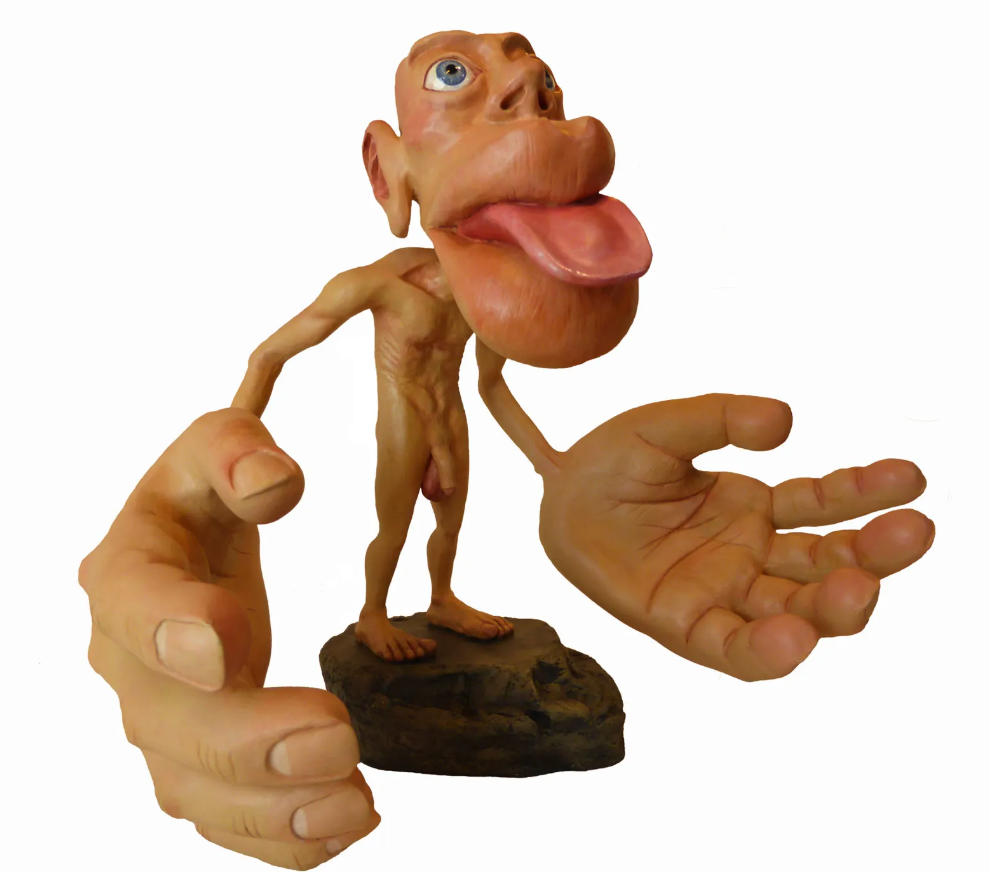
Figure 2. The cortical homunculus model by Sharon Price James, a representation of how different parts of the body are mapped onto the brain’s sensory and motor cortices (Baugh n.d.).

The amygdala, a brain region involved in processing fear, may then amplify the threat created by this mysterious presence. The fear of being unable to move, combined with your cultural beliefs and expectations may shape this presence into something frightening, such as a demon or shadowy figure (John Fakoya et al. 2018).

However, this is one of many proposed explanations for these hallucinations, and the exact mechanisms remain a mystery. So, the next time you spot a shadowy figure in your room, it may just be your brain. But then again, I don’t recommend tossing that exorcist’s number just yet.

References

Baugh, Sue. n.d. “Homunculus | Description, History, Models, & Importance | Britannica.” Www.Britannica.Com. Accessed October 18, 2026. https://www.britannica.com/science/homunculus-biology.

Denis, Dan. 2015. “Understanding Sleep Paralysis: A Terrifying but Unique State of Consciousness.” The Conversation, October 5. https://theconversation.com/understanding-sleep-paralysis-a-terrifying-but-unique-state-of-consciousness-48509.

Jalal, Baland. 2018. “The Neuropharmacology of Sleep Paralysis Hallucinations: Serotonin 2A Activation and a Novel Therapeutic Drug.” Psychopharmacology 235 (11): 3083–91. https://doi.org/10.1007/s00213-018-5042-1.

Jalal, Baland, and Vilayanur S. Ramachandran. 2017. “Sleep Paralysis, ‘The Ghostly Bedroom Intruder’ and Out-of-Body Experiences: The Role of Mirror Neurons.” Frontiers in Human Neuroscience 11 (February). https://doi.org/10.3389/fnhum.2017.00092.

John Fakoya, AdegbenroOmotuyi, Esther Olunu, Ruth Kimo, et al. 2018. “Sleep Paralysis, a Medical Condition With a Diverse Cultural Interpretation.” International Journal of Applied and Basic Medical Research 8 (3): 137. https://doi.org/10.4103/ijabmr.ijabmr_19_18.

Taylor, Kenji. 2026. “Sleep Paralysis Hallucinations Aren’t Random—Here’s What Triggers Them. | Ubie Doctor’s Note.” Ubiehealth.Com, Ubie, Inc., January 16. https://ubiehealth.com/doctors-note/sleep-paralysis-hallucination-trigger-cause-37-why122e3.

Comments

8 Responses to “The Haunting on REM Street”

  1. Zahra Imthiyas Avatar
    Zahra Imthiyas

    Hi Isci!
    I chose this topic because I thought it would be nice to embrace the scary halloween and exam season through a spooky read. This topic is also one I can relate to, as I’ve experienced sleep paralysis frequently for almost two years now, and yes, I have seen the shadow figure hallucinations. Despite experiencing this myself, I never really looked into the hows or the why behind it and thought this would be the perfect chance to explore its science.

    This topic connects to isci through its psychological concepts and our lesson on the nervous system, allowing me to bring together different areas of science to understand a common personal experience. Feel free to leave me any suggestions, I hope you enjoy reading!

    Zahra Imthiyas

  2. Joycee Joseph Avatar
    Joycee Joseph

    Hi Zahra,

    This is a very well written post. I especially loved your hook! It was really intriguing. My only suggestion to further polish your blog would be to add a little more detail to your figure captions! They are not a part of the word count and are really useful to add more context to your post. Excited to read the final draft!

    Joycee

  3. Angie Luo Avatar
    Angie Luo

    Hi Zahra,

    Great work. This is a well-written draft. Here is some feedback:
    – Make sure to define any acronyms you use. GABA in paragraph 3 is not defined, and most likely not common knowledge.
    – I recommend splitting the last sentence into 2 by removing the “however”, for better flow. Consider rewording the last portion to: “Sleep paralysis occurs when awareness is gained before voluntary movement.”
    – Make sure to hyperlink your citations. I should be able to click them and visit the page you sourced.

    I am excited to read the final draft! Happy editing!

    Angie

  4. Hanna Yip Avatar
    Hanna Yip

    Hey Zahra,

    This is a super interesting topic! Some suggestions I have:

    – Ensure to define your acronyms before the first time you mention it (e.g ” rapid eye movement (REM)”)

    – In your citation “John Fakoya..” I believe that John Fakoya Adegbenro Omotuyi is one person, and Esther Olunu is the primary author of the paper you cited, so they should be listed first.

    Have a good time editing!
    Hanna

  5. Kristen Taylor Avatar
    Kristen Taylor

    Hi Zahra,

    Great job on your blog post – you chose a fascinating topic and did a great job captivating the reader from the start! Here are just a few small suggestions I had for your edits:

    – Make sure to reference both figures somewhere in your text.

    – Consider expanding on your figure caption for Figure 1 to explain the different stages of sleep so the reader can better understand the chart.

    – In the last sentence of paragraph 4, I would suggest adding a comma between the words “movement” and “that”.

    Overall, great job and good luck with your edits!
    – Kristen

  6. Nima Soleimani Avatar
    Nima Soleimani

    Hi Zahra!
    This was a great blog post on an interesting topic! A few small things:

    – In the paragraph directly below figure. 1 there is some awkward wording in “before voluntary movement that is when sleep paralysis occurs.” at the end. I think removing the that in the section or rewording it will be more correct and make your paragraph more clear.

    – In psychology during one of the lectures we went over inhibitory neurotransmitters such as GABA! Not feedback, just something interesting to add that further connects to lecture.

    – The Baugh Britannica page you cited actually does have a date that you can add, as you can check the history of the article, which was last updated in 2026 and added in 2023.

    – In your second to last citation, you forgot to put a space in the name AdegbenroOmotuyi. You may also want to recheck the rules looking at listing multiple authors of an article in a citation.

    – I think you struck a really good balance between engaging the audience and being scientifically accurate!

    Overall I’m excited to see where this goes!
    Nima

  7. Via Kim Avatar
    Via Kim

    Hi Nima,
    What a fun read! You did an amazing job making your writing super engaging and clearly articulating your ideas! Here are a few suggestions:

    -P1: For better flow, I would suggest combining your last two sentences!

    -I think P1 and P2 could also be combined together!

    -Make sure that you are introducing figures in the text before showing the figure! This might mean moving your body paragraphs so they come before your figure. Ex. P4

    Overall, you did a fantastic job and I cannot wait to read your final copy.

    Happy editing,
    Via

  8. Daniel Cao Avatar
    Daniel Cao

    Hi Zahra,

    This was a great read, always wondered what exactly caused sleep paralysis and enjoyed reading about some of they hypotheses you researched! I did notice some things that you could correct though:
    – In the first sentence of P1 – “Imagine waking up at 3 a.m” there is a missing period after the m (should be 3 a.m.)
    – There is a missing comma on the first sentence of P2 – “This eerie experience known as sleep paralysis, is something…” should be “This eerie experience, known as sleep paralysis, is something”
    – “Hypnongram” is misspelled in Figure 1. It should be corrected to “Hypnogram”

    Overall great blog post!
    Daniel

Leave a Reply