The morning after a night of heavy drinking, it is common for one to experience gaps in memory of the night prior. Memory impairment and alcohol are commonly linked, but does this association hold true regardless of the specific alcoholic beverage? Studies done on red wine consumption have shown a potential effect of reducing the risk of developing dementia, a common disorder known to disrupt memory (Stockley 2015). Polyphenols are large constituents of red wine and could be the driver of this positive effect, overriding the impairments alcohol causes.
Dementia is an umbrella term used in describing a range of major neurocognitive disorders associated with a decline in memory, learning, and social abilities (Stockley 2015). Alzheimer’s disease (AD) is the most common form of dementia and is caused by mutations in genetic material, resulting in neuronal and synaptic loss in regions of the brain important for memory.
Current literature shows promising evidence on the beneficial effects of red wine on this disease despite the well-understood cause of alcohol-induced cognitive decline. This is predicted to be due to polyphenols, which are extracted from grapes during the fermentation process (Boccardi et al. 2024). Polyphenols have antioxidant and anti-inflammatory properties that may help protect brain cells from damage associated with AD.
One of the defining characteristics of AD is the accumulation of abnormal amyloid-beta (Aβ) peptides, which disrupt communication between neurons and contribute to cognitive decline (Ono et al. 2008). Research from Sanders et al. (2021) has found that grape-derived polyphenols, particularly resveratrol, may interfere with the formation and accumulation of these proteins by blocking their ability to bind (Figure 1). Additionally, this compound also acts on tau proteins, which are found in the brain and can contribute to AD by undergoing an abnormal chemical change called hyperphoshorylation, causing tau to detach from microtubules. Resveratrol suppresses enzymes that promote this process and increase activity of enzymes that remove phosphate groups (He et al. 2017).
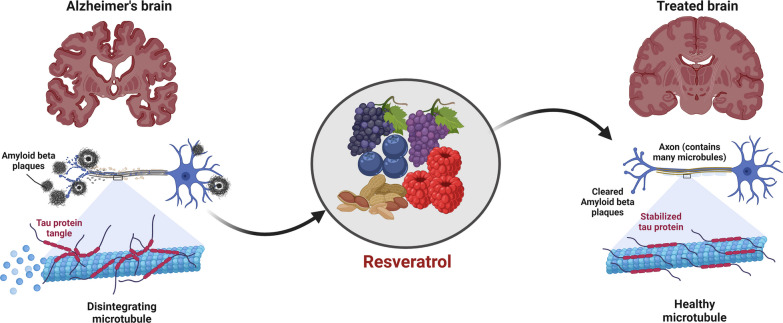
Figure 1: Demonstrates how a polyphenol, resveratrol, can help restore specific AD neuropathology hallmarks. 2 main contributors to AD are amyloid beta peptide plaques and tau protein tangles, which are essential proteins found in the brain but can undergo abnormal changes contributing to cognitive decline. Resveratrol alleviates these processes (Azargoonjahromi and Abutalebian 2024).
It is important to note that this relationship is not linear but rather reflects a U-shaped trend between consumption of red wine and risk of AD (Wojtowicz 2023). This means that while light to moderate drinking can be seen as protective against AD, beyond that, this response is diminished, and there can be adverse health outcomes. A possible reason for this is that people who consume red wine often go for the cheaper option, which contains less of these polyphenols. Additionally, alcohol itself has neurotoxic effects, particularly when consumed in excessive amounts (Wojtowicz 2023). Chronic alcohol exposure can increase oxidative stress and neuroinflammation, contributing to neuronal damage and cognitive decline. These harmful effects may outweigh any potential benefits associated with the polyphenols in red wine.
Red wine has demonstrated potential neuroprotective effects due to the high concentration of polyphenols. While these findings are notable, alcohol still induces harmful effects, which should not be overlooked.
References
Azargoonjahromi, Ali, and Fatemeh Abutalebian. 2024. “Unraveling the Therapeutic Efficacy of Resveratrol in Alzheimer’s Disease: An Umbrella Review of Systematic Evidence.” Nutrition & Metabolism 21 (March): 15. https://doi.org/10.1186/s12986-024-00792-1.
Boccardi, Virginia, Luca Tagliafico, Angelica Persia, et al. 2024. “The Potential Effects of Red Wine and Its Components on Neurocognitive Disorders: A Narrative Review.” Nutrients 16 (20): 3431. https://doi.org/10.3390/nu16203431.
He, Xiaping, Zhenhui Li, Joshua D. Rizak, et al. 2017. “Resveratrol Attenuates Formaldehyde Induced Hyperphosphorylation of Tau Protein and Cytotoxicity in N2a Cells.” Frontiers in Neuroscience 10 (January). https://doi.org/10.3389/fnins.2016.00598.
Ono, Kenjiro, Margaret M. Condron, Lap Ho, et al. 2008. “Effects of Grape Seed-Derived Polyphenols on Amyloid β-Protein Self-Assembly and Cytotoxicity*.” Journal of Biological Chemistry 283 (47): 32176–87. https://doi.org/10.1074/jbc.M806154200.
Sanders, Henry M., Blagojce Jovcevski, Michael T. Marty, and Tara L. Pukala. 2022. “Structural and Mechanistic Insights into Amyloid-β and α-Synuclein Fibril Formation and Polyphenol Inhibitor Efficacy in Phospholipid Bilayers.” The FEBS Journal 289 (1): 215–30. https://doi.org/10.1111/febs.16122.
Stockley, Creina S. 2015. “Wine Consumption, Cognitive Function and Dementias – A Relationship?” Nutrition and Aging 3 (2–4): 125–37. https://doi.org/10.3233/NUA-150055.
Wojtowicz, Jeffrey S. 2023. “Long-Term Health Outcomes of Regular, Moderate Red Wine Consumption.” Cureus 15 (10). https://doi.org/10.7759/cureus.46786.

Leave a Reply
You must be logged in to post a comment.