A fish about the length of your finger hangs just under the surface of a mangrove swamp. Above it, a beetle sits on a leaf. The fish can’t see where the beetle really is, but it fires anyway, and the beetle tumbles into the water. It looks like a physics problem solved on the spot, so is the archerfish really a tiny physicist? Not quite. Physics and evolution each do part of the work.
The archerfish (Toxotes jaculatrix) is a small fish that lives in the shallow, mangrove-lined waters of tropical Asia and northern Australia (Denver Zoo Conservation Alliance 2024). It hunts by ejecting jets of water from its mouth to knock insects off overhanging plants and into the water, where it can eat them (MacDonald 2019). Using high-speed video, researchers found that the jet delivers roughly six times the power the fish’s own muscles could produce (Scientific American 2012). But the extra power comes from outside the fish. By speeding up the jet as it spits, the archerfish makes water from the back catch up with the water at the front, so it combines into one large drop that hits with much more force (Scientific American 2012). But a powerful shot is useless if it misses.
Aiming is the archerfish’s biggest challenge, and it faces two obstacles. The first is refraction. Archerfish keep their eyes underwater when they stalk prey, but light bends as it crosses the surface, so the insect appears somewhere other than where it really is (MacDonald 2019). The second is gravity. Once the water leaves the fish’s mouth, it behaves like any projectile. It keeps moving forward at a constant speed while gravity pulls it downward, so the droplet follows a curved path (MacDonald 2019). This means that they must aim above the insect and choose an angle that lets gravity bring the water down onto it.
So how does a fish even end up with this peculiar ability? A study led by Matthew Girard traced the archerfish through genetics and morphology to determine how their spitting mechanism may have evolved over time (ECO 2022). By comparing them to a closely related species, the beach salmon, the researchers discovered that the two share similar structures in their oral cavity (Figure 1).
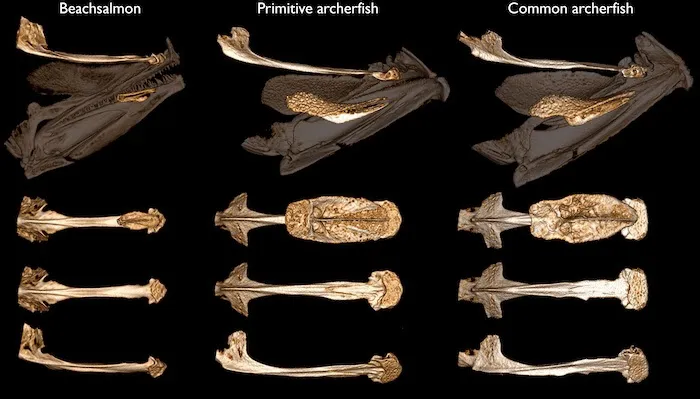
Figure 1. Tongue and mouth bones of the beach salmon (left), primitive archerfish (centre), and common archerfish (right). The structures look larger and more developed in the archerfish. Credit: Matthew Girard (ECO 2022).
Beach salmon use these structures to crush hard-bodied prey, which suggests that the archerfish already had most of the mechanisms they needed (ECO 2022). They developed their shooting abilities by evolving existing structures in their mouths to adapt to their environment, as they usually live in areas where vegetation or prey is overhanging the water surface (NBC News 2022).
So the archerfish is not quite a tiny physicist. Physics sets the path of every shot and amplifies its power, while evolution repurposed old mouth structures to make the shot possible. The archerfish isn’t a genius, just a fish that makes good use of old parts and the laws of physics.
References
Denver Zoo Conservation Alliance. 2024. “Archerfish.” Last modified July 3, 2024. https://denverzoo.org/animals/archerfish/.
ECO. 2022. “Researchers Publish Most Thorough Study Yet of ‘Smart’ Spitting Archerfishes.” Environment Coastal & Offshore, April 18, 2022. https://ecomagazine.com/news/fisheries-aquaculture/researchers-publish-most-thorough-study-yet-of-smart-spitting-archerfishes/.
MacDonald, James. 2019. “The Amazing Eyes of the Archerfish.” JSTOR Daily, June 10, 2019. https://daily.jstor.org/the-amazing-eyes-of-the-archerfish/.
NBC News. 2022. “How Did Archerfish Learn to Shoot Down Their Prey?” April 24, 2022. http://nbcnews.com/science/science-news/archerfish-learn-shoot-prey-new-study-idea-rcna24556.
Scientific American. 2012. “Fish Shoots Down Prey with Super-Powered Jet.” Scientific American (blog), October 24, 2012. https://www.scientificamerican.com/blog/observations/fish-shoots-down-prey-with-super-powered-jet-video/.


Leave a Reply
You must be logged in to post a comment.