You enter a room for the first time, yet have a sudden sense that you have been there before. You know the setting is new, so why does it feel familiar? This experience is called déjà vu, French for “already seen”: a feeling of familiarity that conflicts with recognizing the situation as new. Understanding it requires exploring how memory creates familiarity and why that feeling can seem so convincing.
Cognitive psychology offers one explanation through recognition memory. Familiarity is the sense that something has been encountered before, while recollection involves retrieving details of that encounter. Cleary and colleagues (2012) investigated whether spatial arrangement could trigger familiarity without recollection. Participants viewed virtual scenes, then encountered new ones containing different objects arranged in matching or unrelated layouts. When participants could not recall the earlier scene, matching layouts produced greater familiarity and more reports of déjà vu than unrelated layouts. A new room might therefore feel familiar because its arrangement resembles a place we cannot bring to mind. This supports one possible explanation for déjà vu, although laboratory reports may not fully reproduce spontaneous experiences.
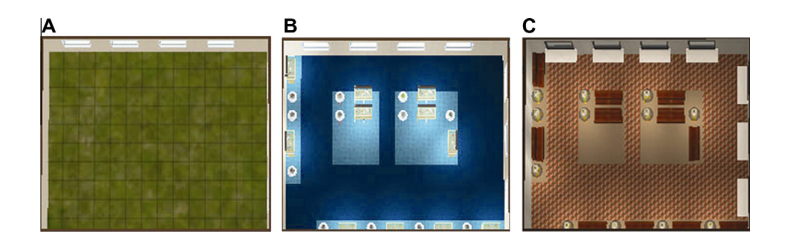
Figure 1. Different settings with matching spatial arrangements. (A) Grid used to position objects. (B) Aquarium and (C) doctor’s waiting room, with different objects occupying corresponding locations. Such matching layouts may trigger familiarity even when the earlier setting cannot be recalled (Cleary et al. 2012, fig. 2).
Neuroscience approaches the question by examining what happens when brain activity changes. Bartolomei and colleagues (2004) studied 24 patients with epilepsy who had electrodes implanted for evaluation before surgery. Electrical stimulation of the entorhinal cortex, part of the brain’s memory network, sometimes elicited déjà vu. This provides evidence that altering activity in memory-related circuits can produce the experience. It does not establish that this region acts alone, confirm the spatial-similarity explanation, or demonstrate that everyday déjà vu arises through the same mechanism.
Beyond feeling familiar, déjà vu can create a sense of knowing what happens next. Cleary and Claxton (2018) investigated this through metacognition, how people judge their own knowledge. Participants viewed virtual routes and predicted upcoming turns. When they could not recall a similar earlier route, reports of déjà vu were associated with stronger feelings of knowing the next turn, but not greater prediction accuracy. This helps explain why the feeling of prediction during déjà vu can be convincing: the sense of knowing can exceed what a person can actually demonstrate.
Together, these studies suggest that déjà vu reflects a mismatch between familiarity and what we can consciously remember or recognize as new. Spatial similarities may trigger familiarity without recall, while brain stimulation provides a separate route to eliciting the experience. Neither finding explains every occurrence, and even the accompanying sense of prediction can be misleading. That strangely familiar room may reveal how memory shapes our experience of the present, rather than confirm that we have lived the moment before.
References
Bartolomei, F., E. Barbeau, M. Gavaret, et al. 2004. “Cortical Stimulation Study of the Role of Rhinal Cortex in Déjà Vu and Reminiscence of Memories.” Neurology 63 (5): 858–64. https://doi.org/10.1212/01.wnl.0000137037.56916.3f.
Cleary, Anne M., Alan S. Brown, Benjamin D. Sawyer, Jason S. Nomi, Adaeze C. Ajoku, and Anthony J. Ryals. 2012. “Familiarity from the Configuration of Objects in 3-Dimensional Space and Its Relation to Déjà Vu: A Virtual Reality Investigation.” Consciousness and Cognition 21 (2): 969–75. https://doi.org/10.1016/j.concog.2011.12.010.
Cleary, Anne M., and Alexander B. Claxton. 2018. “Déjà Vu: An Illusion of Prediction.” Psychological Science 29 (4): 635–44. https://doi.org/10.1177/0956797617743018.


Leave a Reply
You must be logged in to post a comment.