Have you ever taken a bite of a delicious food you expect to love, only to find yourself suddenly disgusted by it? Possibly the food seems wrong, accompanied by a sudden and unexplained feeling that something terrible is about to happen. Initially you may not notice any physical changes, but could this unexpected sense of disgust or impending sense of doom be connected to your body’s response to an allergen? Hives, vomiting, swelling, and difficulty breathing are all recognized symptoms of anaphylactic food allergy (Dhanjal, 2016). But what if the body’s response influences how we feel prior to exhibiting these physical signs? Could the feelings of repulsion or unexplained doom be an overlooked and early warning sign of an allergic response? Exploring this question reveals a fascinating connection between immunology and psychology.
In someone with a food allergy, the body mistakenly recognizes certain food proteins as a threat. During the initial sensitization, the body “tags” normal food proteins and produces IgE antibodies specific to that allergen. These antibodies attach to immune cells known as mast cells. When the same food allergen enters the body again, it binds to, and cross-links the IgE antibodies, activating the mast cells to release histamine and other inflammatory chemicals that cause allergy symptoms (Figure 1). In severe instances, an allergic reaction can develop into anaphylaxis, a potentially life-threatening medical emergency (Biswas et al., 2025). While the progressive physical symptoms of anaphylaxis are well recognized, researchers are investigating how the immune system communicates with the brain and influences perception, including our experience of taste (Auvray and Spence, 2007). People experiencing an allergic reaction may also report anxiety and a sense of doom, as though something terrible is about to happen (Science Insights Team, 2026). This raises a compelling question: could these emotional experiences and responses reflect the brain’s response to changes occurring inside the body, potentially before physical symptoms appear? While a sense of impending doom is a recognized symptom of anaphylaxis, does it precede the physical signs of an allergic reaction, and could it serve as an early warning sign?
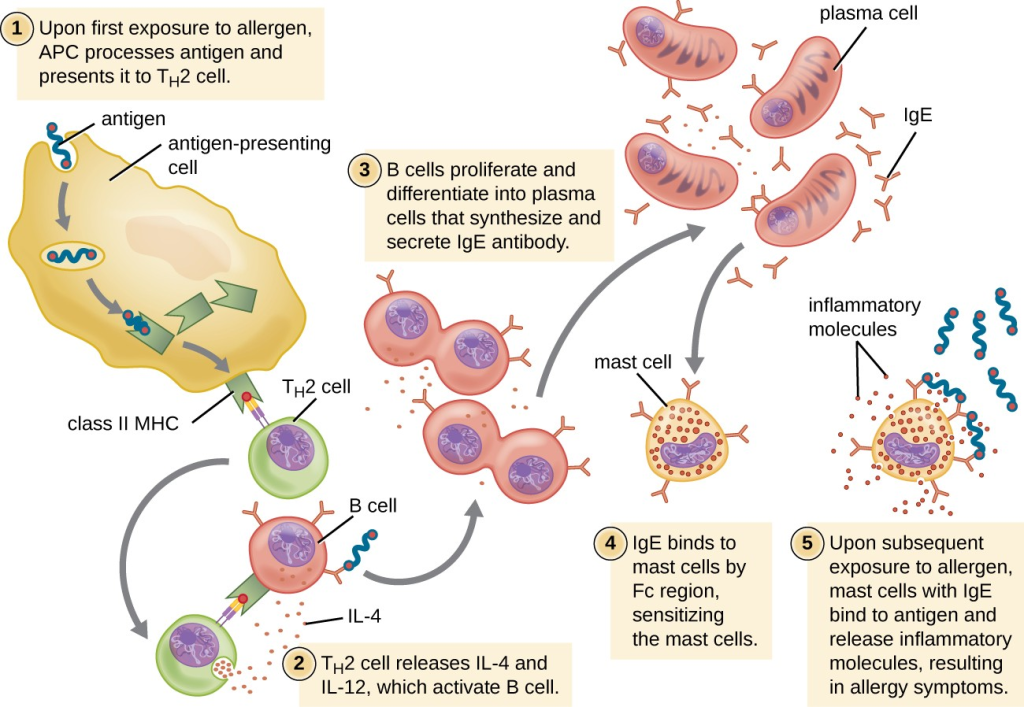
Figure 1: Process of IgE-mediated allergic reaction. First encounter with an allergen stimulates plasma to produce IgE antibodies that attach to mast cells: repeated exposure triggers histamine release (Bruslin, 2019).
Human perception of food is an important part of exploring this unique connection. What we perceive as flavour is not determined by our taste buds alone, but is created through our brain’s integration of taste, texture, smell, and other sensory information (Auvray and Spence, 2007). Memories, past experiences, emotions, and even expectations can all influence our reaction to food. As an example, someone who becomes ill after eating a certain food may later feel repulsed by that food, even when the food is safe to consume (Piqueras-Fiszman and Jaeger, 2016). Another important concept is interoception, the brain’s ability to sense and interpret internal signals from all over the body, such as changes in heart rate, or feelings of nausea (Figure 2; McLeod, 2025). When the body experiences an allergic reaction, could these internal signals affect how the brain interprets the flavour of the food or cause someone to suddenly want to stop eating it? Could a sudden change in food perception and taste involve a combination of emotional responses, sensory information, and the brain’s interpretation of internal bodily signals? Exploring these questions connects psychology and immunology in a fascinating way.
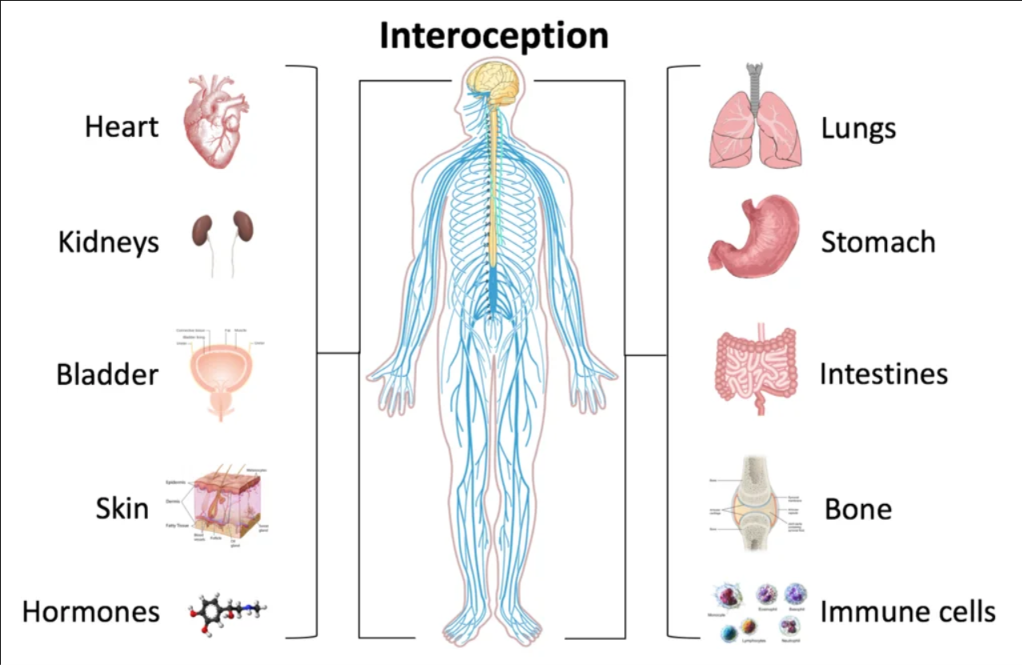
Figure 2: Overview of the interoceptive system. Signals from internal organs and systems are relayed to the brain- such as the heart, lungs, disgestive tract and immune cells (Psynso, n.d).
A study conducted by Florsheim and colleagues (2023) explored how the immune system can influence an animal’s response to food containing an allergen. The researchers found that when mice ate food containing an allergen, their immune systems triggered a response in the brain that caused them to avoid that food, even before physical symptoms, such as stomach inflammation, appeared (Florsheim et al., 2023). These findings are relevant because they suggest that the immune system can communicate with the brain to influence food-related behaviour. This raises an interesting question: could a similar process occur in humans, potentially contributing to feelings of disgust and impending doom when consuming a food allergen? However, because the study was conducted on mice, its findings cannot reliably establish that humans experience the same response.
Overall, human responses to food are complex, and involve an important relationship between the brain and the immune system (Houghton et al., 2024). Our reactions to food may include more than just physical symptoms. An unexpected feeling of disgust, or sense of impending doom raises questions about what is happening inside the body. Could these emotional experiences be connected to the beginning of an allergic reaction? Research on immune-related food avoidance in mice shows that the immune system can influence behaviour, while the experience of impending doom highlights the emotional component of allergic reaction (Florsheim et al., 2023). Although these findings do not prove humans experience similar responses, they encourage further investigation of how biological signals and psychological experiences interact. Emotional responses alone cannot confirm that an allergen has been contacted, but exploring this relationship could reveal more about how the brain communicates with the body when it detects a threat. Perhaps the most important question is not simply how we recognize an allergic reaction, but whether we experience changes within our bodies before we consciously understand what they mean, with emotions potentially reflecting these changes.
References:
Auvray, Malika, and Charles Spence. 2007. “The Multisensory Perception of Flavor.” Consciousness and Cognition 17 (3): 1016–31. https://doi.org/10.1016/j.concog.2007.06.005.
Biswas, Ruchi, Jamie Moore Fried, and Maria A. Curotto de Lafaille. 2025. “Expanding the Immunologic and Neuronal Landscape of IgE‐Mediated Anaphylaxis.” Immunological Reviews 337 (1). https://doi.org/10.1111/imr.70078.
Bruslin, Linda. 2019. IgE-Mediated Allergic Reactions. In OpenStax Microbiology. https://open.oregonstate.education/microbiology/chapter/19-1hypersensitivities/.
Dhanjal, Ranjit. 2016. “Do You Know the Signs and Symptoms of Anaphylaxis?” Food Allergy Canada, July 7. https://foodallergycanada.ca/know-signs-symptoms-anaphylaxis/.
Florsheim, Esther B, Nathaniel D Bachtel, Jaime L Cullen, et al. 2023. “Immune Sensing of Food Allergens Promotes Avoidance Behaviour.” Nature 620 (7974). https://doi.org/10.1038/s41586-023-06362-4.
Houghton, Vikki, Thomas Eiwegger, Esther Borges Florsheim, Rebecca C. Knibb, Sandrine Thuret, and Alexandra F. Santos. 2024. “From Bite to Brain: Neuro‐Immune Interactions in Food Allergy.” Allergy 79 (12): 3326–40. https://doi.org/10.1111/all.16366.
McLeod, Saul. 2025. “Interoception.” Simply Psychology, September 16. https://www.simplypsychology.org/interoception.html.
Piqueras-Fiszman, Betina, and Sara R Jaeger. 2016. “The Incidental Influence of Memories of Past Eating Occasions on Consumers’ Emotional Responses to Food and Food-Related Behaviors.” Frontiers in Psychology (Switzerland) 7 (June): 943. PubMed Central. https://doi.org/10.3389/fpsyg.2016.00943.
Psynso. n.d. Interoception. Accessed October 29, 2026. https://psynso.com/interoception/.
Science Insights Team. 2026. “What Is Impending Doom? A Medical Symptom Explained – ScienceInsights.” ScienceInsights, April 30. https://scienceinsights.org/what-is-impending-doom-a-medical-symptom-explained/.


Leave a Reply
You must be logged in to post a comment.