The Climate Cost of Inhalers and the Race to Replace HFA-134a

For people living with asthma or chronic obstructive pulmonary disease (COPD), an inhaler is part of everyday life. Unfortunately it is also a persistent source of greenhouse gas. Pressurized metered-dose inhalers (pMDIs) deliver medication using hydrofluoroalkane (HFA) propellants, which replaced ozone-depleting chlorofluorocarbons in the 1990s (Janson et al. 2020). “HFA” is the pharmaceutical label but chemically, these gases are hydrofluorocarbons (HFCs). HFA-134a and HFC-134a are the same molecule and are used interchangeably in the literature. HFA-134a has a 100-year global warming potential (GWP) of 1530, meaning one kilogram released warms the planet as much as 1530 kilograms of carbon dioxide (Forster et al. 2021).

Every puff releases propellant into the atmosphere, so the emissions are built into the treatment itself (Figure 1). They are measured in CO2-equivalents (CO2e), which is a gas’s mass multiplied by its GWP. The product gives the mass of carbon dioxide that would cause the same warming (Liang et al. 2023). Janson et al. (2020) estimated that a year of pMDI-based therapy produced about 439 kg CO2e per patient compared to 17kg for dry powder inhalers (DPIs). DPIs differ as they do not need a propellant to reach the target tissue. In a large UK asthma trial, patients switched to a DPI more than halved their footprint, from 240 to 108 kg CO2e, without losing asthma control (Woodcock et al. 2022).
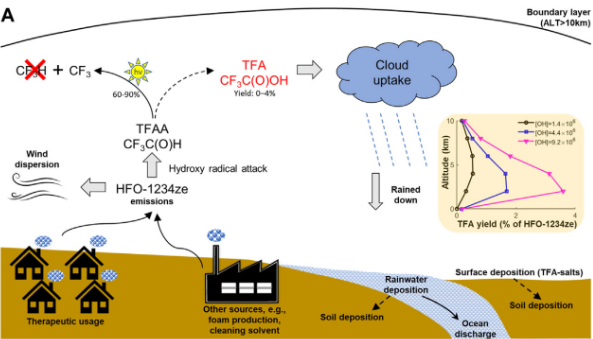
Figure 1: Atmospheric fate of HFO-1234ze(E). After release, hydroxyl radicals attack the molecule’s double bond, producing trifluoro-acetaldehyde, most of which is destroyed by sunlight; a small share goes on to form trifluoroacetic acid (TFA), which rain and snow remove from the air. The shaded inset shows the model’s estimated TFA yield at different altitudes and hydroxyl radical concentrations. Adapted from Tewari et al. (2023).


Switching devices to a DPI is not for everyone, as children, older adults, and people with disabilities may lack the inspiratory flow a DPI requires so manufacturers are therefore changing the gas instead (Liang et al. 2023). In May 2025, the UK Medicines and Healthcare products Regulatory Agency approved a version of AstraZeneca’s COPD inhaler Trixeo, that used HFO-1234ze(E). This is a hydrofluoroolefin whose carbon-carbon double bond makes it break down quickly in the atmosphere, giving a GWP of 1.37 (Figure 2) (MHRA 2025; Forster et al. 2021). Because the active drugs were unchanged, approval rested on bioequivalence studies showing the new formulation delivered the same drug exposure on the lungs and bloodstream (AstraZeneca 2025). The success of the new gas has prompted AstraZeneca to move its entire pMDI portfolio to the new propellant by 2030, signaling a large shift for the pharmaceutical industry as a whole.
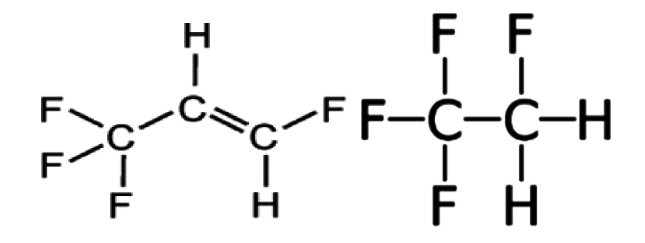
Figure 2: Molecular structures of the next-gen propellant HFO-1234ze(E) (left) and the current propellant HFA-134a (right). Both carry four fluorine atoms, but HFO-1234ze(E) also has a carbon–carbon double bond, which leaves it open to attack by hydroxyl radicals and shortens its atmospheric lifetime from years to weeks. Structures reproduced from Giffen et al. (2024)

Canada has been slow to adopt either option. In British Columbia’s Fraser Health region, dispensed inhalers produced an estimated 8,478 tonnes of CO2e per year, equal to 21.8% of the health authority’s reported facility emissions. The data showed that pMDIs accounted for more than 98% of that footprint (Liang et al. 2023). In Ontario, pMDIs made up roughly 70 to 80% of new prescriptions between 2017 and 2023. That is despite guidance favouring lower-emission devices (Train et al. 2026).

New propellants are not an entirely clean fix either. HFO-1234ze(E) falls within the definition of PFAS used in the European Union’s proposed restriction on these persistent chemicals, and the outcome is still unknown. Its main rival is HFC-152a, has a GWP of 164 and is flammable, so factories need new investment to handle it safely (Forster et al. 2021; EFCTC 2025). Low-carbon versions will also only help if prescribers choose them, and the Ontario data show that available alternatives alone have not shifted prescribing (Train et al. 2026).

The inhaler shows that climate solutions can hide inside products nobody thinks of as polluting.  Reformulation and device switching can both cut emissions without compromising care, but neither one works alone. Lasting change will depend on policy, such as drug coverage and prescribing feedback, making the lower-carbon choice the easy one.

References

AstraZeneca. 2025. “Trixeo Aerosphere Approved in the UK as First Inhaled Respiratory Medicine Using Next-Generation Propellant with Near-Zero Global Warming Potential.” Press release, May 12, 2025. https://www.astrazeneca.com/media-centre/press-releases/2025/trixeo-aerosphere-approved-in-the-uk-as-first-inhaled-respiratory-medicine-using-next-generation-propellant-with-near-zero-global-warming-potential.html.

EFCTC (European FluoroCarbons Technical Committee). 2025. “Significant Progress for the Introduction of Lower GWP Propellants in Metered Dose Inhalers (pMDIs).” News, December 4, 2025. https://www.fluorocarbons.org/news/significant-progress-for-the-introduction-of-lower-gwp-propellants-in-metered-dose-inhalers-pmdis/.

Forster, Piers, Trude Storelvmo, Kyle Armour, et al. 2021. “The Earth’s Energy Budget, Climate Feedbacks, and Climate Sensitivity.” In Climate Change 2021: The Physical Science Basis. Contribution of Working Group I to the Sixth Assessment Report of the Intergovernmental Panel on Climate Change, edited by V. Masson-Delmotte, P. Zhai, A. Pirani, et al., 923–1054. Cambridge University Press. https://doi.org/10.1017/9781009157896.009.

Giffen, Paul S., Joanne D. Kilgour, Matthew Jacobsen, Karen Thacker, and Ann A. Holmberg. 2024. “The Nonclinical Assessment of Trans-1,3,3,3-Tetrafluoropropene (HFO-1234ze (E)), a Near Zero Global Warming Potential Propellant for Use in Metered Dose Inhalation Products.” International Journal of Toxicology 43 (1): 4–18. https://doi.org/10.1177/10915818231206025.

Janson, Christer, Richard Henderson, Magnus Löfdahl, Martin Hedberg, Raj Sharma, and Alexander J. K. Wilkinson. 2020. “Carbon Footprint Impact of the Choice of Inhalers for Asthma and COPD.” Thorax 75 (1): 82–84. https://doi.org/10.1136/thoraxjnl-2019-213744.

Liang, Kevin E., Jiayun Angela Yao, Philip Hui, and Darryl Quantz. 2023. “Climate Impact of Inhaler Therapy in the Fraser Health Region, 2016–2021.” British Columbia Medical Journal 65 (4): 122–27. https://bcmj.org/articles/climate-impact-inhaler-therapy-fraser-health-region-2016-2021.

MHRA (Medicines and Healthcare products Regulatory Agency). 2025. “MHRA Approves World’s First Low-Carbon Version of COPD Inhaler Trixeo Aerosphere.” GOV.UK, May 12, 2025. https://www.gov.uk/government/news/mhra-approves-worlds-first-low-carbon-version-of-copd-inhaler-trixeo-aerosphere.

Tewari, Shivendra G., John P. Bell, Nigel Budgen, et al. 2023. “Pressurized Metered-Dose Inhalers Using Next-Generation Propellant HFO-1234ze(E) Deposit Negligible Amounts of Trifluoracetic Acid in the Environment.” Frontiers in Environmental Science 11: 1297920. https://doi.org/10.3389/fenvs.2023.1297920.

Train, Anthony, Krishna K. Vemuri, Angela Coderre-Ball, et al. 2026. “Prescription Patterns of Inhaler Medications from 2017 to 2023: A Retrospective Study Using Ontario Administrative Healthcare Data.” PLOS ONE 21 (6): e0348119. https://doi.org/10.1371/journal.pone.0348119.

Woodcock, Ashley, Christer Janson, Jamie Rees, et al. 2022. “Effects of Switching from a Metered Dose Inhaler to a Dry Powder Inhaler on Climate Emissions and Asthma Control: Post-Hoc Analysis.” Thorax 77 (12): 1187–92. https://doi.org/10.1136/thoraxjnl-2021-218088.

Comments

6 Responses to “The Climate Cost of Inhalers and the Race to Replace HFA-134a”

  1. Luca Madriz-Zikic Avatar
    Luca Madriz-Zikic

    Hi iSci,

    I chose this topic as it links back to our climate project as well as to the commercial and regulatory side of pharma. Inhalers show how a product’s design can be a climate solution with changing the propellant cutting emissions without changing the treatment.
    Any feedback is welcome.
    – Luca

  2. Hava Quail Avatar
    Hava Quail

    Hi Luca!

    I really enjoyed reading your post. Super important to consider more sustainable options pharmaceuticals.

    I just have a few minor suggestion to consider while editing!

    P1S2- add a comma after “unfortunately”
    P2S3- having the citation at the beginning of the sentence is a little awkward to read, you could change it to be: “It is estimated that a single year of pMDI-based therapies produce about 439 kg CO2e per patient compared to 17kg for dry powder inhalers (DPIs) (Janson et al. 2020). “
    – Your figure 1 is blurry and not the most clear, is there a way you can get a higher resolution image?
    P5S2 consider changing the sentence to “Its main rival is HFC-152a, which has a GWP of 164 and is flammable, and consequently, factories require additional investments to handle it safely…”

    Great job overall!

    -Hava

  3. Keira Sponagle Avatar
    Keira Sponagle

    Hi Luca,
    Interesting blog post. I have a few suggestions for you during your editing process:
    – In general, you should avoid beginning sentences with acronyms. Try to rework sentences like P1S3-6 with this in mind.
    – Figure 1 is good but it is a bit blurry and the smaller text is hard to read. If possible, find a different and clearer figure. Otherwise, I think it would be worth it to add text boxes with clearer text or try to recreate the figure in Canva to ensure better quality.
    – Figure 2 could be helpful but I think its formatting could be improved. Try to make the molecules the same size and have the panels denoted with “a” and “b”

    Overall, great work and I look forward to reading your final draft
    Keira

  4. Kurtis Ng Avatar
    Kurtis Ng

    Hi Luca!

    This was a really interesting read! Here are some suggestions for improvements:

    – P2S1: “so the emissions are built into the treatment itself (Figure 1)” points to Figure 1, but that figure shows how HFO-1234ze(E) breaks down, and the reader doesn’t meet that gas until P3. Maybe make the structures figure Figure 1 and place it in P3, then move the breakdown figure next to the PFAS discussion in P5, since its caption about trifluoroacetic acid (TFA) fits right there.

    – P3S1: “may lack the inspiratory flow a DPI requires so manufacturers are therefore changing the gas instead” is a run-on, and “so” and “therefore” do the same job. Maybe “…may lack the inspiratory flow a DPI requires. Manufacturers are therefore changing the gas instead.”

    – P3S2: “approved a version of AstraZeneca’s COPD inhaler Trixeo, that used HFO-1234ze(E)” has a stray comma (and a double space) before “that”. Maybe “…approved a version of AstraZeneca’s COPD inhaler Trixeo that uses HFO-1234ze(E).”

    – P3S4: “The success of the new gas has prompted AstraZeneca to move its entire pMDI portfolio to the new propellant by 2030” needs a citation, and AstraZeneca announced that 2030 plan before the 2025 approval, so it wasn’t prompted by it. Maybe “AstraZeneca plans to move its entire pMDI portfolio to the new propellant by 2030…” with a source.

    I learned a lot about how a single carbon-carbon double bond can cut a gas’s warming potential from over 1500 to almost nothing. Can’t wait to see the final copy!

    – Kurtis

  5. Mitchell Yim Avatar
    Mitchell Yim

    Hi Luca,

    This was an informative read! I did not consider inhalers to also be a major contributor to GHG emissions. Generally, make sure you revise your writing for clarity, flow, and specificity. For example,
    – P2S1-3: The sentences here are detached from each other and read awkwardly. In S2, “they” is vague in context to the previous sentence and reads informally as a personal pronoun. I suggest combining the first and second sentences to make your subject clearer. Same thing for S3, where you mention “cause the same warning”, which is vague as a standalone sentence, and could easily be clarified by conjoining sentences with the same subject.
    – P4, last sentence: I would switch “despite” for “in spite of”, and again, connect this sentence to the previous one for a smoother read.

  6. Saniyah Farzeen Avatar
    Saniyah Farzeen

    Hi Luca!!

    I really liked this!! I honestly never would have thought about inhalers as a meaningful source of greenhouse gas emissions, and I thought you did a really good job connecting the chemistry of the propellants to the bigger healthcare and policy side of the issue 🙂

    I had a few thoughts while I was reading:

    – In the second paragraph, you give the 439 kg CO2e estimate and then the UK trial where emissions dropped from 240 to 108 kg CO2e. Since those numbers come from different studies, I wonder if it might be worth making it a little clearer that they are not directly comparable estimates. Otherwise, a reader might wonder why the starting footprints are so different even though both are describing pMDI use

    – When you say that “Canada has been slow to adopt either option,” I think the examples from BC and Ontario definitely support the idea that pMDIs are still really common, but I wonder if the wording could be slightly narrower since those two provinces/regions are doing most of the work for that claim. Something like saying that adoption has been slow in the Canadian settings you discuss might keep the conclusion really well matched to the evidence you have.

    – I also thought the PFAS point near the end was really interesting and could maybe use one extra sentence. HFO-1234ze(E) fitting within the EU’s proposed PFAS definition sounds concerning, but I was left wondering what that actually means environmentally compared with the more familiar persistent PFAS compounds. Since Figure 1 also shows that a small fraction can form TFA, maybe you could connect those ideas and briefly distinguish between being included under a regulatory PFAS definition and what is actually known about the environmental risk of this specific propellant.

    Overall though, this was genuinely such an interesting read and I thought the balance between the chemistry, clinical side, and climate implications worked really well. Also the comparison between the two molecular structures was super helpful 🙂

    Happy editing!
    Saniyah

Leave a Reply