Figure 1. King’s College Choir performance of Gregorio Allegri’s Miserere mei, Deus (King’s College Choir, 2014).
Sound is all around us, being our second most valuable of our 5 senses (Enoch et al. 2019). But have you ever been in a structure where acoustics are incorporated to the architecture so that sound emotionally overwhelms the individual? This effect is especially seen in large religious buildings such as cathedrals, as they have been built so that wet effects of sound (e.g. reverberations, echoing, etc.) are exaggerated (Figure 1). This begs the question: “For how does one’s environment impact their emotions?”
Algargoosh et al. (2022) analyzed this effect through a mixed-methods qualitative and quantitative study where the wet sound with the ambiance of the building was compared to the original dry audio waves. The results of the self-report from participants showed that participants reported higher rates of positive emotions such as “inspired,” “cheerful,” and “thrilled” while listening to the wet recordings in comparison to dry recordings (Figure 2). Findings also show higher physiological arousal as the participants’ heart rate response on average increased during wet recordings, showing the physical response to audio stimuli(Algargoosh et al. 2022).
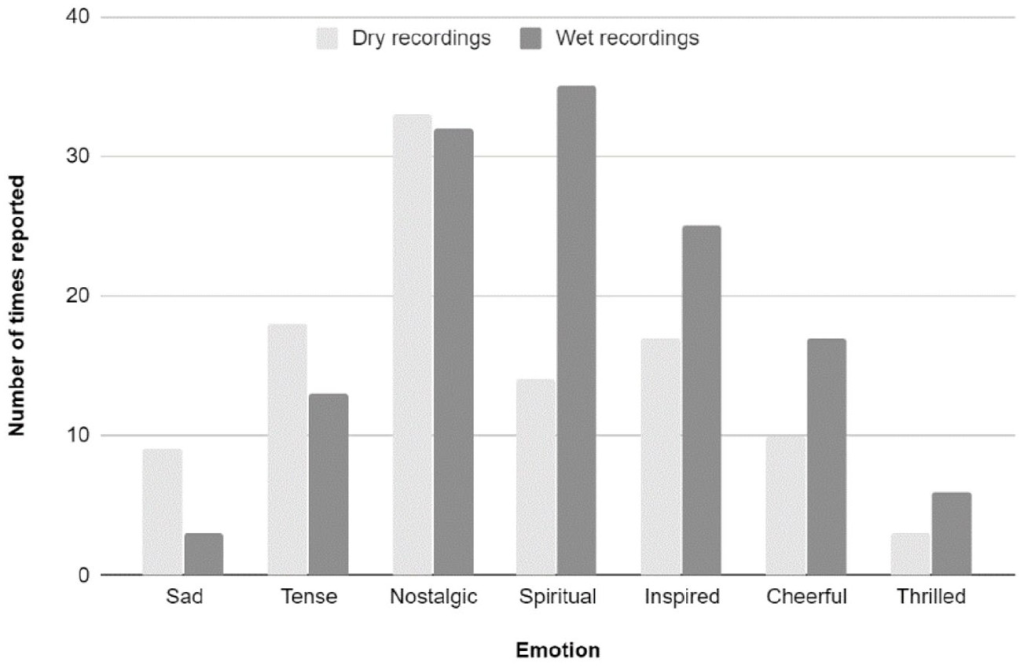
Figure 2. Bar-chart of the number of times each keyword emotion was reported by participants while listening to dry and wet recordings (Algargoosh et al. 2022).
The emotional receptors involved in transforming music to various emotions are best understood as the brain’s reward system. The mesolimbic dopamine system normally reinforces certain crucial stimuli such as food, drugs, or money; correlating each with pleasure. Yet, that same system responds to music. ‘Chills’ or ‘musical frisson’ are normally used as a mark of peak emotional response to audio as they represent a pattern of autonomic nervous system (ANS) arousal (Blood and Zatorre, 2001).
PET imaging shows endogenous dopamine release in the striatum of the brain when listening to pleasurable music. Statistically, when listening to pleasurable music, heart rate rises significantly (P<0.05), respiration rises very significantly (P<0.001), and temperature decreases significantly (P<0.01). Similarly, fMRI scanning alongside self-reports of chills reveal that dopamine-binding receptors at the caudate are more active during anticipation, and the receptors at the nucleus accumbens are more active during the peak itself (Figure 3). In fact, composers and performers in music frequently take advantage of this phenomenon, manipulating emotional arousal by violating expectations in certain ways or by delaying the predicted outcome. This can be done by slowing the tempo, adding extra notes and effects, and heightening the motivation to the resolution (Salimpoor et al. 2011). This cycle of dopamine release from anticipation and peak is especially prominent in sacred music composed for resonant spaces, with slow harmonic swells and long suspensions.
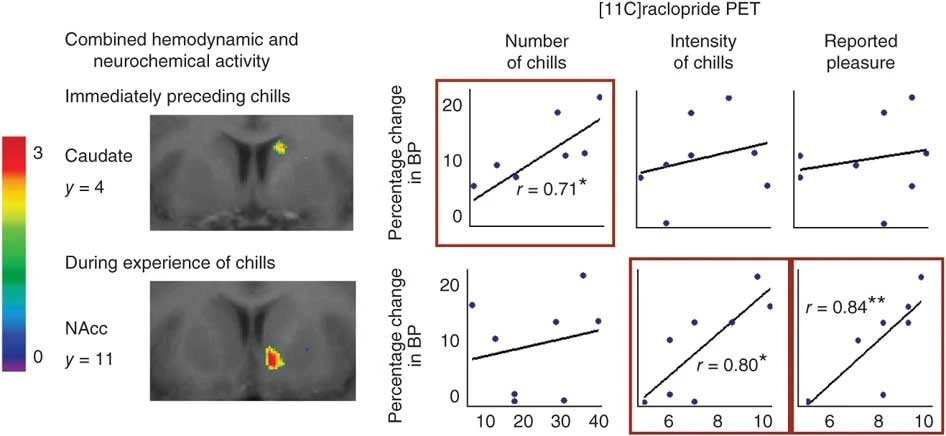
Figure 3. Coronal slices (left) that show the differences in striatum activity during and preceding chills. Behavioral ratings of the number and intensity of chills and pleasure reported (right) during the PET scans plotted against [11C]raclopride binding potential changes in the two clusters – represents dopamine binding through competitive inhibition. The number of chills reported was positively correlated with percent binding potential change in the caudate (Salimpoor et al. 2011).
Music is a consistent feature of a majority of religious services. Music can create a strong positive emotional response that, when intensified through the social aspects of the ritual, can lead to ecstasy (Penman and Becker, 2009). The connection between music and religion runs through awe. Awe is the emotional response to perceptually vast stimuli that are greater and beyond current understanding (Keltner & Haidt, 2003). Cappellen & Saroglou (2012) analyzed the effect of awe on individuals who are religious. Participants who were asked to recall an awe-inspiring event were often more likely to answer the given questionnaire with spiritual answers or would report feeling more ‘oneness’ after watching given media of childbirth (Van Cappellen and Saroglou, 2012). Taken together, these studies discuss a diverse relationship: intensified musical emotion can envoke awe, and awe is linked to spiritual feelings and religious emotion.
References
Algargoosh, A., B. Soleimani, S. O’Modhrain, and M. Navvab. 2022. “The Impact of the Acoustic Environment on Human Emotion and Experience: A Case Study of Worship Spaces.” Building Acoustics 29 (1): 85–106. https://doi.org/10.1177/1351010X211068850.
Blood, Anne J., and Robert J. Zatorre. 2001. “Intensely Pleasurable Responses to Music Correlate with Activity in Brain Regions Implicated in Reward and Emotion.” Proceedings of the National Academy of Sciences of the United States of America 98 (20): 11818–11823. https://doi.org/10.1073/pnas.191355898
Enoch, Jamie, Leanne McDonald, Lee Jones, Pete R. Jones, and David P. Crabb. 2019. “Evaluating Whether Sight Is the Most Valued Sense.” JAMA Ophthalmology 137 (11): 1317–20. https://doi.org/10.1001/jamaophthalmol.2019.3537.
Keltner, Dacher, and Jonathan Haidt. 2003. “Approaching Awe, a Moral, Spiritual, and Aesthetic Emotion.” Cognition and Emotion 17 (2): 297–314. https://doi.org/10.1080/02699930302297.
King’s College Choir. 2014. “King’s College Choir Announces Major Change.” YouTube video, March 31, 2014. https://youtu.be/ukDAfF0-8q8?si=vXH17TQPag7JQ0X1&t=48.
Penman, Joshua, and Judith Becker. 2009. “Religious Ecstatics, ‘Deep Listeners,’ and Musical Emotion.” Empirical Musicology Review 4 (2): 49–70. https://doi.org/10.18061/1811/37474.
Salimpoor, Valorie N., Mitchel Benovoy, Kevin Larcher, Alain Dagher, and Robert J. Zatorre. 2011. “Anatomically Distinct Dopamine Release during Anticipation and Experience of Peak Emotion to Music.” Nature Neuroscience 14 (2): 257–62. https://doi.org/10.1038/nn.2726.
Van Cappellen, Patty, and Vassilis Saroglou. 2012. “Awe Activates Religious and Spiritual Feelings and Behavioral Intentions.” Psychology of Religion and Spirituality 4 (3): 223–36. https://doi.org/10.1037/a0025986.

Leave a Reply
You must be logged in to post a comment.