Too Hot to Handle: Can Heat Change How Your Medication Works?

“Take once daily” assumes a lot in just three words. Prescription labels tell us when to take a medication, whether to take it with food, and what substances to avoid, but rarely anything about the temperature outside. That omission looked less trivial during British Columbia’s 2021 heat dome, when hundreds of people died from heat-related causes. Boudreault et al. (2025) compared 504 heat-related community deaths with 2,520 matched controls and found that recent dispensations of anti-Parkinson drugs, antiepileptics, and psycholeptics were associated with higher odds of heat-related death, even after adjustment for chronic disease (Figure 1). Association is not causation, but it raises an uncomfortable question: how much does a prescription assume about the environment in which it is taken?
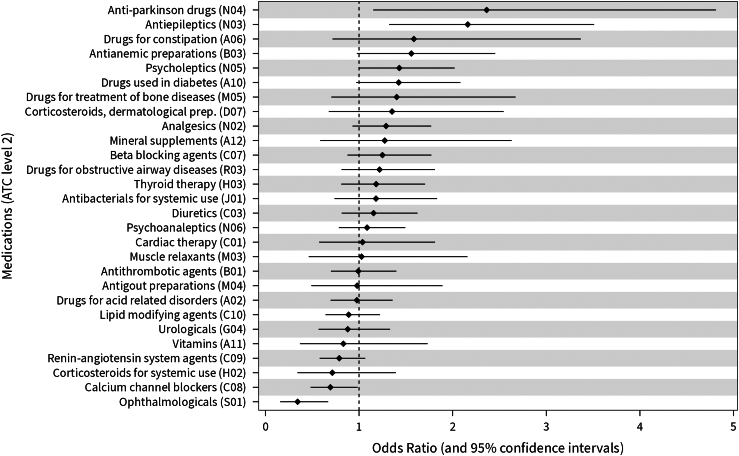
Figure 1. Adjusted odds ratios and 95% confidence intervals for heat-related community death across 28 medication classes dispensed within 30 days before death (or the end of the heat event for controls) during British Columbia’s 2021 heat dome. The dashed vertical line represents an odds ratio of 1 (no association). Reproduced from Boudreault et al. (2025), Figure 2.

The biology gives that association a plausible mechanism. To keep core temperature stable, the body increases skin blood flow and sweating, two heat-loss pathways that medications can disrupt (Wee et al. 2023). Across 35 randomized heat-stress studies, atropine, an anticholinergic medication, raised core temperature by an average of 0.42°C at air temperatures of at least 30°C while reducing sweating; non-selective beta-blockers, medications that can also interfere with the body’s heat-loss responses, raised it by 0.11°C (Hospers et al. 2024). Even relatively small increases in core temperature can become more concerning during heat stress, when the body is already working to dissipate excess heat.

But medication–heat interactions are not just a thermostat problem. Heat-related illness can involve fluid and electrolyte imbalance. Risk can be compounded by age, multimorbidity (having multiple chronic conditions), and polypharmacy (taking multiple medications at once) (Tews et al. 2026). Nor is the relationship one-way. Elevated temperature can increase delivery of some transdermal and topical drugs by changing drug release, skin permeability, blood flow, and dermal clearance (Hao et al. 2016). Heat can therefore alter both drug action and, for some formulations, drug delivery.

The stranger part is how thin the evidence becomes when we ask who was actually studied. Hospers et al. (2024) found only 353 participants across those 35 studies: 337 men and just 16 women. With women making up less than 5% of participants, it is difficult to know how well these findings generalize across sexes. The average participant was under 30, and only one study included a clinical population. A 2026 review of 61 primary studies similarly found limited evidence-based guidance for managing medication–heat interactions in older adults (Tews et al. 2026). The populations most relevant to these risks, including older adults, people with chronic illness, and those taking multiple medications, remain poorly represented in controlled evidence.

Those blind spots would matter in a stable climate. We do not have one. Across 732 locations in 43 countries, 37% of warm-season heat-related deaths between 1991 and 2018 were attributable to human-induced climate change (Vicedo-Cabrera et al. 2021). Climate change is often framed as a future pressure on healthcare, but it may also be rewriting the assumptions underneath treatments we already use.

A prescription is not an isolated chemical instruction. It is an interaction between a drug, a body, and an environment. If one of those three is changing, medicine cannot keep treating it as background.

References

Boudreault, Jeremie, Kathleen E. McLean, and Sarah B. Henderson. 2025. “Exploring the Relationship between Medications and Heat-Related Community Deaths during the 2021 Heat Dome: A Hybrid Approach Using Machine Learning.” eBioMedicine 117: 105788. https://doi.org/10.1016/j.ebiom.2025.105788.

Hao, Jinsong, Priyanka Ghosh, S. Kevin Li, Bryan Newman, Gerald B. Kasting, and Sam G. Raney. 2016. “Heat Effects on Drug Delivery across Human Skin.” Expert Opinion on Drug Delivery 13 (5): 755–768. https://doi.org/10.1517/17425247.2016.1136286.

Hospers, Lily, Gabrielle A. Dillon, Andrew J. McLachlan, et al. 2024. “The Effect of Prescription and Over-the-Counter Medications on Core Temperature in Adults during Heat Stress: A Systematic Review and Meta-Analysis.” EClinicalMedicine 77: 102886. https://doi.org/10.1016/j.eclinm.2024.102886

Tews, Lily M., Daniel T. Abazia, Hayley Blackburn, Kiri Carmody, and Mary Barna Bridgeman. 2026. “Recognizing and Mitigating the Effects of Medication on Heat-Related Illness in Older Adults: A Scoping Review.” Pharmacy 14 (3): 74. https://doi.org/10.3390/pharmacy14030074.

Vicedo-Cabrera, A. M., N. Scovronick, F. Sera, et al. 2021. “The Burden of Heat-Related Mortality Attributable to Recent Human-Induced Climate Change.” Nature Climate Change 11 (6): 492–500. https://doi.org/10.1038/s41558-021-01058-x

Wee, Jericho, Xiang Ren Tan, Samuel H. Gunther, et al. 2023. “Effects of Medications on Heat Loss Capacity in Chronic Disease Patients: Health Implications Amidst Global Warming.” Pharmacological Reviews 75 (6): 1140–1166. https://doi.org/10.1124/pharmrev.122.000782

Comments

9 Responses to “Too Hot to Handle: Can Heat Change How Your Medication Works?”

  1. Saniyah Farzeen Avatar
    Saniyah Farzeen

    Hi iSci! I chose this topic because we’ve been talking a lot about climate change in 3A12, and I wanted to look at a health impact that felt a little less obvious. I thought it was really interesting to connect extreme heat with physiology and pharmacology, especially how medications can interact with the body differently during heat exposure.

    I also found the gaps in the research really surprising, especially for older adults and people taking multiple medications. I’d really appreciate any feedback or thoughts. Thanks in advance! 🙂

  2. Charles Bowen Avatar
    Charles Bowen

    Hi Saniyah,

    Great work on your blog post! I really enjoyed the connections you made to our climate change project; this is a very relevant issue based on the heat we get in Hamilton. A couple of suggestions for your final draft:

    – Consider expanding more on the significance of British Columbia’s heat dome, which you mention in P1S3.
    – Consider defining ‘polypharmacy’ (P3S2) for those who may not be familiar with this term.
    – Consider rephrasing P3S2, and maybe splitting into two smaller, distinct sentences for clarity.

    Overall amazing work! Really looking forward to reading your final blog. Happy editing!

    Cheers,
    Charlie

    1. Saniyah Farzeen Avatar
      Saniyah Farzeen

      Hi Charlie! Thank you so much!! I really appreciate the feedback 🙂 I definitely agree that I could give a bit more context on the heat dome, and defining polypharmacy would make that section way more accessible. I’m also going to go back to that sentence and clean it up a bit. Thanks again!!

  3. Kristen Taylor Avatar
    Kristen Taylor

    Hi Saniya,

    Great blog post! This is one danger associated with extreme heat that never occurred to me! Here are a few suggestions I had:

    – Consider rephrasing P1S3 to something like: “A study conducted during the 2021 heat dome in British Colombia suggests that this omission may be less trivial than it seems.”

    – In P2S3, maybe clarify that atropine is an anticholinergic medication, rather than an endogenous compound.

    – In P3S2, you could define or replace the word “multimorbidity” as I don’t think this is common knowledge.

    – In P4, if word count allows, consider expanding slightly on the lack of female participants in the study (or if this is not a consistent problem across studies, maybe you can mention that).

    Your post is so well written! Good luck with your edits!

    – Kristen

    1. Saniyah Farzeen Avatar
      Saniyah Farzeen

      Hi Kristen! Thank you so much for all of this!! These are really helpful suggestions, especially the point about defining some of the more technical terms. I also really like your suggestion about expanding on the lack of female participants because that was honestly one of the things that surprised me most while researching. I’ll definitely see what I can fit in with the word count 🙂 Thanks again!!

  4. Troy Lin Avatar
    Troy Lin

    Hi Saniyah,

    I really enjoyed reading your blog post. It was very interesting and new information for me. However, I have a couple of suggestions that would strengthen your post:

    – In paragraph two, I think you should expand more on why the 0.42 and 0.11 celsius matter as they seem the increase in increment seems so insufficient.
    – Adding on to the previous suggestion, you could also explain what the anticholiengic and beta blocker are as I believe that would make that paragraph a little more impactful and clear for the readers.

    Good luck editing your post,
    Troy

    1. Saniyah Farzeen Avatar
      Saniyah Farzeen

      Hi Troy! Thank you!! I really appreciate the feedback 🙂 That’s a really good point about the temperature increases because I think I understood why they mattered while writing it, but didn’t fully explain that for someone reading it for the first time. I’ll definitely add a bit more context there and clarify the medication classes too. Thanks so much!

  5. Aaron Ling Avatar
    Aaron Ling

    Hey Saniyah!

    Great post! It is really interesting how the different medications disrupt the heat regulation of the body and how different regions around the world can affect the effectiveness of these medications. There are a couple things that I would suggest.

    First, the formatting of the figure 1 should be as an annotation and not full sized like the text. Also with that figure, the citations should also be in Chicago style, so “et al.” should suffice instead of having to write everybody’s named on the citation.

    Secondly, the citations themselves are a little inconsistent. Just remember to start and end each citation with a bracket, and if it doesn’t have a person who wrote the article, “n.a.” is a good substitution.

    Lastly, if possible, it would be nice to have a figure of a map for all the areas where these medication related climate change casualties occur. Otherwise great post, happy editing!

    Aaron Ling

    1. Saniyah Farzeen Avatar
      Saniyah Farzeen

      Hi Aaron! Thank you so much for taking the time to leave such thoughtful feedback. I really appreciate your suggestions, especially around the figure formatting and citation consistency. The map idea is also really interesting, and I’ll keep it in mind as I work through my edits and the word/space limits. Thanks again! 🙂

Leave a Reply