Too often we find ourselves in the predicament between an assignment due too soon and a night full of sleep. The deprivation accumulates into a frightening sleep debt, and by the end of the week we convince ourselves, “I’ll just catch-up on sleep this weekend”. Except you can’t.
The repercussions of sleep deprivation are unanimously discussed, yet consistently disregarded. Aside from the commonly known symptoms of fatigue and drowsiness, lack of sleep is also associated with adverse health outcomes in adults and risk-taking behaviours in teenagers (Chaput et al. 2020; Medic et al. 2017). Consistent sleep deprivation can lead to higher sympathetic activity and homeostatic imbalances, such as fluctuations in ghrelin and leptin levels, which increase and decrease appetite respectively (Medic 2017; Molumphy and Brock. 2024). By rescheduling lost sleep to the weekend, the dangers of sleep deprivation are undermined.
The concept of “sleep-debt” and “payment” are respectively associated with reduced sleep on weekdays and lengthened sleep on weekends. As the world went into lockdown in 2020, the need for early risetimes decreased, and testing whether lost sleep is recoverable gained more samples than ever. A sleep–wake model used data from before and during the lockdown to test if the amount of sleep attained during the week affected the hours slept over the weekend (Putilov 2021).
The biological drive to sleep-sleep pressure-builds up the longer an individual is awake and decays from the moment they fall asleep over a 24 hour sleep–wake cycle (Eq. 1)(Putilov 2021; NIOSH 2025).The sleep–wake model (Figure 1) displays a threshold of the maximum sleep pressure attainable before an individual sleeps, or the exact moment pressure switches from build-up to decay (Putilov 2021). Intuitively, if sleep does not occur, the pressure will accumulate.
Equation 1. A periodic function with a period τ assigned to a 24 hour sleep–wake cycle (Putilov 2021). C(t) represents the circadian rhythm process; t (time) shows the specific hour being measured; A (amplitude), representing the strength or intensity of the circadian rhythm; τ (tau/period) is the total length of one full circadian cycle (24 hours); 𝝋𝟎 (Phi-naught/initial phase) is the starting offset or timing of the internal clock relative to the outside world—accounts for chronotype; whether an individual wakes up early or stays up late.
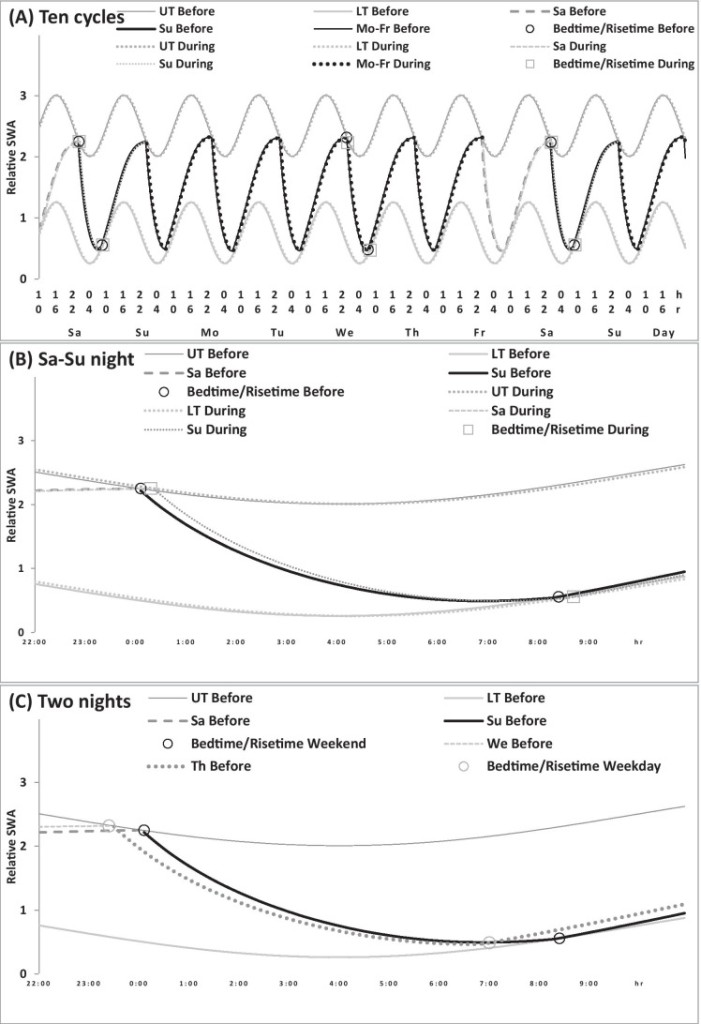
Figure 1. Model-based simulations showing alterations between exponential buildups and decays of slow-wave activity (SWA, index of sleep pressure) over 10 sleep–wake cycles (days) before and during “lockdown”. The model tracks SWA as it builds up while awake and drops during sleep, shaped by a 24-hour circadian rhythm (sine-form function, see Eq. 1). The upper threshold (UT) and lower threshold (LT) are the wavy lines showing the maximum limit of sleepiness before falling asleep (UT) and the lowest point of sleep pressure upon waking up (LT). Panel (A) showcases the 10-day stimulation, comparing sleep–wake patterns before and during lockdown. Panel (B) compares sleep on the weekend night of Saturday to Sunday, specifically. Panel (C) compares a pre-lockdown weekend night (Saturday–Sunday) versus a pre-lockdown weekday night (Wednesday–Thursday). Despite the weekday curve stopping before hitting the bottom line–indicating sleep cut short–sleep pressure does not build past the normal UT the next night. The weekend sleep length stayed identical before and during lockdown regardless of the amount of sleep gained during the week (Putilov 2021).
Irrespective of whether individuals woke up naturally on weekends, or by alarms during the week, the statistical analysis illustrates no excess or above normal accumulation of sleep pressure by bedtime. The switch of sleep pressure occurred exactly at the model-predicted threshold, never above. Since the body does not accumulate sleep pressure from the week, “sleep debt” cannot be paid off. The belief of “catching-up on sleep” is disproven by the model-based stimulations (Putilov 2021).
A study led by a physiology professor at the University of Colorado, Dr. Kenneth Wright, Jr., found that recovery sleep didn’t provide any benefit over continuous sleep deprivation either. A group dedicated to “weekend recovery sleep” were only able to sleep an average of 3 hours extra over two nights, despite being allowed however much sleep they pleased. In fact, when the recovery group was subject to sleep deprivation the subsequent week, the extra sleep from the weekend disrupted their circadian rhythms instead. Following the recovery sleep, the participants were more likely to wake up even when the natural rhythm of their body was promoting sleep (NIH 2019).
Although you may be able to sleep in over the weekend, the human body has no way to deal with weekday sleep loss because it cannot be accounted for beyond the 24 hour sleep–wake cycle (Garefelt et al. 2020). Weekend sleep is not extended sleep, it is simply rest that you would have needed whether you slept 12 hours that week, or 40. Don’t wait until this weekend; there is no better time to sleep than now.
References
Chaput, Jean-Philippe, Caroline Dutil, Ryan Featherstone, et al. 2020. “Sleep Timing, Sleep Consistency, and Health in Adults: A Systematic Review.” Applied Physiology, Nutrition, and Metabolism = Physiologie Appliquee, Nutrition Et Metabolisme 45 (10 (Suppl. 2)): S232–47. https://doi.org/10.1139/apnm-2020-0032.
Cleveland Clinic. 2023. “Good News: You Can Make Up for Lost Sleep Over the Weekend (Kind Of).” August 15. https://health.clevelandclinic.org/insomnia-can-you-make-up-for-lost-sleep-on-weekends.
Garefelt, Johanna, Sara Gershagen, Göran Kecklund, Hugo Westerlund, and Loretta G. Platts. 2020. “How Does Cessation of Work Affect Sleep? Prospective Analyses of Sleep Duration, Timing and Efficiency from the Swedish Retirement Study.” Journal of Sleep Research 30 (3): e13157. https://doi.org/10.1111/jsr.13157.
Medic, Goran, Micheline Wille, and Michiel EH Hemels. 2017. “Short- and Long-Term Health Consequences of Sleep Disruption – PMC.” May 19. https://pmc.ncbi.nlm.nih.gov/articles/PMC5449130/.
Molumphy, Nicole, and Sharon Brock. 2024. “How Sleep Deprivation Affects Your Metabolic Health | Lifestyle Medicine.” December 8. https://lifestylemedicine.stanford.edu/how-sleep-deprivation-affects-your-metabolic-health/.
NIH. 2019.“Weekend Catch-up Can’t Counter Chronic Sleep Deprivation | National Institutes of Health (NIH).” National Institutes of Health, December 3. https://www.nih.gov/news-events/nih-research-matters/weekend-catch-cant-counter-chronic-sleep-deprivation.
NIOSH. 2025. “Module 2. Sleep Pressure: Homeostatic Sleep Drive | NIOSH | CDC.” National Institute for Occupational Safety and Health, May 1. https://www.cdc.gov/niosh/work-hour-training-for-nurses/longhours/mod2/11.html.
Putilov, Arcady A. 2021. “Sleep during ‘Lockdown’ Highlighted the Need to Rethink the Concept of Weekend Catch-up Sleep.” Sleep & Breathing = Schlaf & Atmung 26 (4): 2001–7. https://doi.org/10.1007/s11325-021-02492-z.


Leave a Reply
You must be logged in to post a comment.