Nearly 4 billion years of Earth’s history is encompassed by the Precambrian, a span of time stretching from the creation of the Earth to the Cambrian period, when complex animal ecosystems began to emerge and diversify(Windley 2019). The Neoproterozoic Era (1000–539 Ma) was the final era of the Precambrian, and a pivotal period for the evolution of life on Earth. Marine ecosystems underwent major restructuring as organisms became more diverse and ecosystems became more complex (Maloney et. al 2023). These changes may have created more opportunities for coevolution, in which interactions between organisms influence the evolutionary pressures faced by each lineage (Zhang et al. 2021).
For much of the Neoproterozoic, benthic sea floors were dominated by microbial communities that formed extensive mats, called matgrounds (Droser et al. 2026). Matgrounds supported microbial communities across steep chemical gradients, resulting in vertically structured benthic environments (Ding et al. 2019). An example of biota interaction with microbial mats can be seen in Figure 1. By the late Neoproterozoic (Ediacaran period, 635-539 Ma), these communities experienced change as organisms developed increasingly complex behaviours and body structures (Chen and Liu 2025). Fossil evidence suggests a period of evolutionary innovation coinciding with the diversification of Neoproterozoic biota (Muscente et al. 2019).
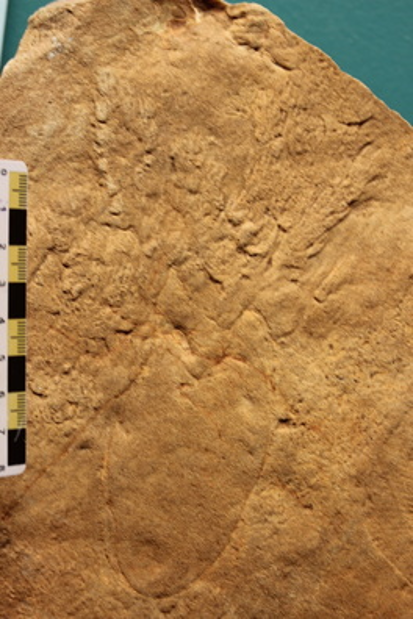
This ecological shift occurred with the emergence of active sediment exploration. Fossilized burrows indicate that animals started burrowing into sediment in three dimensions (Chen and Liu 2025). This marked a change in how the seafloor environment functioned because this activity disturbed matgrounds and created new habitats within the sediment (Meek et al. 2023). This ecological restructuring represents the early stages of what is now recognized as the Cambrian Substrate Revolution, a major transition in the ecological structure of seafloors (Oji et al. 2018). Some trace fossils from the Ediacaran, like those from Namibia’s Nama Group (see Figure 2), provide evidence of bilaterian organisms capable of disturbing sediment. These organisms are described as “sediment bulldozers”, providing an early example of ecosystem engineering, in which organisms physically modify their environment in ways affecting other organisms (Buatois et al. 2018).
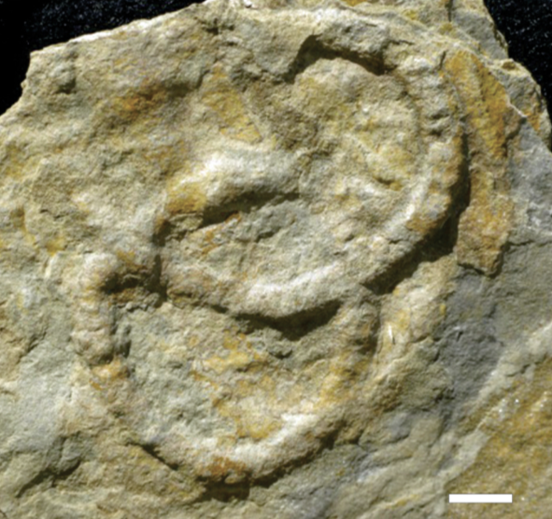
Burrowing likely disrupted or displaced organisms that relied on matgrounds for feeding, shifting the sea floor from relatively stable microbial mats to a more disturbed and heterogenous environment (Craffey et al. 2024). As mobile, burrowing animals became more prevalent alongside sessile suspension feeders, the interactions between these ecological ways of life likely became increasingly significant in shaping benthic communities (Bottjer et al. 2000). Bioturbation may have created new opportunities for niche differentiation and ecological diversification, while increased predation and competition for space may have put increased pressure on sessile organisms who were adapted to stable matgrounds (Gougeon et al. 2025). Although direct evidence for coevolutionary dynamics is limited, these interactions may have created conditions in which organisms could begin influencing the evolutionary pressures experienced by one another.
The Neoproterozoic–Cambrian transition marked a shift from mat-dominated seafloors to increasingly complex marine ecosystems (Babcock 2005). As burrowing, competition, and predation became more common, the way which organisms interacted with each other was altered (Chipman 2026). Although the fossil record does not directly demonstrate coevolution, The Cambrian Substrate Revolution may have created conditions for organisms to begin affecting each other’s evolutionary trajectories (Wang et al. 2026).
References
Babcock, Loren E. 2005. “Interpretation of Biological and Environmental Changes Across the Neoproterozoic–Cambrian Boundary: Developing a Refined Understanding of the Radiation and Preservational Record of Early Multicellular Organisms.” Interpretation of Biological and Environmental Changes across the Neoproterozoic-Cambrian Boundary 220 (1): 1–5. https://doi.org/10.1016/j.palaeo.2004.09.013.
Bottjer, David J., James W. Hagadorn, and Stephen Q. Dornbos. 2000. “The Cambrian Substrate Revolution.” CaltechAUTHORS, Geological Society of America, September. https://authors.library.caltech.edu/records/m5441-0kt16.
Buatois, Luis A, John Almond, M. Gabriela Mángano, Sören Jensen, and Gerard J. B. Germs. 2018. “Sediment Disturbance by Ediacaran Bulldozers and the Roots of the Cambrian Explosion.” Scientific Reports (England) 8 (1): 4514. PubMed Central. https://doi.org/10.1038/s41598-018-22859-9.
Chen, Zhe, and Yarong Liu. 2025. “Advent of Three-Dimensional Sediment Exploration Reveals Ediacaran-Cambrian Ecosystem Transition.” Science Advances 11 (44). https://doi.org/10.1126/sciadv.adx9449.
Chipman, Ariel D. 2026. “An Increase in Animal Diversity Was Facilitated by Ecologically‐Driven Brain Complexity Throughout the Cambrian.” BioEssays 48 (4). https://doi.org/10.1002/bies.70136.
Craffey, M, P. J. Wagner, David K Watkins, S. A. F. Darroch, and S. K. Lyons. 2024. “Co-Occurrence Structure of Late Ediacaran Communities and Influence of Emerging Ecosystem Engineers.” Proceedings. Biological Sciences (England) 291 (2036): 20242029. PubMed Central. https://doi.org/10.1098/rspb.2024.2029.
Ding, Weiming, Lin Dong, Yuanlin Sun, et al. 2019. “Early Animal Evolution and Highly Oxygenated Seafloor Niches Hosted by Microbial Mats.” Scientific Reports 9 (1). https://doi.org/10.1038/s41598-019-49993-2.
Droser, Mary L., Rachel L. Surprenant, Heather K. McCandless, and Robert R. Gaines. 2026. “The Relationship Between Organic Matgrounds and Sedimentary Packaging: Examples From the Ediacaran and Early Cambrian.” Sedimentology 73 (4): 965–81. https://doi.org/10.1111/sed.70094.
Gehling, James, Bruce Runnegar, and Mary Droser. 2014. “Scratch Traces of Large Ediacara Bilaterian Animals.” Www.Ediacaran.Org. http://www.ediacaran.org/microbial-mats.html.
Gougeon, Romain, Luis A. Buatois, M. Gabriela Mángano, et al. 2025. “Environmental and Evolutionary Controls in Animal-Sediment Interactions at the Onset of the Cambrian Explosion.” Current Biology 35 (2): 249–64.e4. https://doi.org/10.1016/j.cub.2024.11.028.
Maloney, Katie M., Dakota P. Maverick, James D. Schiffbauer, Galen P. Halverson, Shuhai Xiao, and Marc Laflamme. 2023. “Systematic Paleontology of Macroalgal Fossils From the Tonian Mackenzie Mountains Supergroup.” Journal of Paleontology 97 (2): 499–515. https://doi.org/10.1017/jpa.2023.4.
Meek, Dean M, Luis A Buatois, M. Gabriela Mángano, and Bruce M Eglington. 2023. “Increased Habitat Segregation at the Dawn of the Phanerozoic Revealed by Correspondence Analysis of Bioturbation.” Scientific Reports (England) 13 (1): 22328. PubMed Central. https://doi.org/10.1038/s41598-023-49716-8.
Muscente, A. D., Natalia V Bykova, Thomas H Boag, et al. 2019. “Ediacaran Biozones Identified With Network Analysis Provide Evidence for Pulsed Extinctions of Early Complex Life.” Nature Communications 10 (1). https://doi.org/10.1038/s41467-019-08837-3.
Oji, Tatsuo, Stephen Q. Dornbos, Keigo Yada, et al. 2018. “Penetrative Trace Fossils From the Late Ediacaran of Mongolia: Early Onset of the Agronomic Revolution.” R. Soc. Open Sci. 5 (2): 172250. https://doi.org/10.1098/rsos.172250.
Skovsted, Christian B, Glenn A Brock, Anna Lindström, John S Peel, John R Paterson, and Margaret K Fuller. 2007. “Early Cambrian Record of Failed Durophagy and Shell Repair in an Epibenthic Mollusc.” Biology Letters (England) 3 (3): 314–17. PubMed Central. https://doi.org/10.1098/rsbl.2007.0006.
Wang, Zekun, Yong Zhou, Yuyang Shan, and Aihua Yang. 2026. “An Exceptionally Preserved Cambrian Psammichnites Assemblage as a Window Into the Earliest Extensive Horizontal-Burrowing Ecosystem Engineers in Shallow Marine Environments.” Palaeogeography, Palaeoclimatology, Palaeoecology 701 (November): 114123. https://doi.org/10.1016/j.palaeo.2026.114123.
Windley, Brian Frederick. 2019. “Precambrian | Life, Climate, & Facts.” In Encyclopædia Britannica. April 15. https://www.britannica.com/science/Precambrian.
Zhang, Xingliang, Chao Chang, Linhao Cui, and Yuheng Qiao. 2021. “Ecosystem Reconstruction During the Cambrian Explosion.” Paleontological Research 25 (4). https://doi.org/10.2517/2021pr003.


Leave a Reply
You must be logged in to post a comment.