When you hear the word creatine, you probably think of people trying to build muscles. One of the most popular sports supplements is creatine, which is well-known for helping muscles in producing energy during intense exercise (McCallum 2024). However, the body needs a steady flow of energy for more than just muscles. Our minds also do. Recent studies have shown that creatine may affect how the brain functions and could potentially have an impact on mental health, specifically depression (Juneja et al. 2024).
Adenosine triphosphate (ATP) is the primary energy source for cells. When ATP is used, it loses a phosphate group and becomes ADP. Through the creatine-phosphocreatine pathway, creatine aids in replenishing this supply (Greenhaff 2001). When energy demand increases, phosphocreatine can quickly donate a phosphate group to ADP, regenerating ATP. Although this process is commonly recognized for providing energy to muscles during physical activity, it also takes place in the brain (Morton 2015).
The brain needs a large and constant supply of energy to maintain processes such as ion gradients, neurotransmission, and neural signalling (Sethuraman 2017). This has led researchers to investigate whether disruptions in brain energy metabolism may be involved in mental health disorders. Studies have found differences in energy metabolism and creatine-related compounds in the brains of individuals with depression (Juneja et al. 2024). Since creatine helps maintain the brain’s energy supply, researchers are now exploring whether increasing its availability could potentially influence depressive symptoms.
Therefore, researchers have started looking at creatine from a psychiatric and psychological standpoint. In one clinical trial, women with major depressive disorder were given a selective serotonin reuptake inhibitor (SSRI), which is a commonly prescribed type of antidepressant, alongside either creatine or a placebo (Lyoo et al. 2012). As shown in figure 1, depression scores improved more in the creatine group, with changes showing up as early as the second week of treatment.
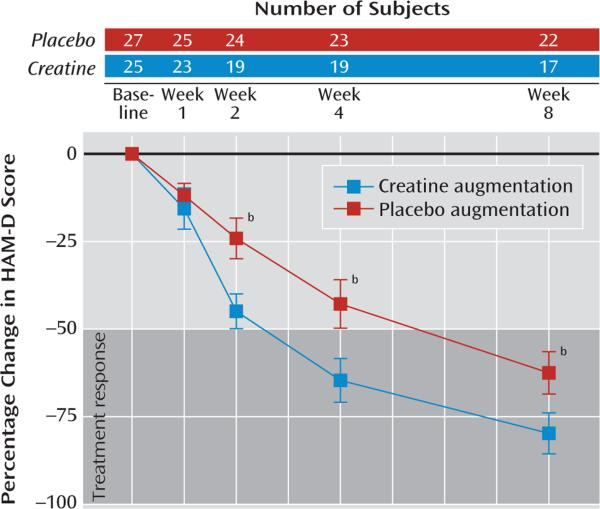
A proposed explanation is that increasing creatine availability may improve the brain’s ability to maintain ATP levels, potentially supporting biological processes involved in mood regulation (Mangunsong et al. 2025). However, this does not mean that creatine is a cure for depression. Research into its mental health effects is still developing, and factors such as dosage, biological sex, diet, and existing treatments may influence the results (Fabiano and Stubbs 2025). Before definitive findings can be drawn, larger and longer clinical trials are required.
Although creatine is most commonly used as a supplement in the gym, its benefits to the body extend far beyond building muscle. As research continues, creatine may offer new insight into how brain energy metabolism can influence mental health.
References
Fabiano, Nicholas, and Brendon Stubbs. 2025. “Creatine as a Treatment for Depression: A Brain Bioenergetics Perspective.” European Neuropsychopharmacology 96 (July): 3–4. https://doi.org/10.1016/j.euroneuro.2025.03.014.
Greenhaff, Paul L. 2001. “The Creatine-Phosphocreatine System: There’s More Than One Song in Its Repertoire.” The Journal of Physiology 537 (3): 657–57. https://doi.org/10.1111/j.1469-7793.2001.00657.x.
Juneja, Keshav, Hamsa Priya Bhuchakra, Soumyodip Sadhukhan, et al. 2024. “Creatine Supplementation in Depression: A Review of Mechanisms, Efficacy, Clinical Outcomes, and Future Directions.” Cureus, ahead of print, October 16. https://doi.org/10.7759/cureus.71638.
Lyoo, In Kyoon, Sujung Yoon, Tae-Suk Kim, et al. 2012. “A Randomized, Double-Blind Placebo-Controlled Trial of Oral Creatine Monohydrate Augmentation for Enhanced Response to a Selective Serotonin Reuptake Inhibitor in Women With Major Depressive Disorder.” American Journal of Psychiatry 169 (9): 937–45. https://doi.org/10.1176/appi.ajp.2012.12010009.
Mangunsong, Joshua, Liam Browning, Brandon Luu, Nicholas Fabiano, and David Puder. 2025. “Psychiatry & Psychotherapy Podcast.” Psychiatry & Psychotherapy Podcast, April 18. https://www.psychiatrypodcast.com/psychiatry-psychotherapy-podcast/episode-238-creatine-mental-health-benefits.
McCallum, Katie. 2024. “Creatine: How Does It Work, Is It Safe & When Should You Take It?” Www.Houstonmethodist.Org, April 12. https://www.houstonmethodist.org/blog/articles/2024/apr/creatine-how-does-it-work-is-it-safe-when-should-you-take-it/.
Morton, Alan. 2015. “Creatine Phosphate – an Overview | ScienceDirect Topics.” Sciencedirect.Com. https://www.sciencedirect.com/topics/neuroscience/creatine-phosphate.
Sethuraman, M. 2017. “Brain Metabolism – an Overview | ScienceDirect Topics.” Www.Sciencedirect.Com, March 31. https://www.sciencedirect.com/topics/neuroscience/brain-metabolism.


Leave a Reply
You must be logged in to post a comment.