Is DNA Its Own Enemy?

It feels like since childhood, every beautiful summer day is often companied by the same phrase, “Don’t forget your sunscreen!”. While sunscreen can offer some DNA protection from the loved yet threatening UV rays, a stranger threat persists. In fact on any day of the year, it hides within the very bonds holding DNA together; the proton.

DNA’s two strands are joined by base pairs, such as guanine (G) with cytosine (C), held together by hydrogen bonds. In this case, the hydrogen bonds are formed when a hydrogen atom, covalently bonded to nitrogen or oxygen on one base, is attracted to a lone pair of electrons on the opposite base. In 1963, Per-Olov Löwdin proposed that the hydrogen’s nucleus, a single proton, could “tunnel” from one base to the other along this bond and attach to the atom on the opposite base (Löwdin 1963).

Classically, a particle needs enough energy to climb over a barrier, like a ball over a hill. A barrier is a region where a particle’s potential energy would exceed its total energy; entering it classically would require an impossible negative kinetic energy. For the proton, the barrier lies between the two bases (Figure 1). Thus, Löwdin was essentially proposing that the proton could cross the barrier through quantum tunnelling rather than strictly gaining enough energy to climb over it.
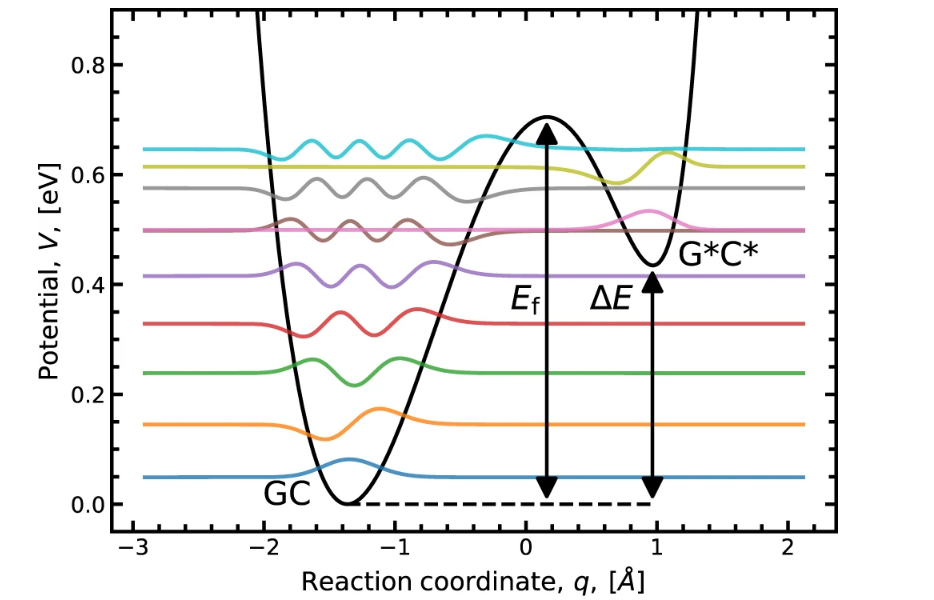
Figure 1. The energy landscape felt by the G-C proton as it moves along the hydrogen bond, where 1 Å is 10⁻¹⁰ m. The deep valley on the left corresponds to the normal G-C pair, while the shallower valley on the right corresponds to the tautomeric G*-C* pair. The hill between them is the barrier the proton must cross, with a height of Ef= 0.704 eV. Each coloured line represents the wavefunction of the proton at an allowed energy level. The lowest energy states are drawn starting from the bottom and move up in allowed energy as you move towards the top; with the lowest energy state being shown in blue and the highest energy state being shown in light-blue. The lowest levels are confined entirely to the normal valley while the higher levels, reached with energy from the surrounding cellular environment, extend into the tautomeric valley on the right (Slocombe, Sacchi, and Al-Khalili 2022).

Quantum mechanically, a particle is described by a wavefunction, whose modulus squared gives its probability of being at each position. Inside the barrier, the wavefunction decays exponentially rather than vanishing, leaving a small chance of finding the particle beyond it (Equation 1).

Equation 1. Approximate probability (T) of a particle with mass m and energy E tunnelling through a barrier of height V₀ and width α, where ℏ is a constant (Griffiths and Schroeter 2018).

Since κ grows with m, heavier particles have a smaller T and tunnel less. Yet protons, 1836 times heavier than electrons, still tunnel because hydrogen-bond barriers are extremely narrow, making α small enough to offset a large κ. When one G-C proton tunnels across, a second shifts the opposite way, converting both bases into tautomers; the same molecules with rearranged hydrogens (Figure 2). Some proposed this could cause point mutations during replication, as tautomeric G can pair with thymine (T) instead of C, and tautomeric C with adenine (A) (Slocombe, Sacchi, and Al-Khalili 2022). However, many argued tautomers were too short-lived to survive strand separation.
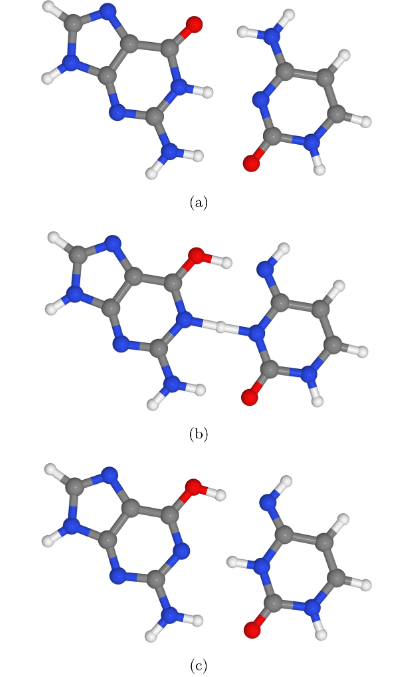
Figure 2. The proton transfer reaction between guanine (G) and cytosine (C). (a) the normal G-C pair, (b) the highest-energy point of the transfer, at the top of the barrier, and (c) the tautomeric G*-C* pair after both protons have moved across. Hydrogen atoms are shown in white, nitrogen atoms in blue, carbon atoms in grey, and oxygen atoms in red (Slocombe, Sacchi, and Al-Khalili 2022).

Nearly 60 years later, Slocombe, Sacchi, and Al-Khalili (2022) modelled a G-C pair within a cellular environment. Tunnelling outpaced classical hopping by several orders of magnitude, flipping the pair between forms far faster than helicase, the enzyme that unzips DNA, can separate the strands. This rapid flipping keeps a steady fraction of pairs in tautomeric form during unzipping; at biological temperatures, about 1.7 in 10,000 G-C pairs, over 10,000 times the classical prediction. However, real mutation rates are far lower, about one per hundred million base pairs, since repair enzymes catch most errors, and tautomer rates remain experimentally unmeasured (Slocombe, Sacchi, and Al-Khalili 2022).

Unlike UV damage, this needs no sunlight, only a cell copying its DNA to divide. Sunscreen blocks UV rays, but nothing stops a proton from behaving like a wave. If quantum mechanics quietly edits the genetic code, how much of evolution has it written?

References

Griffiths, David J., and Darrell F. Schroeter. 2018. Introduction to Quantum Mechanics. 3rd ed. Cambridge University Press.

Löwdin, Per-Olov. 1963. “Proton Tunneling in DNA and Its Biological Implications.” Reviews of Modern Physics 35 (3): 724–32. https://doi.org/10.1103/RevModPhys.35.724.

Slocombe, Louie, Marco Sacchi, and Jim Al-Khalili. 2022. “An Open Quantum Systems Approach to Proton Tunnelling in DNA.” Communications Physics 5: 109. https://doi.org/10.1038/s42005-022-00881-8.

Comments

4 Responses to “Is DNA Its Own Enemy?”

  1. Nam Nguyen Avatar
    Nam Nguyen

    Hi iSci!

    In Quantum Mechanics, we’ve been learning about quantum tunneling and I overheard some of my biological physics peers talking about proton tunnelling in DNA during class. I was intrigued by this and thought it was a neat biological implication of the concept. Hope you guys enjoy the read!

    Nam

  2. Mansi Bhandari Avatar
    Mansi Bhandari

    Hey Nam,

    This was such an interesting blog post and really well-written! All of the information was super digestible even though I didn’t know much about the topic before. Here are some suggestions for editing if you see fit:

    – When citing Slocombe, Sacchi, and Al-Khalili, I believe you can shorten the in-text reference to (Slocombe et al. 2022) since there are three authors.

    – In P6S2, I would consider breaking the sentence up to improve clarity. Some of the grammar tenses also aren’t consistent, so maybe rewording it to something like this would work better: “Tunnelling outpaced classical hopping by several orders of magnitude. As a result, the pair flipped between forms far faster than helicase – the enzyme that unzips DNA – could separate the strands.”

    – In P6S3, I’d change the semi-colon to a colon instead because the second part of the sentence is further explaining the first part.

    Overall, this was a great read and hopefully some of my edits helped!
    Best,
    Mansi

  3. Saniyah Farzeen Avatar
    Saniyah Farzeen

    Hi Nam!

    I really enjoyed this!! I’ve heard about quantum tunnelling before, but I had never thought about it in the context of DNA, so I thought this was such a cool way of connecting quantum mechanics and biology. I also really liked the sunscreen opening and how you brought it back at the end 🙂

    I just had a few thoughts while I was reading:

    – When you introduce Equation 1, I wonder if it would be worth briefly mentioning that it is a simplified approximation for tunnelling through a barrier. Figure 1 shows a more complicated double-well energy landscape, so just clarifying that the equation is mainly there to show how things like barrier width and particle mass affect tunnelling probability might help connect the two without making it seem like the actual DNA system has a perfectly simple barrier.

    – I think the part where you explain that the tautomeric forms could cause mutations could maybe use one extra sentence walking through how that actually happens during replication. You explain that G* can pair with T and C* with A, but I think showing that next step from temporary tautomer → incorrect base pairing → possible point mutation would make the biological consequence feel even clearer.

    – Near the end, I really liked that you compared the predicted tautomer frequency with the much lower real mutation rate. Since you also mention that the tautomer rate has not been experimentally measured yet, I wonder if you could emphasize a little more that this is still a proposed mechanism rather than something we know contributes a certain amount to real mutations. I think that would make your final question about how much of evolution quantum tunnelling has “written” hit even harder because the uncertainty is part of what makes it so interesting.

    Overall though this was genuinely such an interesting read and I thought you did a really good job making the quantum mechanics understandable without oversimplifying it 🙂

    Happy editing!
    Saniyah

  4. Troy Lin Avatar
    Troy Lin

    Hi Nam,

    I really enjoyed reading your blog post, it was very easy to understand and I like how your conclusion ties back to your introduction. I have a couple suggestion to make your blog better:

    – P1S1: “companied” should be “accompanied”. “Often” is kind of redundant so in my opinion you should remove it. Also, you wrote ” “Don’t forget your sunscreen!”. “, which has an extra period at the end.
    – P5S1: You state “Since κ grows with m,” but κ is never defined, which is confusing for the reader.

    Great job on your blog post and good luck with editing!
    Troy

Leave a Reply