The origins of life on Earth are a highly debated topic among experts in the field. The prevailing hypothesis is abiogenesis, a chemical process in which the building blocks of life – nucleotides, carbohydrates, fatty acids, and amino acids – were made from abiotic material (Pross and Pascal 2013). These basic elements then went on to develop into the complex life around us according to endosymbiosis and the theory of evolution. In 1953, the Miller-Urey experiment supported abiogenesis by simulating primordial Earth conditions and subjecting gases to an electric charge. When Parker et al. (2014) replicated the experiment, they produced various nucleotides.
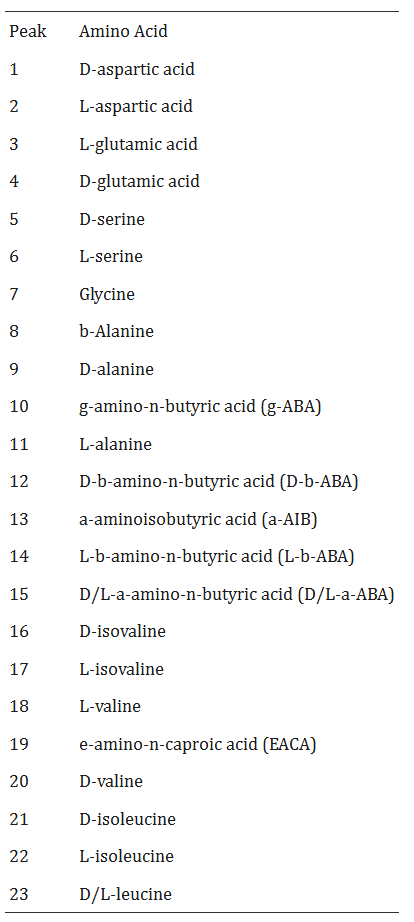
Figure 1. Amino acids produced from Miller-Urey experiment replication (Parker et al. 2014). Many of the amino acids present are among the 20 standard amino acids in the human body.
An even more controversial topic is the existence of life within our universe. According to the Big Bang theory, billions of years ago, what would become our universe was condensed into a hot and relatively small mass (National Academy of Sciences 1999). The mass went on to expand, projecting matter and energy in all directions to form a solar nebula where denser material aggregated to the center (National Academy of Sciences 1999).
In 2023, NASA’s OSIRIS-REx, an explorer similar in function to a Mars rover, returned from its voyage to asteroid Bennu, a carbonaceous asteroid near Earth (Taveau 2025). The objective of the exploration was to retrieve rock and dust samples from Bennu for examination. What NASA would go on to find significantly changed the discourse around the question of extraterrestrial life.
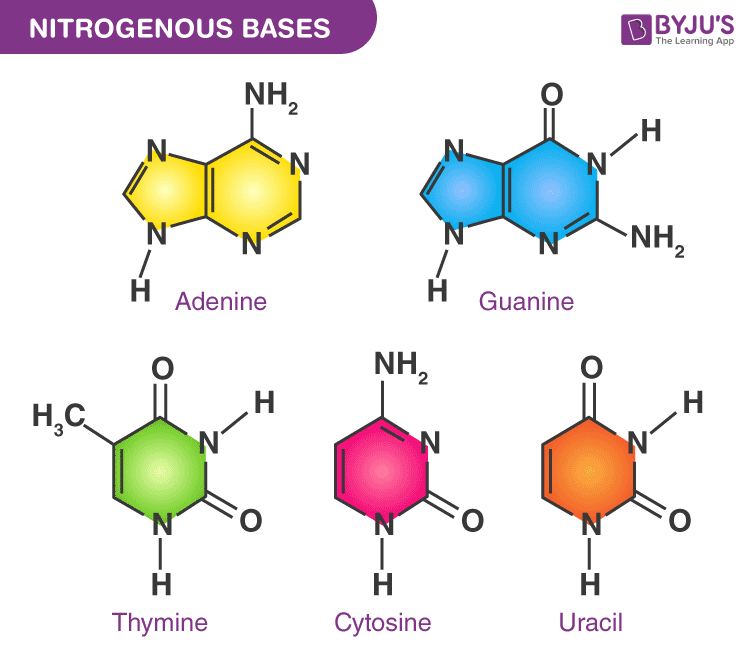
14 out of the 20 amino acids discovered among Bennu’s samples were ones that life on Earth is confirmed to use to make proteins. The five nitrogen bases used to contain and transcribe genetic information (adenine, guanine, thymine, cytosine, uracil) were also found within the asteroid samples (Taveau 2025). After such a revelation that identical amino acids to those in Earth life were found outside of the planet, an interesting proposition arose: if similar material aggregated at the center of our solar system and abiogenesis produced life on Earth from hydrogen gases, ammonia, methane and water, then perhaps other celestial bodies at a relatively similar distance as Earth is from the Sun may carry the same potential for life similar to ours on Earth.
Although Jovian planets have the same molecules that were the building blocks of life, what sets Bennu apart is that those simple molecules may have already undergone a massive step in the process of developing life, which is the electric charge creating amino acids and nucleotides according to the Miller-Urey experiment (Kenny 2023). Consequently, Bennu might only be a few hundred million years away from forming simple life, not quite to the same level as what we see in movies, but it is a start. Perhaps the reason we have not found any life in our solar system yet is because we started looking a little too early.
References
National Academy of Sciences (US). “The Origin of the Universe, Earth, and Life.” In Science and Creationism: A View from the National Academy of Sciences. 2nd ed. January 1, 1999. https://www.ncbi.nlm.nih.gov/books/NBK230211/.
John, Kenny. “Jovian Planets.” Astronomy and Astrophysics: Research Starters. EBSCO, 2023. https://www.ebsco.com/research-starters/astronomy-and-astrophysics/jovian-planets.
Parker, Eric T., James H. Cleaves, Aaron S. Burton, Daniel P. Glavin, Jason P. Dworkin, Manshui Zhou, Jeffrey L. Bada, and Facundo M. Fernández. “Conducting Miller-Urey Experiments.” Journal of Visualized Experiments, no. 83 (January 21, 2014). https://doi.org/10.3791/51039.
Pross, Addy, and Robert Pascal. “The Origin of Life: What We Know, What We Can Know and What We Will Never Know.” Open Biology 3, no. 3 (March 2013): 120190. https://doi.org/10.1098/rsob.120190.
Taveau, Jessica. “NASA’s Asteroid Bennu Sample Reveals Mix of Life’s Ingredients.” NASA, February 3, 2025. https://www.nasa.gov/news-release/nasas-asteroid-bennu-sample-reveals-mix-of-lifes-ingredients/.
Comments
7 Responses to “Life Outside Earth? We’re Early to the Party”
This is relevant to iSci activities by intersecting chemistry through discussing the original molecules and the reaction that transformed them into nucleotides, biology through discussing the nucleotides Earth life uses and the amino acids found on Bennu, and earth sciences through discussing the beginnings of our universe, asteroids, and space exploration.
Overall, this blog post serves as an integration of many of the disciplines covered in iSci. Even some of the aspects relating to earth sciences were brought up in previous lectures.
Hi Praise,
This is a very great blog post! The origins of life are such an interesting topic, and I loved learning a little bit more about the possibility of life close to Earth.
There are a couple sentences that are a bit long and could be split into multiple sentences. For example: “The objective of the exploration was to retrieve rock and dust samples from Bennu for examination what NASA would go on to find significantly changed the discourse around the question of extraterrestrial life.” I think it might be beneficial to break it into two separate sentences.
Ex. “The objective of the exploration was to retrieve rock and dust samples from Bennu for examination. What NASA would go on to find significantly changed the discourse around the question of extraterrestrial life.
My only suggestion would be to read through the post out loud to find where sentences are a little bit too long, and consider breaking them into multiple sentences.
Happy editing!
Anchan
Hi Anchan,
I appreciate your comment, and I can see in hindsight how a wordy sentence might negatively impact the post.
Hey Praise!
Great blog post – it’s always interesting to learn more about the origins of life and your post was easy to understand. I have a few comments for a few sentences that I think could be cleared up a bit:
1. In your second paragraph, I think it could be more formal by avoiding saying “a sort of big bang”. I would also suggest not using contractions in the last paragraph, for the same reason of formality.
2. I think you might be missing a period in the last sentence of your third paragraph. Does it mean to read: “The objective of the exploration was to retrieve rock and dust samples from Bennu for examination. What NASA would go on to find significantly changed the discourse around the question of extraterrestrial life”?
3. I’m slightly confused by the first sentence of your fourth paragraph, it sounds a bit contradictory. “14 out of the 20 amino acids discovered among Bennu’s samples were ones that life on Earth is confirmed to use to make proteins, not including the five nitrogen bases used to contain and transcribe genetic information, which were also found within the asteroid samples”. It is a bit unclear whether or not nitrogenous bases were found in the asteroid samples. I would also suggest cutting down the sentence, as long sentences can be hard to follow.
Overall I enjoyed reading it, especially how the ending makes us readers pause and think.
Excited to see your final product!
Alice
Hi Alice,
1) My intention there was to be comedic, but if it takes away from the formality, I might change the wording. I agree that contractions aren’t formal.
2) Yes. I did miss a period.
3) This seems to be a common point. Both the amino acids and nitrogenous bases were found. I’ll improve the clarity of that sentence
Many thanks for the feedback!
Hi Praise,
Great job on your first blog post! I really enjoyed reading it and it was comprehensive and engaging. A few suggestions you may want to consider when editing over the next week:
– In Chicago 18 Author-Date, there is no comma between the author name(s) and date, so (Pross and Pascal, 2013) would be (Pross and Pascal 2013). You would only use a comma (after the date) when you are referring to a particular page.
– Also make sure your references are in Chicago 18 Author-Date format! All info is available in the Chicago Manual of Style, linked on Avenue.
– For your figure, I think it would be nice if you could find/create a figure that includes the structures of the amino acids to provide more of the chemistry/biology context, as you mentioned in your comment.
– P1S1: If you can find the information, I think it would be nice to include the name of the Mars rover(s) that OSIRIS-REx is similar to since there have been several Mars rovers that are all pretty different!
Overall, it was a super cool read and I learned a lot about the progress being made in the search for extraterrestrial life!
Happy editing!
Amanda
Hi Amanda,
Thank you for your comments.
Your input on citations and proper Chicago style formatting is valued.
I see how another figure on amino acids and nitrogenous bases would be helpful.
Many thanks!