“A glass of red wine a day is good for your heart.” This has been a common saying most people have heard, most of the time while someone is pouring themselves a second glass. Physicians from Hippocrates to Galen prescribed wine as medicine. As much as some of us would like to believe this claim, the biology and psychology behind it tell a different story (Rathee and Jain 2020) .
The biology: what happens when you drink wine?
Wine is not simply alcohol; it is a complex mix of compounds that together create its distinct flavours, colours and aromas (Buljeta et al. 2023). Among these compounds, researchers have focused in particular on flavonoids and resveratrol, which are both types of polyphenols, because of their potential health benefits (Buljeta et al. 2023). Grapevines naturally produce resveratrol to defend against fungal infection, and most of it is concentrated in the grape skins.
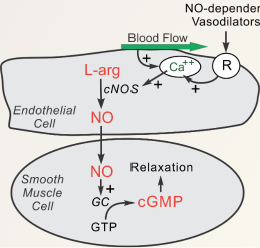
Resveratrol works by signalling for the cells that line blood vessels to release nitric oxide. In doing so this relaxes the arteries and discourages clotting which can be seen in figure 1.
The psychology: why did we believe it?
The “French Paradox” was the main reason the idea came to be. France had been seen to have low rates of heart disease death even though their diet consisted of saturated fats and wine seemed to be the reason. The evidence is strictly from observational studies and hence cannot be used to prove causation.
The claim stuck because of psychological factors. We like to strictly look at evidence that helps our views which is called confirmation bias. So when we hear that wine could be possibly beneficial we only look at claims that help support that belief. Wine also carries a “health halo,” linked with meals, Mediterranean living and sophistication rather than heavy drinking (Ferrières 2004) . In the late 1990s, the wine industry lobbied for US labels inviting drinkers to ask their doctor about wine’s health effects (Ferrières 2004) .
The drinkers themselves differ too. Compared with beer and spirits drinkers, wine drinkers tend to be more educated, wealthier and more active, are less likely to smoke, and report fewer psychiatric symptoms (IARC Working Group on the Evaluation of Carcinogenic Risks to Humans 2010). Any of these could make wine look protective. Many studies also grouped former drinkers with lifelong non-drinkers. This is misleading because some people stop drinking after developing health problems such as heart or liver disease. Counting these people as “non-drinkers” makes the non-drinking group look less healthy, which can make moderate drinking seem more beneficial than it really is (Cook et al. 2024) .
So, is it good for you?
Wine’s compounds have genuinely interesting biology, but it hasn’t been shown to produce healthier hearts, and Canada’s 2023 guidance links even three to six drinks a week with a higher risk of several cancers (Canadian Centre on Substance Use and Addiction 2023). The lesson isn’t that wine is poison. It’s that a plausible mechanism plus a flattering belief is not proof. Sometimes what makes wine drinkers healthy isn’t in the glass, but who’s holding it.
References
Buljeta, Ivana, Anita Pichler, Josip Šimunović, and Mirela Kopjar. 2023. “Beneficial Effects of Red Wine Polyphenols on Human Health: Comprehensive Review.” Current Issues in Molecular Biology 45 (2): 782–798.https://doi.org/10.3390/cimb45020052.
Canadian Centre on Substance Use and Addiction. 2023. Canada’s Guidance on Alcohol and Health: Final Report. Ottawa, ON: Canadian Centre on Substance Use and Addiction.https://www.cancercare.mb.ca/pdflink/en/22a3de4e-5027-11e6-816f-005056a734b7/Canadas-Guidance-on-Alcohol-and-Health-Final-Report.pdf.
Cook, W. K., W. C. Kerr, Y. Zhu, S. Bright, C. Buckley, C. Kilian, A. M. Lasserre, L. Llamosas-Falcón, N. Mulia, J. Rehm, and C. Probst. 2024. “Alcoholic Beverage Types Consumed by Population Subgroups in the United States: Implications for Alcohol Policy to Address Health Disparities.” Drug and Alcohol Review 43 (4): 946–955.https://doi.org/10.1111/dar.13819.
Ferrières, Jean. 2004. “The French Paradox: Lessons for Other Countries.” Heart 90 (1): 107–111.https://doi.org/10.1136/heart.90.1.107.
IARC Working Group on the Evaluation of Carcinogenic Risks to Humans. 2010. “Alcohol Consumption and Ethyl Carbamate. 1. Exposure Data.” IARC Monographs on the Evaluation of Carcinogenic Risks to Humans, no. 96. Lyon: International Agency for Research on Cancer.https://www.ncbi.nlm.nih.gov/books/NBK326559/.
Klabunde, Richard E. 2018. “Nitric Oxide.” Cardiovascular Physiology Concepts. Revised January 5, 2018. https://cvphysiology.com/blood-flow/bf011.
Puddey, Ian B., Kevin D. Croft, R. Abdu-Amsha Caccetta, and Lawrence J. Beilin. 1998. “Alcohol, Free Radicals and Antioxidants.” Novartis Foundation Symposium 216: 51–62; discussion 63–67, 152–158. https://doi.org/10.1002/9780470515549.ch5.
Stockley, C. S. 2015. “The Relationships between Alcohol, Wine and Cardiovascular Diseases: A Review.” Nutrition and Aging 3 (2–4): 55–88.https://doi.org/10.3233/NUA-150052.
Weiskirchen, Sabine, and Ralf Weiskirchen. 2016. “Resveratrol: How Much Wine Do You Have to Drink to Stay Healthy?” Advances in Nutrition 7 (4): 706–718.https://doi.org/10.3945/an.115.011627.
Comments
9 Responses to “A Glass of Wine a Day keeps the Doctor Away… Or Does it?”
Hi Isci I chose to talk about this topic after thinking about the widely known saying a glass of wine keeps the doctor away and how as a society we have shifted from that thinking to understanding the implications of alcohol consumption. In wine sci Chad had mentioned the differences in generations in regards to alcohol consumption and decided to look more into the biological and psychological side of that. Hope you guys enjoy!
Hi Gurdit!
I really like the topic you selected! From the title itself I was intrigued to read the rest! I just have a few ideas for improvements:
I believe “keeps” in the title should be capitalized to follow proper titlecase. In your second paragraph, the second half of the last sentence seemed fragmented. I believe it just needs to be reworded or broken into two sentences. Also, I would provide context for some of the sentences where you cite certain facts. For example, for the sentence “Many studies also counted people who quit because they were already sick as ‘non-drinkers,’” you should explain what people quit and what you mean by “sick.”
Thank you for giving me such an interesting read!
Sincerly,
Sofia
Hi Sofia,
Thank you so much for the feedback, I tried my best to incorporate it!
-Gurdit
Hi Gurdit!
Thanks for such an interesting read! I really enjoyed learning about the biological and psychological background of the common misconception of wine being medicine. Here’s just a couple things I noticed to maybe change.
In the biology section, the sentence “Grapevines make resveratrol to fight fungal infection, and because red wine ferments with the grape skins (Puddey et al. 1998).” is a little confusing. It isn’t quite clear what the correlation between resvertol and fermentation is.
Secondly, when talking about the required dose of resvertol needed to feel affects, it is slightly misleading as the study you are referencing was tested on animals, so the 500L figure is does not necessarily hold true for humans.
Overall, you did an amazing job of making a complex process really easy to follow and understand!
Eshal
Thanks Eshal!
I clarified the resveratrol and fermentation sentence and added that the 500 L figure comes from animal studies, so it may not apply directly to humans. Really appreciate the feedback!
-Gurdit
Hi Gurdit,
I think that you chose an incredible topic and certainly an engaging one. I just have a couple of suggestions so that you can potentially improve your final draft.
– My first suggestion would be to capitalize all of the necessary words in the title
– I would also recommend trying to expand the sentences, especially in the first paragraph; potentially using connecting phrases.
– My last suggestion would be to use a comma after the word resveratrol, in paragraph two.
Happy editing!
Sayana 🙂
Thanks Sayana!
I fixed the title capitalization, added connecting phrases to the first paragraph, and added the comma after resveratrol. Appreciate it!
-Gurdit
Hey Gurdit,
This was a fantastic blog; I would’ve never thought about the positive effects of wine!
Here is some feedback that I have for you:
+ P2S2: I would rephrase “Research has really dove” into “Research dove”, “Research investigated”, etc for a better read
+ P5S1: These sentences are a little informal/vague; I would expand this sentence if the word count permits for a tad more clarity.
+ P4S1: I believe you have a forward slash typo before “Wine”.
I hope this feedback was helpful!
Happy editing,
Amy
Thanks Amy!
I’d already fixed the “Research has really dove” wording and the slash typo in my newer draft, but I took your advice and made the “body complicates this” sentence clearer. Really appreciate it!
-Gurdit