Have you ever yawned simply because you saw someone else do it? Yawning is one of the most common human behaviours, yet we rarely question its purpose — why does our body do it? Scientists have not found one clear cut answer, but research over recent years suggest that this is due to the deep inhalation and wide opening of the mouth during a yawn. This brings in cooler air and changes blood flow, resulting in a lowering of brain temperature. (Gallup and Gallup 2007; Platek, Mohamed, and Gallup 2005; Wani and Agarwal 2025).
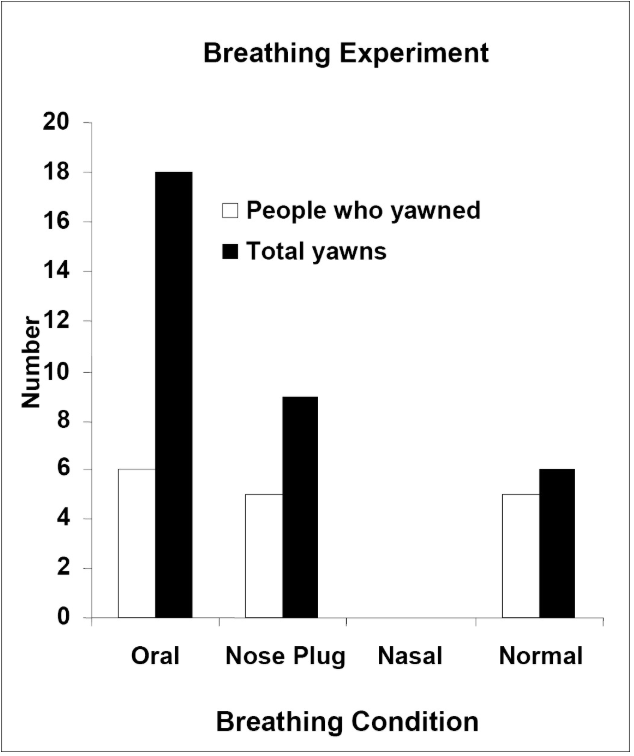
One theory states yawning is a method of homeostasis (Guggisberg et al. 2010), used as a mechanism to cool down the brain. To test this hypothesis, researchers showed participants short videos of other people yawning (as a stimulant) while controlling how they breathed. When people breathed orally, 54% of them were reported to have yawned. When the same participants were instructed to breathe nasally, none of them were reported to have yawned. Nasal breathing cools the blood travelling to the brain because air passing through the nasal passages transfers heat away from blood vessels lining the nose. Since this cooling was already occurring, the researchers argued that the participants’ brains did not need the extra cooling that yawning may provide. (Gallup and Gallup 2007).
In another experiment, participants held packs of varying temperatures (cold, room temperature, and warm)to their forehead. Participants with warm or room-temperature packs had been reported to yawn contagiously about 40% of the time, but those with cold packs had only been reported to yawn 9% of the time (Figure 1). Both of these experiments demonstrate that when the brain is already being cooled by nasal breathing or a cold temperature, then the urge to yawn largely decreases (Gallup and Gallup 2007).
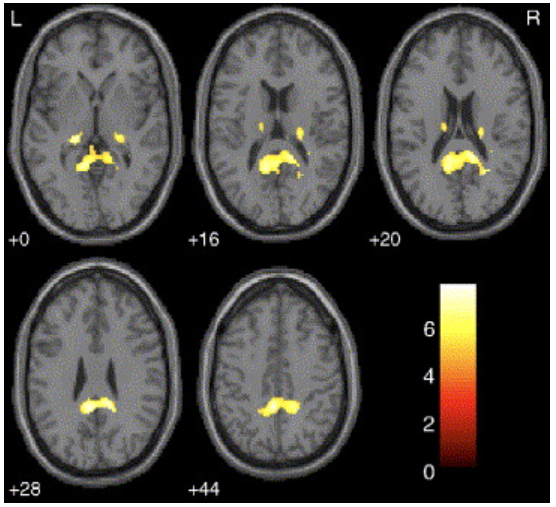
Yawning is not only linked to temperature and breathing conditions, but also how we process other people (Platek, Mohamed, and Gallup 2005). In a brain-imaging study, participants were instructed to watch videos of various human expressions such as yawning, laughing, and neutral expressions while inside a functional magnetic resonance imaging (fMRI) scanner. When researchers compared brain activity during yawning videos in contrast to laughing videos, they found a stronger activation in the posterior cingulate and precuneus (Figure 2). In the brain image (Figure 2), brighter colours indicate areas with greater activity during yawning than during laughing (Platek, Mohamed, and Gallup 2005; Cooper et al. 2011). These regions are involved in self-reflection and understanding other people’s thoughts, supporting the idea that contagious yawning is related to social mirroring and empathy (Platek, Mohamed, and Gallup 2005).
Ultimately, yawning is more than a sign of tiredness and boredom. Although scientists do not have a definitive reason for why we yawn, these experiments and studies show that it can be a method of homeostasis by cooling the brain, in addition to contagious yawning reflecting social processing and empathy.
References
Cooper, Nicholas R., Ignazio Puzzo, Adam D. Pawley, et al. 2011. “Bridging a Yawning Chasm: EEG Investigations Into the Debate Concerning the Role of the Human Mirror Neuron System in Contagious Yawning.” Cognitive, Affective, & Behavioral Neuroscience 12 (2): 393–405. https://doi.org/10.3758/s13415-011-0081-7.
Gallup, Andrew C., and Gordon G. Gallup. 2007. “Yawning as a Brain Cooling Mechanism: Nasal Breathing and Forehead Cooling Diminish the Incidence of Contagious Yawning.” Evolutionary Psychology 5 (1). https://doi.org/10.1177/147470490700500109.
Guggisberg, Adrian G., Mathis Johannes, Schnider Armin, and Christian W. Hess. 2010. “Why Do We Yawn?” Neuroscience & Biobehavioral Reviews 34 (8): 1267–76. https://doi.org/10.1016/j.neubiorev.2010.03.008.
Platek, Steven M., Feroze B. Mohamed, and Gordon G. Gallup. 2005. “Contagious Yawning and the Brain.” Cognitive Brain Research 23 (2): 448–52. https://doi.org/10.1016/j.cogbrainres.2004.11.011.
Wani, Pinaki Deepak, and Mayank Agarwal. 2025. “The Science of Yawning: Exploring Its Physiology, Evolutionary Role, and Behavioral Impact.” Journal of Family Medicine and Primary Care 14 (8): 3115–20. https://doi.org/10.4103/jfmpc.jfmpc_1677_24.


Leave a Reply
You must be logged in to post a comment.