The Pink Iguana Darwin Never Saw

Upon the slopes of Volcán Wolf lives one of Earth’s rarest and most ecologically unique reptiles. Charles Darwin missed the Galápagos pink land iguana (Conolophus marthae) on his 1835 Galápagos voyage, a species whose evolution remains puzzling (Figure 1)(Gentile et al. 2009). Darwin’s Galápagos observations were central to his ideas about evolution, making this species’ absence significant to its modern evolutionary mystery. C. marthae is critically endangered and endemic to Isabela Island, with only about 200 adults estimated to remain (Galápagos Conservation Trust 2026; Gargano et al. 2024). These researchers later found that these iguanas migrate up Volcán Wolf to use geothermal heat to incubate their eggs, an unusual trait among their Conolophus relatives. However, genetic studies indicate that the pink iguana lineage split from other Galápagos land iguanas potentially before Isabela Island and Volcán Wolf even existed, making their presence on this young volcano an evolutionary mystery (Gentile et al. 2009).
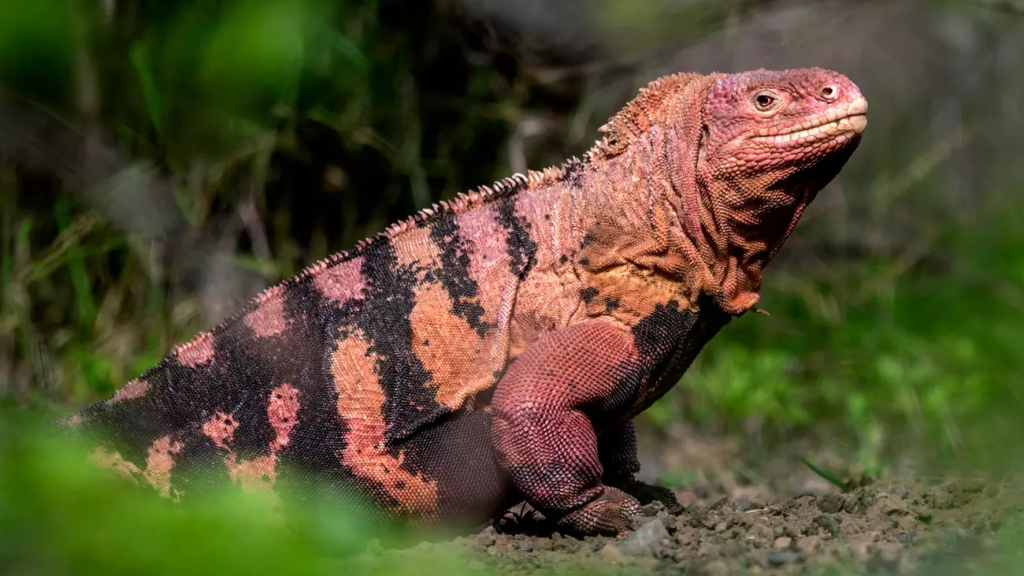
Figure 1. Galápagos pink land iguana (Conolophus marthae) resting on dirt on Isabela Island, Galápagos Islands (Bustamante 2025).

The island’s invasive feral cats prey on this species, and the eruption of Volcán Wolf in 1982 threatened the population of C. marthae (Gargano et al. 2024). During rescue efforts, researchers struggled to locate nesting grounds until tracking females during the 2019–2020 reproductive season revealed nests located on a small plateau inside Volcán Wolf’s caldera, ~400 meters below the rim. Females travelled over 2 kilometres from their usual habitat to reach these sites. After laying eggs, C. marthae females only guard their nests for 2 days to a week; an unusually short period for iguanas.

The question of how C. marthae came to live on Volcán Wolf becomes more interesting considering its evolutionary history. The Galápagos has three main terrestrial Conolophus species: C. subcristatus, C. pallidus and C. marthae (Paradiso et al. 2025). Using RADseq data, Paradiso et al. (2025) estimated that iguanas colonized the Galápagos ~10 mya. These scientists believe that within this period, C. marthae diverged from C. subcristatus through allopatric speciation after the emergence of Isabela Island ~0.57 mya (Figure 2). This timing supports recent allopatric speciation after Isabela’s emergence, indicating that this volcano played a role in their distinctive evolutionary habits. However, mitochondrial DNA evidence from Gentile et al. (2009) suggest that C. marthae split from other Conolophus species ~5.7 mya, before Isabela Island emerged. This earlier divergence suggests that these species may have adapted to its volcanic environment after becoming genetically distinct.
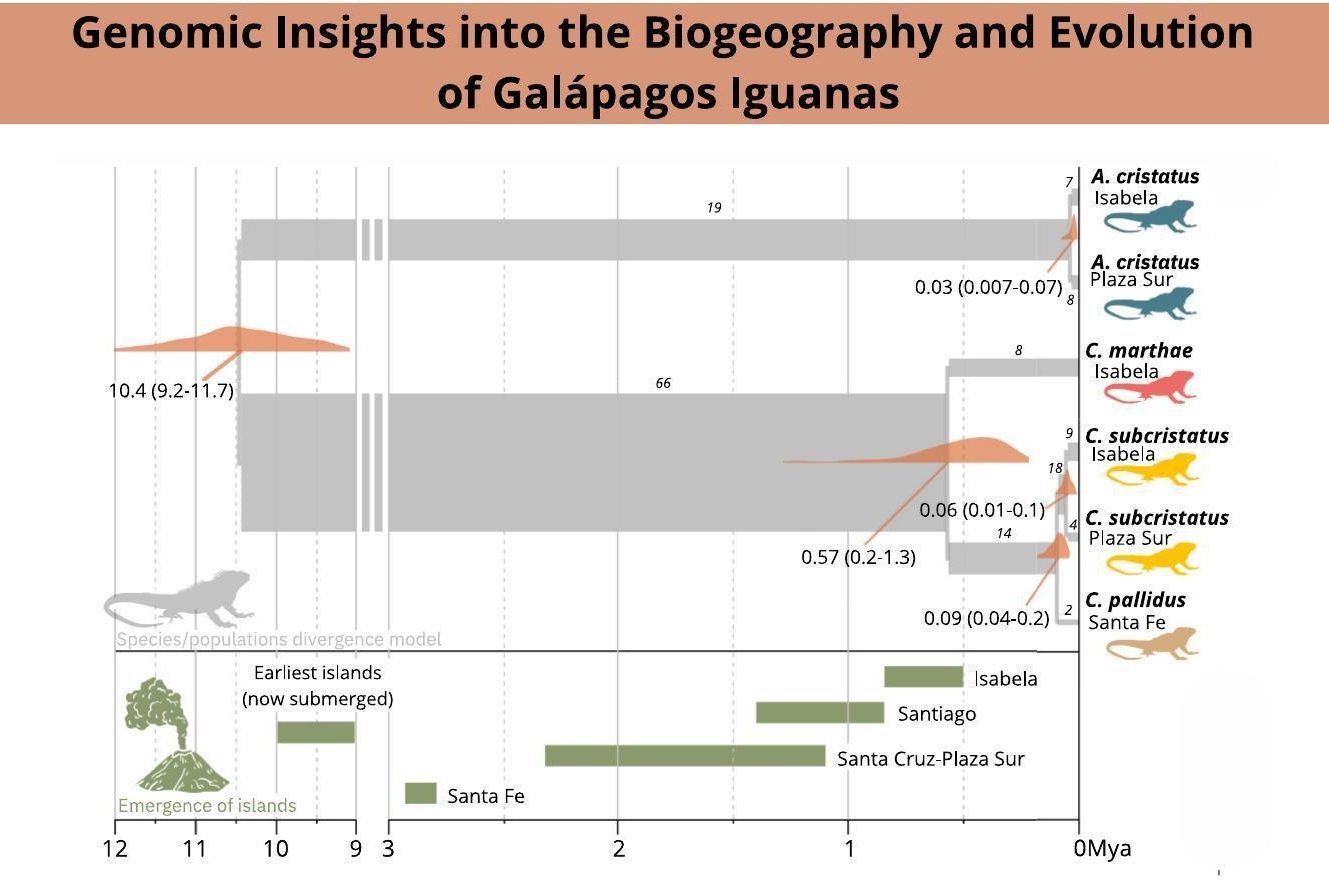
Figure 2. The timeline illustrates the estimated divergence of Conolophus iguanas (upper panel) in relation to the emergence of the Galápagos Islands (lower panel) using RAD-seq data. Grey bar width is proportional to current population size while representing divergence intervals. Values in parentheses indicate uncertainty intervals (mya). Green bars show the approximate periods of the Galápagos Islands’ emergence (Paradiso et al. 2025).

The evolutionary history of C. marthae remains uncertain. Recent research suggests they diverged from other land iguanas after the emergence of Isabela Island, while earlier genetic evidence suggests a much older split (Paradiso et al. 2025). These conflicting estimates and its unusual nesting behaviour make C. marthae an evolutionary puzzle. If Darwin had encountered this species, its unique traits may have provided another example of how isolation and environmental pressures shape evolution. More than a century later, C. marthae still raises questions about its origins, adaptations, and connection to Volcán Wolf. If only Darwin had explored a bit further.

References

Bustamante, Lucas. “Galapagos Iguanas Given Strongest Protection Possible.” IFAW, December 3, 2025. https://www.ifaw.org/press-releases/galapagos-iguanas-given-strongest-protection-possible.

Gargano, Marco, Giuliano Colosimo, Lorenzo Garizio, Paolo Gratton, Gregory A. Lewbart, Glenn P. Gerber, Pierpaolo Loreti, et al. 2024. “Locating Nesting Sites for Critically Endangered Galápagos Pink Land Iguanas (Conolophus Marthae).” Animals 14 (12): 1835. https://doi.org/10.3390/ani14121835.

Galápagos Conservation Trust. “Galápagos Pink Land Iguana.” Galápagos Conservation Trust, July 16, 2026. https://Galápagosconservation.org.uk/species/Galápagos-pink-land-iguana/.

Gentile, Gabriele, Anna Fabiani, Cruz Marquez, Howard L. Snell, Heidi M. Snell, Washington Tapia, and Valerio Sbordoni. 2009. “An Overlooked Pink Species of Land Iguana in the Galápagos.” Proceedings of the National Academy of Sciences of the United States of America 106 (2): 507–511. https://doi.org/10.1073/pnas.0806339106

Paradiso, Cecilia, Paolo Gratton, Emiliano Trucchi, Julia López-Delgado, Marco Gargano, Lorenzo Garizio, Ian M. Carr, Giuliano Colosimo, Christian Sevilla, Mark E. Welch, Mohd Firdaus-Raih, Mohd Noor Mat-Isa, Simon J. Goodman, and Gabriele Gentile. 2025. “Genomic Insights into the Biogeography and Evolution of Galápagos Iguanas.” Molecular Phylogenetics and Evolution 204: 108294. https://doi.org/10.1016/j.ympev.2025.108294

Comments

15 Responses to “The Pink Iguana Darwin Never Saw”

  1. Amelia Nolan Avatar
    Amelia Nolan

    Hi everyone!

    Our recent life science lecture about evolution looked at how leaf-cutter ants evolved to have pharmaceutical-like patches on their necks. This inspired me to look at other unique evolutionary traits of other animals. I stumbled across the Galápagos pink land iguana, where they utilize volcanoes to incubate their eggs. I thought this would be a perfect way to connect the volcanoes we are learning about in earth science to evolution in life science. However, as I researched, I realized there were still questions regarding what separated these species from their ancestors.

    Looking forward to hearing your feedback.

    Amelia Nolan

  2. Via Kim Avatar
    Via Kim

    Hi Amelia,

    This was such an interesting post to read! You did a great job with having a clear narrative and making your writing very easy to follow. Here are a few suggestions:

    -For your first reference, you can remove the proxy URL (the link to the McMaster libraries) from your reference and just include the DOI!

    – Make sure that whenever you are using the scientific name of a species (e.g., “C. marthae” and “Conolophus marthae”), it is italicized.

    -P2: I think every single in-text citation for this paragraph is (Gargano et al. 2024). You can combine consecutive statements backed by the same paper into a single paragraph-level citation or signpost the source early in the paragraph to reduce redundancy!

    -P3S1: Make sure that the genus is capitalized! (“conolophus” –> “Conolophus”)

    Overall, you did an amazing job, and I cannot wait to read your final copy!

    Happy editing,
    Via

    1. Amelia Nolan Avatar
      Amelia Nolan

      Hi Via!
      Thank you so much for this input. I corrected all my genus/species titles. I appreciate your feedback about the citations– I have always been confused about how often I am supposed to put them in. We actually just had a science literacy lecture about citations!
      Thank you so much,
      Amelia

  3. Anchan Zhou-Moore Avatar
    Anchan Zhou-Moore

    Hello Amelia!

    I loved reading about the Galapagos pink land iguana and some of their evolutionary traits! Super cool!

    My only advice is that some transitions between paragraphs could be a little smoother. For example:

    P3: I think you could smooth the transition a little bit into this section about genetics. For example, saying something along the lines of “The question of how C.marthae came to live on Volcan Wolf is even more interesting when looking at its evolutionary history.”

    P4: I think it would be beneficial to summarize a little bit more what you talked about within the article. Maybe mention that these iguanas have some unusual evolutionary traits that distinguish them from their relatives that also live on these islands, which is part of what makes this species so interesting to scientists.

    As well, in your final paragraph, “Mya” is capitalized, and I believe it should be lowercase.

    Overall, amazing job!!

    Happy editing!
    Anchan

    1. Amelia Nolan Avatar
      Amelia Nolan

      Hi Anchan,
      Thank you so much for your feedback. I added these tips in, and it sounds a lot smoother. I appreciate it.
      Amelia

  4. Celine Hamze Avatar
    Celine Hamze

    Hi Amelia!

    Great blog post! Below are a few suggestions for you:

    -I would add an introductory sentence at the start of your blog post instead of jumping right into Darwin

    -ensure to italicize the scientific names of species. You can also use their short form later on in the article

    -I recommended putting you in text citations at the end of your sentences as opposed to in between

    -I would crop out the institution symbols in your figure

    Happy editing!

    Celine

    1. Amelia Nolan Avatar
      Amelia Nolan

      Hi Celine,
      Thank you for the feedback. I cropped my figure and edited the scientific names. I appreciate the tip about the short form– it helped save my word count!
      As for the in-text citations, I changed a couple of awkward citations; however, I kept some citations in when introducing my references at the beginning of a sentence (ex. P3-S3). I’m not sure if this formatting is still awkward.
      Thank you,
      Amelia

  5. Ava Sproule Avatar
    Ava Sproule

    Hi Amelie,

    Good job on your blog post! Your topic was very interesting and was a good application of topics that are discussed in life science. I have a few suggestions:

    – You can state the scientific name after the common name in brackets and in italics and then use the short version (C. marthae) throughout the paper. Right now you switch from its full scientific name to its shortened version.

    – Instead of re-referencing Gargano et al. 2024 2 sentences back to back, you can make it clear that the information is from the same study. You can do this by saying, “These researchers also found…”

    – You should reference your figure in the text before it. Additionally, your figure caption should be centred.

    Overall, very well done! I look forward to reading the final copy.

    -Ava

    1. Amelia Nolan Avatar
      Amelia Nolan

      Hi Ava!
      Thank you for the feedback! I edited the scientific names to the short form and referenced my figure. I appreciate the advice about citations; it helps make the information flow better!
      Thank you so much,
      Amelia

  6. Euna Kim Avatar
    Euna Kim

    Hi Amelia!

    The topics that you have chosen to connect are unique and made the blog such an interesting read! Here are a few suggestions for your draft:

    – P1: The paragraph overall is a good introduction that connects the volcano to evolution. However if you explained why Darwin is relevant, such as why Darwin missing a species mattered may make the title more meaningful and why it is important to understand rather than being just a fact.

    – P4S1: You introduce the idea of what the researchers are leaning towards, however I found that statement a bit strong, as the previous paragraphs talk about how there were different estimates for when the C. marthae split from other land iguanas. Perhaps presenting evidence about this scientific consensus will provide a thorough understanding of the claim to the reader.

    Overall, this was such a fun read- looking forward to reading your final draft!

    Happy editing,

    – Euna

    1. Amelia Nolan Avatar
      Amelia Nolan

      Hi Euna,
      Thank you so much for the advice. I edited my draft to dig deeper into Darwin’s importance in the first and last paragraphs, and I shifted the focus of my last paragraph to tie all my ideas together. Let me know what you think!
      Thank you,
      Amelia

  7. Asad Baig Avatar
    Asad Baig

    Hi Amelia,

    This is a great and really interesting blog!

    A picture of the Iguana would be really cool, wouldn’t require a lengthy Figure description, and could improve visual engagement.

    “Early research by Gargano et al. estimated a population of about 200 adults left and found no hatchlings”.
    ^
    Bringing up the no-hatchling part is a great point, but it could be even clearer. For instance, maybe add to the hatchling issue by saying “… and found no hatchlings, highlighting the reproductive and conservation concerns”

    “The island’s invasive feral cats that prey on these species, and the eruption of Volcán Wolf in 1982 threatened the population of C. marthae”.
    ^
    Important issue to point out but I would recommend changing “these” to “this” as only one species has been referred to far.

    Otherwise, great job! I am excited to see your future blogs.

    – Asad B.

    1. Amelia Nolan Avatar
      Amelia Nolan

      Hi Asad!
      Great idea about the iguana figure– I definitely think it helps tie everything together visually. I added clarification about the hatchling concerns and corrected my grammar.
      Thank you so much,
      Amelia

  8. Maria Konstantinovski Avatar
    Maria Konstantinovski

    Hi Amelia!!

    Great blog post!! I’ve never heard of this pink iguana, and thats what drew me in 🙂
    Here are some points to help you edit:
    – P1S4 – Double check one of your citations!! Its not fully clear whether “(2024)” is meant to be part of a citation or timeframe so just double check (this could be my error)
    – I think your topic is really cool and I enjoyed how it started with Darwin’s travels! I think it would be interesting to connect it a little bit more in the end of your post. Maybe why it would be important for him to see this species as well and what impact it may have had in his findings.
    – In the last sentence of your first paragraph, you have a citation mid sentence. You can double check if this is ok, but I think it would be better to have the citation at the end of the sentence to make sure the sentence flow is not disrupted

    Overall great job and I’m excited to see the final product!!

    Masha K.

    1. Amelia Nolan Avatar
      Amelia Nolan

      Hi Maria!
      Thanks for the feedback! I touched up my citations; however, I still used a lot of narrative citations where I mentioned the reference and then put the reference date in brackets. I’m not too sure if this is still confusing/messy. I also included Darwin more throughout the article. I appreciate the tips; let me know what you think!
      Amelia

Leave a Reply