What if one of the most familiar materials on Earth could be transformed into something entirely new? Something that combines the strength of wood with the ability to transmit light, redefining what renewable design can look like. But how could we possibly make wood transparent?
Wood is everywhere around us, from furniture to houses, however, we rarely think of it as something that could allow light through. A solid appearance seems to be inseparable from the idea of wood. So, when scientists began developing transparent wood, their most difficult challenge was answering the question, how can a material known for blocking light be transformed into one that allows it to pass through?
Structurally, wood consists of two basic ingredients: cellulose, which are tiny transparent fibres, and lignin, which bonds those fibres together to give it strength (Zhang 2022). Wood’s capacity to block off light is largely determined by its primary chemical component, lignin .
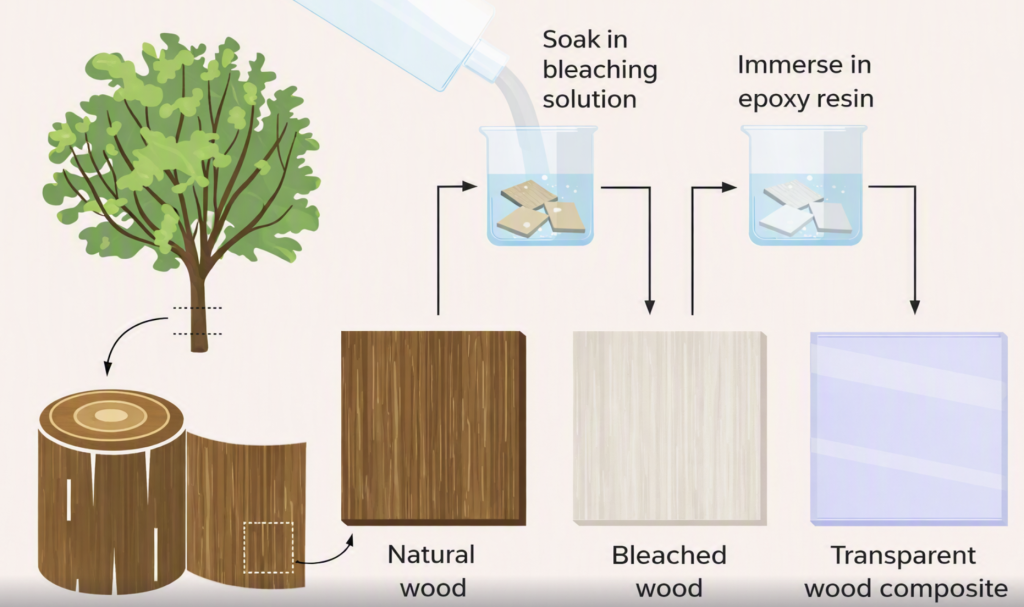
To make wood transparent, scientists need to remove much of the lignin. As seen in Figure 1, The delignification process can involve chemicals such as hydrogen peroxide combined with UV light, to break down the lignin (Hai et al. 2025). The wood’s color then becomes much lighter, while the cellulose framework stays intact. This remaining framework provides the wood with most of its natural strength and structure. The remaining spaces can then be filled with a transparent epoxy resin, often under vacuum to ensure the polymer penetrates the wood structure. By matching the refractive index of the cellulose and polymer, light is scattered less, transforming ordinary wood into a transparent composite.
At its core, the entire procedure relies on the refractive index. In ordinary wood, differences between the refractive indices of wood and air cause light to scatter. Filling these spaces with a polymer of similar refractive index reduces the difference between mediums, which in turn lessens scattering and allows more light to pass through.
So, what would transparent wood be useful for? Its combination of strength and light transmission could make it useful substitution for windows, or any application where glass is conventionally used (Mariani 2024). Additionally, unlike glass, transparent wood can also grant better thermal insulation while remaining lightweight, which finds several applications in housing .
However, being made from wood does not automatically make transparent wood environmentally friendly. Producing it requires chemical treatments, energy, and synthetic polymers, creating environmental impacts of its own. Advances utilizing green chemistry could reduce these impacts over time, improving transparent wood’s potential to be an increasingly sustainable alternative (Malucelli 2022). Accounting for production, processing, transportation, use, and disposal is important because improvements at one stage may be offset by environmental impacts elsewhere. Considering wood’s entire life cycle can give a more complete picture of whether transparent wood can be a sustainable alternative.
Overall, the interesting question is not whether wood can be made transparent, but if its applications to replace glass will truly improve lives, both physically and environmentally.
References
Hai, Le Van, Narayanan Srikanth, Tin Diep Trung Le, Seung Hyeon Park, and Tae Hyun Kim. 2025. “Transparent Wood Fabrication and Applications: A Review.” Molecules 30 (7): 1506. https://doi.org/10.3390/molecules30071506.
Jude Coleman. 2023. “Why Scientists Are Making Transparent Wood.” Popular Science, December 14. https://knowablemagazine.org/article/technology/2023/why-scientists-are-making-transparent-wood.
Mariani, Alberto. 2024. “Transparent Wood-Based Materials: A New Step Toward Sustainability and Circularity.” Next Materials 5 (May): 100255–55. https://doi.org/10.1016/j.nxmate.2024.100255.
Giulio Malucelli. 2022. “Transparent Wood-Based Materials: Current State-of-the-Art and Future Perspectives.” Materials 15 (24): 9069. https://doi.org/10.3390/ma15249069.
Zhang, Jingfa, Ahmed Koubaa, Yubo Tao, Peng Li, and Dan Xing. 2022. “The Emerging Development of Transparent Wood: Materials, Characteristics, and Applications.” Current Forestry Reports 8 (4): 333–45. https://doi.org/10.1007/s40725-022-00172-z.


Leave a Reply
You must be logged in to post a comment.