Science laboratories are essential for innovations and discovery, however, are also major contributors to environmental harm and excess waste (Cimprich et al. 2026). Equipment used in labs may consume large amounts of energy throughout their lifespan, such as refrigerators and pumps (Cimprich et al. 2026). High amounts of energy may also be used in equipment production, such as electron microscopes (Cimprich et al. 2026). Energy consumption can vary based on usage, sustainability effors, and other factors (Cimprich et al. 2026).
Plastic disposable equipment is also heavily used and leads to high amounts of waste (Hood et al. 2026). This is highlighted in calorimetry labs, where disposable polystyrene is frequently used by large amounts of students (Hood et al. 2026). Polystyrene is widely used due to its cost efficiency, stability in thermodynamics, and high availability, however, contributes to landfill, and is environmentally harmful to produce (Hood et al. 2026). 3D printed calorimeters are an option being considered to address environmental demands, while still meeting the needs of calorimetry experiments (Hood et al. 2026).
These 3D printed calorimeters would use material that is biodegradable and recyclable, such as bioplastic polylactic acid and polypropene, which can be recycled for further 3D printing purposes, or composted in industrial settings (Hood et al. 2026). Additionally, polylactic acid is derived from more sustainable sources, such as sugarcane, which lowers the environmental impacts from production (Hood et al. 2026).
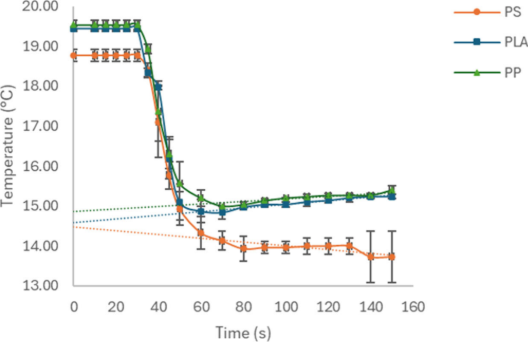
These 3D printed calorimeters may also enhance the lab efficiency, as the 3D printed models are optimized for these experiments (Hood et al. 2026). They also provide the added pedagogical benefit of having students understand the environmental impacts that laboratory experimentation has, while promoting sustainable lab practices (Hood et al. 2026). As shown in Figure 1, polypropene (PP) and polylactic acid (PLA) gathered results that were not significantly different than polystyrene (PS).
Another area of plastic waste commonly found in labs is micropipette tips, which are primarily disposable after a single use due to risk of contamination from reuse (Vaughan et al. 2025). Replacing single use pipettes to ones with multiple uses and using a washing protocol can greatly reduce the amount of laboratory waste (Vaughan et al. 2025). A four-wash protocol was shown to reduce the chemical contamination of over 100 different trace contaminants, and pipette tips can withstand up to 40 reuses, which drastically cuts the amount of plastic waste (Vaughan et al. 2025). Additionally, a solvent of ethanol and water was shown to be effective at both cleaning and minimizing degradation to the pipette tip, while also being a sustainable option to use (Vaughan et al. 2025).
Overall, by implementing sustainable chemistry practices of reducing waste, using safer chemicals, and using biodegradable materials, scientific laboratories can reduce their environmental impact. Sustainable chemistry has contributed to executing these practices through finding alternate materials to harmful ones, and washing procedures to support reuse, supporting sustainability within labratory experimentation!
References
Cimprich, Alexander, Sahand Kasaeipour, and Steven B. Young. 2026. “Environmental Impacts of Laboratory and Scientific Equipment: Focus on Equipment Operation and Procurement.” PLOS Sustainability and Transformation 5, no. 8: e0000271. https://doi.org/10.1371/journal.pstr.0000271.
Hood, Happiness Kagiso, Elize Smit, and Charmaine Arderne. 2026. “Sustainable and Cost-Effective 3D-Printed Calorimeters for Undergraduate Laboratory Experiments.” Journal of Chemical Education 103, no. 6: 3432–3436. https://doi.org/10.1021/acs.jchemed.5c00957.
Vaughan, Amber, Yassir El Hadri, Juditha Gurumurthy, William Francis, Margarita White, Eric Auyang, Stephanie Wright, Leon P. Barron, and Helena Rapp-Wright. 2025. “Reuse of Consumable Pipette Tips for Large-Scale Trace Analysis of Contaminants of Emerging Concern in Wastewater.” RSC Sustainability 3, no. 12: 5470–5485. https://doi.org/10.1039/d5su00644a.


Leave a Reply
You must be logged in to post a comment.