Music is ubiquitous in today’s world. It’s used in advertising, movies and film, and in establishments to influence people’s mood. People listen to music while they commute, while they work out, while they clean… So is there a reason people are drawn to and influenced by melodies so much?
Charles Darwin’s theory of natural selection, or “survival of the fittest”, is well-known in the scientific world; indeed, it is the basis upon which many modern biological assumptions are made. However, it is not the only publication relating to evolution he wrote. One of his other writings explains his theory of sexual selection—the way animals (in this case, humans) have historically chosen partners—and, specifically, how one of these ancient factors could be the reason humans nowadays have such an affinity for music.
In The Descent of Man, and Selection in Relation to Sex, one of Darwin’s publications, he asserts that music was likely a form of courtship in early humans (similar to how birds ‘sing’ to attract mates). He believed this was what eventually evolved into spoken words (Darwin 1871). If this is the case, it would imply that humans have been wired to respond to melodic sounds for millennia.
Building on this theory, Marin and Rathgeber (2022) conducted a study where they played different types of music for participants and asked them to rate the attractiveness of photos of different people afterward. The researchers found that, on average, the attractiveness ratings the participants gave were higher than those of the control group, no matter what kind of music was heard.
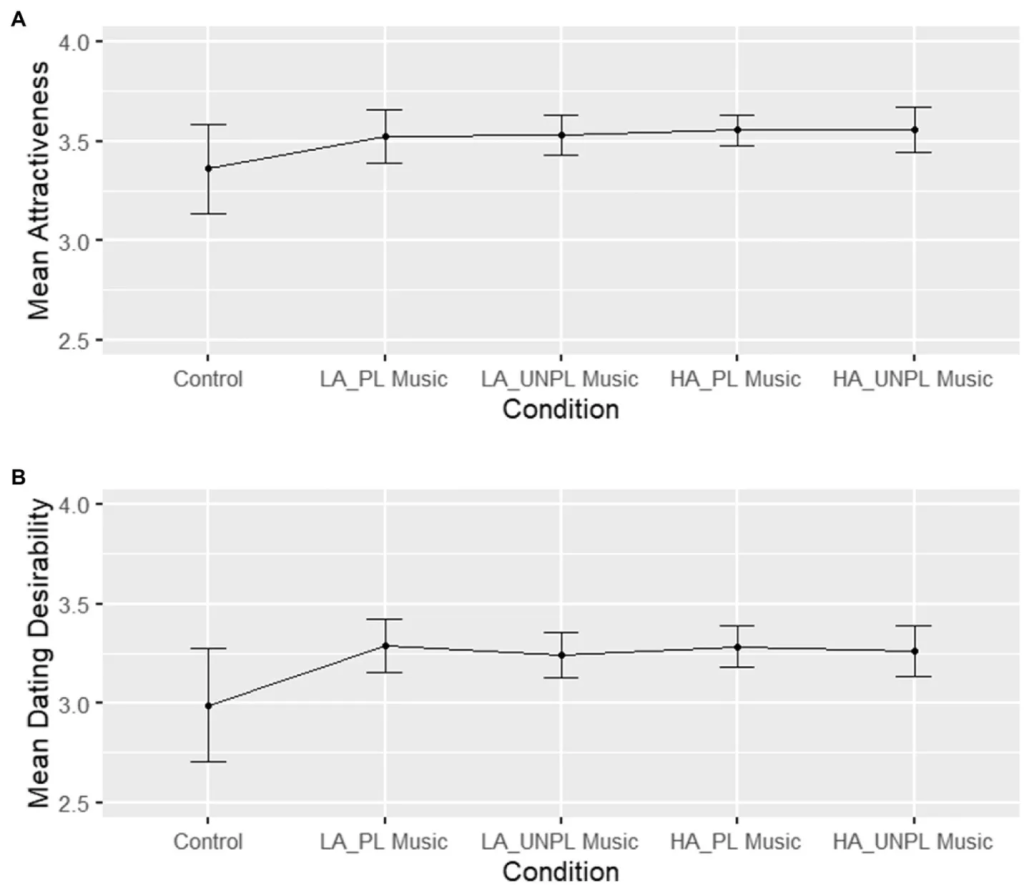
This figure shows the control group vs. participant groups’ answers.
Marin and Rathgeber’s study was based on another from 2017, which showed similar results (Marin et al., 2017)—namely, that the perceived musicality of another person increases one’s attraction to them. This supports Darwin’s theory about music and mating. That isn’t the only way music affects humans, however…
Neuroscientists at Stanford are experimenting with using music to improve the efficiency of transcranial magnetic stimulation (TMS). TMS is a relatively new technique, used both for brain research and to help with certain mental health conditions (such as depression or OCD) where neurons may not fire the ‘correct’ way. Essentially, nerve cells in the brain are stimulated via electromagnetic pulses to encourage normal activity (Healthline, 2024). These scientists discovered that if they play music, participants’ brainwaves synchronize with the beat. This makes it easier to time the pulses to improve the efficiency of the TMS (Collins, 2025). So far, this has only been used for research, but they are confident that it can be used for mental health as well.
These studies, and almost certainly more, imply that humans are intrinsically tied to music in some way. It affects the way we think, how we view others, and even the way our brainwaves move. It’s not known if Darwin was correct about why humans evolved to be so affected by music—it’s just one of many theories about this—but it’s undeniable that we are.
Citations:
Collins, Nathan. 2025. “Groove is in the brain: Music supercharges brain stimulation.” Wu Tsai Neurosciences Institute, September 22. https://neuroscience.stanford.edu/news/groove-brain-music-supercharges-brain-stimulation.
Darwin, C. R. 1871. The Descent of Man, and Selection in Relation to Sex.
Healthline. 2024. “What You Need to Know About Transcranial Magnetic Stimulation (TMS) Therapy.” Last updated August 5. https://www.healthline.com/health/tms-therapy.
Marin, M., and Ines Rathgeber. 2022. “Darwin’s sexual selection hypothesis revisited: Musicality increases sexual attraction in both sexes.” Frontiers in Psychology (13). https://doi.org/10.3389/fpsyg.2022.971988.
Marin, M., Raphaela Schober, Bruno Gingras, and Helmut Leder. 2017. “Misattribution of musical arousal increases sexual attraction towards opposite-sex faces in females.” PLoS ONE 12(9): e0183531. https://doi.org/10.1371/journal.pone.0183531.


Leave a Reply
You must be logged in to post a comment.