If I asked you what colour the ocean is, you would probably say blue. After all, this is a fundamental truth that we’ve been taught since we were children. Trees are green, fire trucks are red, and the ocean is blue. But how do we know if we are all perceiving the same colours? In other words, is your blue my blue?
Looking at the biology of our eyes, we should all see the same colours. Our eyes contain photoreceptors called rods and cones, which are specialized cells that take in light information from the world and convert it into electrical signals that travel to our brains. Rods make up most of the photoreceptors in our eyes, far outnumbering the cones. They are more sensitive in dim light, while cones are more sensitive in daylight. There are three types of cones which can detect blue, green, and red wavelengths. The visible light spectrum we are able to see is the result of the overlap of detectable wavelengths between these three types of cones (Nguyen et al. 2023).
It is from this where differences in colour perception may arise, as although our cones may see the same wavelength, it is our brains which interpret this information. This can be influenced by physical factors, such as the density of lens and macular pigments, which may absorb short-wavelength light before it reaches the photoreceptors (Emery and Webster 2019).
Moreover, colour perception may be influenced by behaviour, as demonstrated by “The Dress”, a picture that went viral in 2015 for splitting opinions on whether it was blue and black or white and gold (see Figure 1).
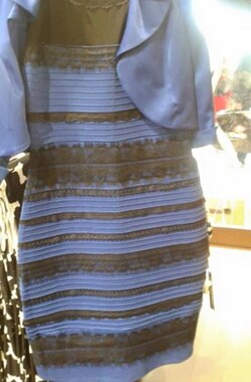
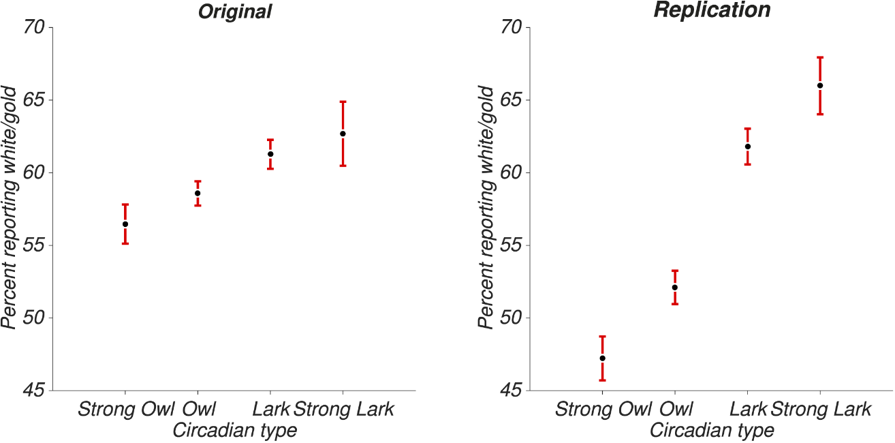
Experts were able to determine that the main reason for the disagreement in colour was due to differences in the perceived lighting, and one study proposed that this could be explained by circadian behaviour. In this study, participants were asked whether they identified as a “lark” (an early riser and early sleeper), or an “owl” (a late riser and late sleeper), and how this corresponded to what colour of dress they saw (see Figure 2).
To try and determine the cause for this correlation, participants were then asked whether they believed the photo was taken in artificial or natural light (see Figure 3), then about how their circadian type corresponded to seeing artificial light (see Figure 4).
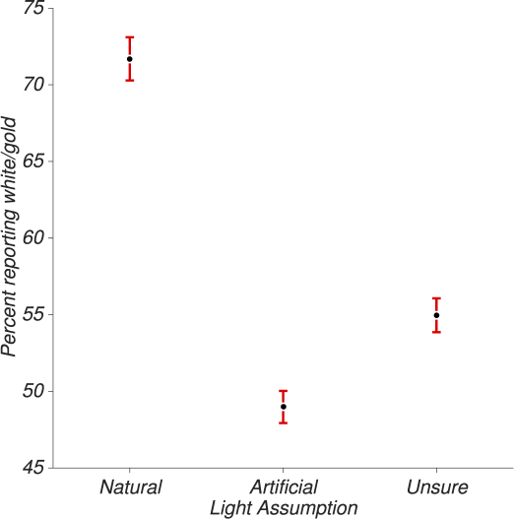
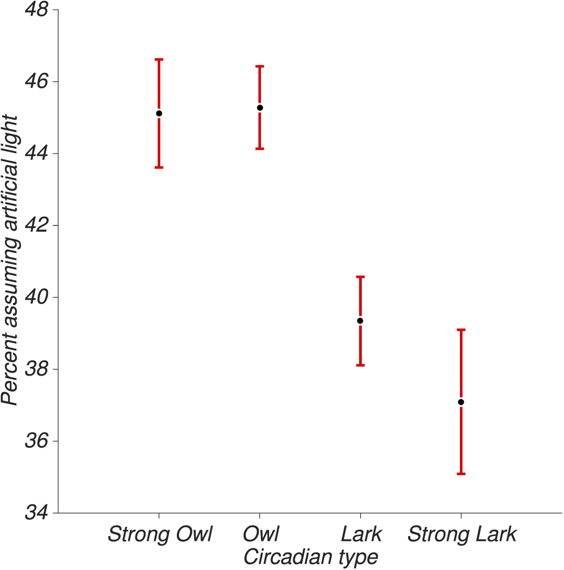
From this, it was concluded that larks assumed the photo was taken in natural light, corresponding to a white/gold dress colour, while owls assumed the photo was taken in artificial light, leading to a black/blue dress colour (Wallisch 2017).
Going back to the original question, we can see that although our eyes may take in the same wavelengths, our brains may interpret them in different ways, depending on things like behaviour, as seen in “The Dress” example. So, it may very well be that when we look at the ocean, your blue is not my blue.
References
Emery, Kara J., and Michael A. Webster. 2019. “Individual differences and their implications for color perception.” Current Opinion in Behavioral Sciences30: 28-33. https://doi.org/10.1016/j.cobeha.2019.05.002.
Nguyen, Kevin H., Bhupendra C. Patel, and Prasanna Tadi. 2023. “Anatomy, Head and Neck: Retina.” StatPearls Publishing. https://pubmed.ncbi.nlm.nih.gov/31194472/.
Wallisch, Pascal. 2017. “Illumination assumptions account for individual differences in the perceptual interpretation of a profoundly ambiguous stimulus in the color domain: “The dress.” Journal of Vision17 (4): 5. https://doi.org/10.1167/17.4.5.


Leave a Reply
You must be logged in to post a comment.