The entire world is made up of tiny entities known as atoms. These are not something you or I could ever see directly; however, despite this, they make up every aspect of our lives, including you. Atoms consist of a nucleus filled with protons and neutrons, with electrons orbiting this inner core. These are referred to as subatomic particles. Protons are positively charged while electrons are negatively charged, allowing for many attraction properties within and amongst atoms. Conversely, neutrons are neutrally charged and help stabilize atoms; however, if their number becomes incongruent, the atom can become erratic, forming what we call an Isotope.
An isotope is an atom of a given element that has the proper number of protons, but an irregular number of neutrons (Figure 1; Nuclear @ McMaster 2018). An atom can become an isotope naturally through decay or artificially in a lab through processes such as fission (IAEA 2023; Canadian Nuclear Safety). Fission involves an atom being struck by a neutron, causing it to split into two or more daughter nuclei while releasing large amounts of energy and additional neutrons that continue the chain reaction. These daughter nuclei and the energy produced can then be harnessed and manipulated for various forms of medical research.
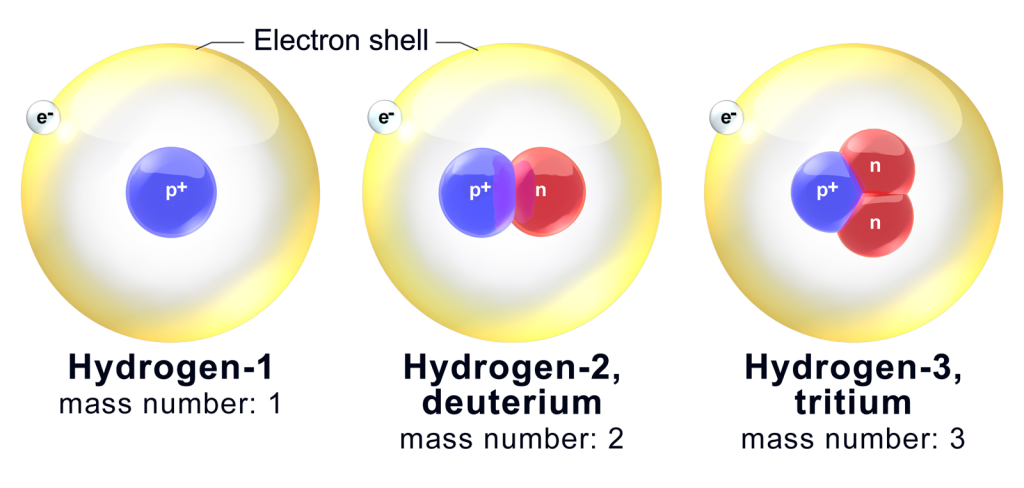
Figure 1. Exemplary figure showing hydrogen isotopes. As you move to the right, the number of protons remains constant while the number of neutrons increases, demonstrating how isotopes of the same element differ only in neutron number.
Having been established in 2001, the Bruce Power Plant, located in the municipality of Tiverton, Ontario, is Canada’s only private sector nuclear generator, supplying Canada with 30% of its overall energy (Bruce Power 2026). In recent years, Bruce Power has been harnessing the medical isotopes formed during fission, a major development in the biological field. Bruce Power specializes in the formation of Cobalt-60, which naturally radiates gamma rays that have shown benefits in cancer research (Bruce Power 2026).
More specifically, Bruce Power mines non-reactive Cobalt-59 as this is the parent atom for Cobalt-60 (Bruce Power 2025). As seen in Figure 2, specially designed adjuster rods of Cobalt-59 are lowered into Bruce Power’s nuclear reactors while the uranium fission chain reaction proceeds.
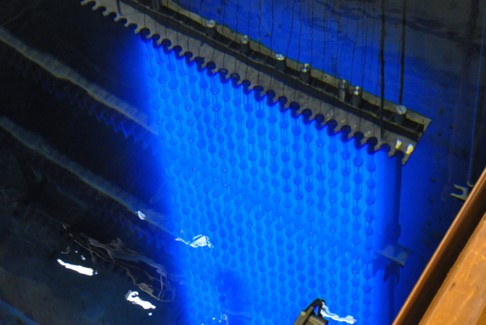
Figure 2. Cobalt-59 adjuster rods held within the nuclear reactor. Excess neutrons produced during uranium fission activate the conversion of stable cobalt-59 into cobalt-60.
Cobalt-60 has been at the forefront of current cancer research (Dyk 2020). For brain and breast cancers, Cobalt-60 therapy allows for the delivery of high-dose radiation to tumors while limiting damage to surrounding healthy tissue and organs (Bruce Power 2023; Carolyn 2016). Because of this, gamma radiation has been considered one of the most precise forms of radiation available. The Gamma Knife specifically is a new development in cancer surgeries, being a non-invasive tool (Bruce Power 2023). In gamma ray radiosurgery, specialized equipment focuses approximately 200 tiny beams of radiation on a cancerous target. Individually, these beams have little to no effect, allowing surrounding healthy tissue to remain virtually unaffected; however, together they deliver a strong dose of radiation where they intersect. More specifically, the cobalt-60 system has been designed to deliver radiation in a spherical pattern, surrounding the entire tumor (Zhu 2010). With the use of multiple systems, irregularly shaped tumors can be treated as well.
As the world of nuclear energy continues to grow, scientists are working to harness its byproducts into effective solutions to worldly issues like cancer. Gamma Knife Radiosurgery provides a one-time therapy, with treatment being completed in a single day, allowing for less time spent in hospitals and a quicker recovery. Thus, not only has Bruce Power provided effective, clean energy, but it has also birthed an entirely new method towards effective cancer research.
Works Cited
Brown, Carolyn. “Will New Isotope Sources Be Ready in Time?” Canadian Medical Association Journal, vol. 188, no. 4, 25 Jan. 2016, pp. 252–252, 10.1503/cmaj.109-5224.
Bruce Power. “Cobalt-60 – Bruce Power.” Bruce Power, 2025, https://www.brucepower.com/isotopes-and-medical-innovation/cobalt-60-isotopes/.
“Bruce Power Cobalt-60 Harvest Builds on Innovation and Partnerships, Strengthens Canada’s Role as Medical Isotope Superpower.” Bruce Power, 31 Mar. 2026, https://www.brucepower.com/2026/03/31/bruce-power-cobalt-60-harvest-builds-on-innovation-and-partnerships-strengthens-canadas-role-as-medical-isotope-superpower/.
Commission, Canadian Nuclear Safety. “What Is Radiation?” Cnsc-Ccsn.Gc.Ca, 2019, https://www.cnsc-ccsn.gc.ca/eng/nuclear-safety-security/educational-resources/radiation/what-is-radiation/.
“Delivering Transparency and Trust – Bruce Power.” Bruce Power, https://www.brucepower.com/who-we-are/delivering-transparency-and-trust/.
Van Dyk, J., Battista, J. J., & Almond, P. R. (2020). A retrospective of cobalt-60 radiation therapy: the atom bomb that saves lives. Med Phys Int J, 4, 327-50.
Galindo, Andrea. “What Is Radiation?” IAEA, International Atomic Energy Agency, 25 Jan. 2023, https://www.iaea.org/newscenter/news/what-is-radiation.
“What Is an Isotope? – Nuclear @ McMaster.” Nuclear @ McMaster, 30 Aug. 2018, https://nuclear.mcmaster.ca/resources/make-a-radioisotope/.
Zhu, Dengsong, et al. “Study of a Spherical Phantom for Gamma Knife Dosimetry.” Journal of Applied Clinical Medical Physics, vol. 11, no. 2, Mar. 2010, pp. 222–229, 10.1120/jacmp.v11i2.3130.


Leave a Reply
You must be logged in to post a comment.