Can A Forest Remember? How the Past Shapes What Grows Back

Imagine walking through a forest right after a wildfire. The trees are burnt, the ground is covered in ash, and almost everything that made the forest feel alive seems to be gone. Looking at it, you might assume that whatever grows next has to start completely from scratch. Surprisingly, that is not really what happens. Even after a major disturbance, pieces of the old forest can stick around and influence what comes next. Ecologists actually have a term for this: ecological memory (Johnstone et al. 2016).

Obviously, forests do not have brains, so what exactly are they “remembering”?

Instead of memories being stored in neurons, a forest’s past can be stored in things like surviving plants, roots, nutrients, and even seeds hiding underground. Johnstone et al. (2016) describe some of these as material legacies. There are also information legacies, which include traits that have helped species survive disturbances in the past. For example, some trees have cones that can protect seeds and release them after a fire. The tree is definitely not thinking, “I remember what happened last time.” But the traits left behind from generations of dealing with fire can affect how the forest responds today.

The part I found most interesting, though, is what can be hiding underneath our feet. Reed et al. (2025) studied how fire, gaps in the forest canopy, and deer affected a forest seed bank. Even 13 years after the experiment began, the different disturbances were still linked to differences in the seeds found underground. Even stranger, what researchers found in the seed bank did not completely match the plants they could see growing above ground (Reed et al. 2025). Basically, you could look at a forest and still be missing part of its history because some of it is buried in the soil.
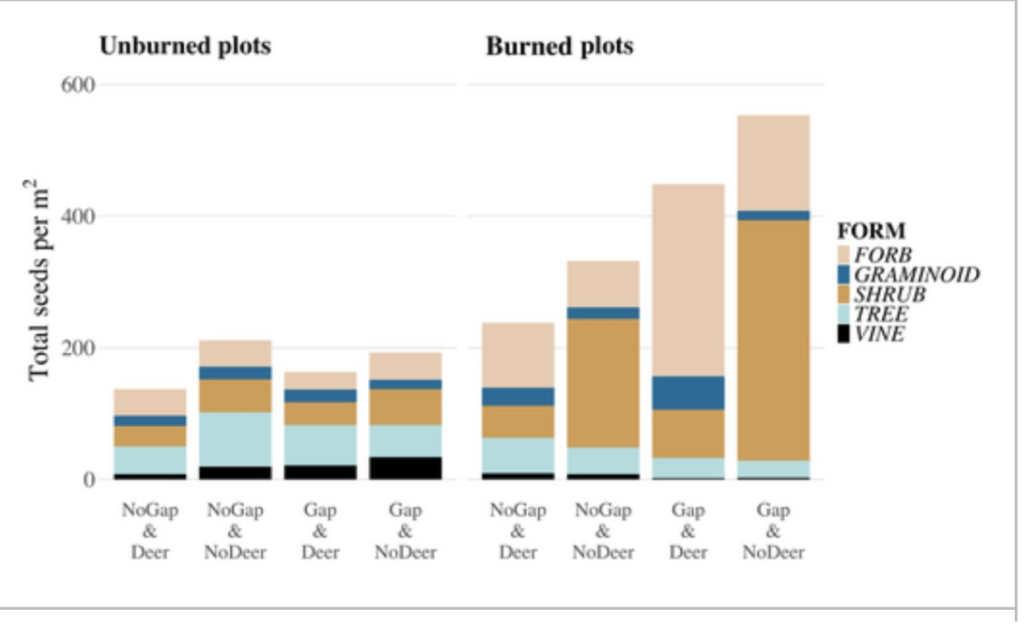
Figure 1. Seed abundance and plant types found in forest seed banks after different combinations of fire, canopy gaps, and deer exposure (Reed et al. 2025).

As Figure 1 shows, the seeds left underground looked very different depending on what that part of the forest had experienced, showing how a disturbance can leave a biological trace years later.

But there is a catch. Remembering the past is only helpful when the future is somewhat similar. Climate change is altering things like the frequency and severity of forest disturbances, meaning forests can experience conditions that are very different from what they experienced historically (Johnstone et al. 2016). If a fire becomes intense enough to destroy the seeds, organisms, or soil conditions that normally help a forest recover, some of that ecological “memory” can disappear with it.

So, can a forest actually remember? Not in the way we can. But a forest is not starting with a blank page every time it is disturbed either. Its past can remain buried in its soil, written into the traits of its species, and carried by whatever survives. And with environments changing so quickly, maybe the bigger question is: what happens when a forest remembers a world that no longer exist.

References

Johnstone, Jill F., et al. 2016. “Changing Disturbance Regimes, Ecological Memory, and Forest Resilience.” Frontiers in Ecology and the Environment 14 (7): 369–378.

Reed, Samuel P., et al. 2025. “Multiple Disturbances, Multiple Legacies: Fire, Canopy Gaps and Deer Jointly Change the Forest Seed Bank.” Journal of Ecology 113: 353–370.

Comments

5 Responses to “Can A Forest Remember? How the Past Shapes What Grows Back”

  1. Nastaho Mohamed Avatar
    Nastaho Mohamed

    Hi Isci, I chose this topic because biodiversity is something we’ve been exploring recently, and I wanted to look further into why it is important and how it can be affected by different factors. I was especially interested in connecting what we’ve learned to real-world ecosystem
    and environmental changes.
    Looking forward to hearing your thoughts!
    – Nastaho Mohamed

  2. Swetha Subramanian Avatar
    Swetha Subramanian

    Hi Nastaho,

    This is a very cool topic, and I like the way you started the blog with a hook to captivate the readers! Some suggestions I have for you are:

    – In the last phrase where you say: “what happens when a forest remembers a world that no longer exist”, add a question mark at the end instead of a period. Moreover, you should replace the word “exist” with “exists.”
    – Bold the References and Figure title sections
    – To make the blog a bit more formal, I’d rewrite the phrase: “The tree is definitely not thinking…” into something like “The tree could never recall…”

    Overall, great work, and I’m looking forward to reading your final draft!

    – Swetha S

  3. Chloe Logan Avatar
    Chloe Logan

    Hi Nastaho,

    What a wonderfully written blog post! I absolutely love the rhetorical question in the title as it really captured my attention. I have a few suggestions for you to consider:

    – I recommend including the sentence “Obviously, forests do not have brains, so what exactly are they “remembering”?” in your introduction paragraph. A one-sentence paragraph is not commonly seen in academic writing.
    – If you include a figure, you must reference it in the text before the figure is seen. Therefore, move your “As Figure 1 shows…” paragraph above the figure.
    – On the topic of figures, yours is slightly blurry. I recommend taking a screenshot instead of copy-pasting directly from the article (this works best for me). Also, figure captions are normally in italics.
    – Overall, I would try to find more sources to strengthen your argument. That being said, the sources you do have are very strong and come from reputable journals (Sci Lit would be happy!)

    I really enjoyed reading your post! Now, if you were to ask me the question “can forests remember?” I would response yes, they can 🙂

    Happy editing,
    Chloe

  4. Zahra Imthiyas Avatar
    Zahra Imthiyas

    Hey Nastaho!

    Your choice of topic was so interesting! I really enjoyed reading your blog post, it definitely taught me something new. Some suggestions I have are:

    – I would recommend using more complex transitional words at the beginning of your sentences. Words such as “however” and “additionally” could help enhance the flow of your writing.
    – In p4, two consecutive sentences start with “even,” which can feel a little repetitive. I’d recommend changing one of them to a synonym or rephrasing the sentence to make the paragraph flow more smoothly.

    Overall great blog post! Have fun editing. 🙂

    – Zahra Imthiyas

  5. Abbie Johnston Avatar
    Abbie Johnston

    Hi Nastaho,

    This is such a good blog post. I think this is a really cool topic that you chose. I just have a couple of suggestions for you.

    1. This sentence “Looking at it, you might assume that whatever grows next has to start completely from scratch” needs to be cited.
    2. I think this sentence “Obviously, forests do not have brains, so what exactly are they “remembering”?” should be in the paragraph above.
    3. This sentence “Instead of memories being stored in neurons, a forest’s past can be stored in things like surviving plants, roots, nutrients, and even seeds hiding underground. Johnstone et al. (2016) describe some of these as material legacies.” I would put the citation at the end in brackets not in the middle of the sentence.
    4. This sentence, “There are also information legacies, which include traits that have helped species survive disturbances in the past,” needs to be cited.
    5. This sentence, “Even 13 years after the experiment began, the different disturbances were still linked to differences in the seeds found underground. I wouldn’t bold the text. It also needs to be cited.
    6. Lastly, for your figure, I would make sure to cite your figure in your writing before the figure appears in the text. So I would move the figure down one paragraph so it is cited before it is shown.
    Overall great work!
    Happy Editing!
    -Abbie

Leave a Reply