Are Panama’s Shrimp Telling Time Right?

A small strip of land between the Atlantic and Pacific ocean might seem like an odd place to look for answers about evolution. But, the Isthmus of Panama is considered to be one of the most important pieces of evidence in questions that involve the triggering of the last Ice Age, the separation of marine species, global ocean current circulation, and even the land connection between North and South America (O’Dea et al. 2016). Unfortunately, there is one problem. Scientists can’t necessarily agree on when the isthmus formed.

The isthmus was thought to have closed relatively rapidly around three million years ago (Ma), based on converging biological and geological evidence. Subduction of the Pacific Plate under the Caribbean Plate caused an underwater volcanic chain known as the Panama arc, which ended up moving westward with the movement of the South American Plate. This eventually closed the Central American Seaway and enabled the Great American Biotic Interchange, a massive land mammal migration (Stehli and Webb 1985, chaps. 2, 4, 5, 12). Additionally, seafloor cores showed that marine fossils (foraminifera) on either side of Panama began speciating 3.5 Ma (Keigwin 1978).

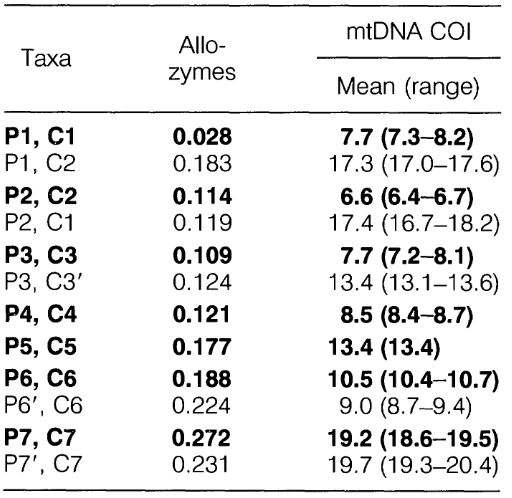
By the 1990s though, advances in molecular techniques allowed scientists to investigate whether the isthmus had formed gradually rather than all at once. One approach was to study marine species on opposite sides of the isthmus. The new land bridge that formed separated populations that had shared the same seaway, an example of allopatric speciation (Scott, 1916). As the newly isolated population accumulated genetic differences through mutation, natural selection, genetic drift, and gene flow, scientists could work backwards to estimate when they diverged. In 1993, a study comparing genetic differences in pairs of closely related snapping shrimp (Alpheus) on either side of the isthmus helped scientists estimate how long they had been evolving separately (Table 1). The findings were that some of the populations had diverged millions of years before the traditional 3 Ma timeline (Knowlton et al. 1993, 1629-32).

Table 1. Genetic divergence between seven pairs of snapping shrimp (Alpheus) from opposite sides of the Isthmus of Panama, measured using allozyme and mitochondrial DNA comparisons (Knowlton et al. 1993, 1630).

This evidence was one of several findings that challenged the original theory that the Isthmus of Panama closed relatively suddenly around 3 Ma (Bacon et al. 2015; Coates et al. 2013). Another clue came from uranium-lead dating technology which was not available previously. Researchers found minerals called zircons originating from Panama in sedimentary rocks dating back 13 to 15 Ma. Since these minerals could have been transported there by rivers flowing from the Panama arc, this means that parts of the isthmus had already emerged above sea level and had become connected to South America much earlier than previously thought (Montes et al., 2015).
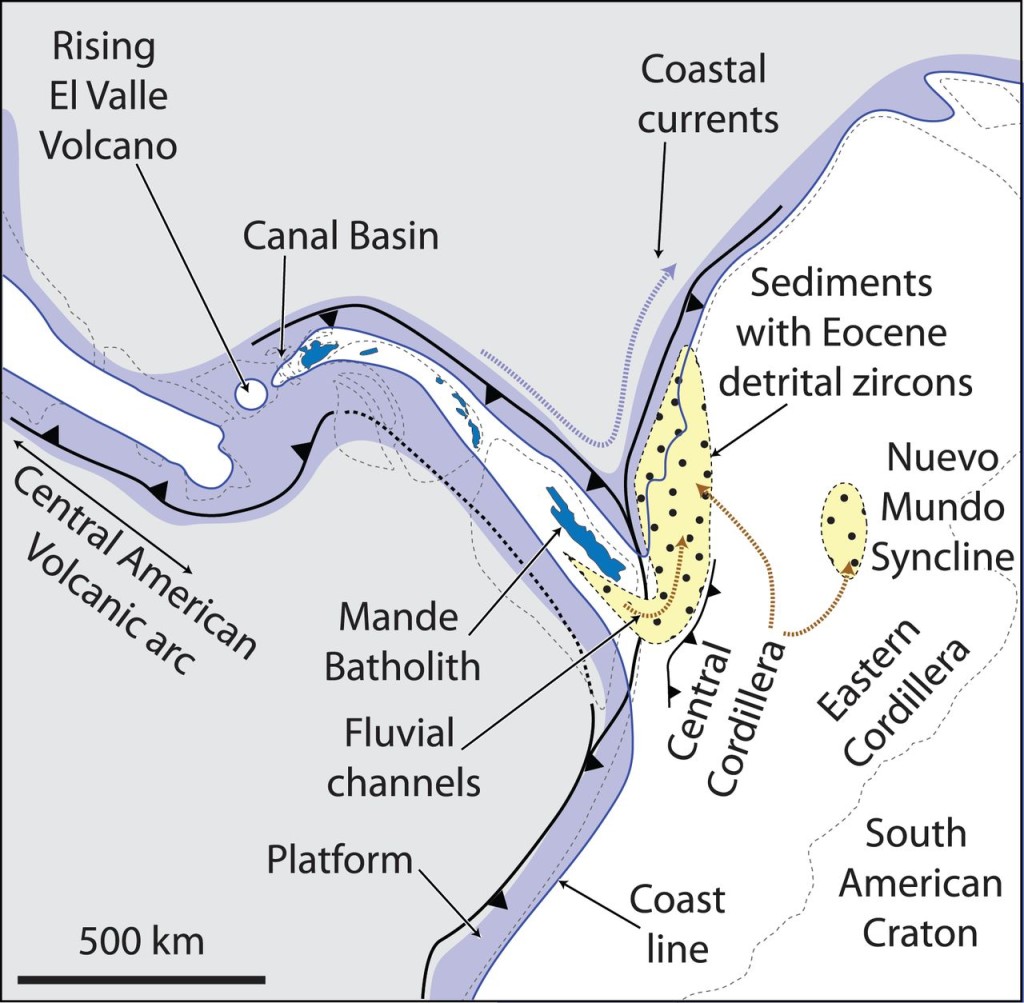
Figure 1. Reconstruction of the Panama arc and northwestern South America during the middle Miocene (13 to 15 Ma), which shows the region’s geography and zircon deposits during an earlier stage of the formation. At least a segment of the Panama arc had emerged meaning the isthmus did not quickly solidify or close 3 Ma (Montes et al., 2015).

So, are Panama’s shrimp telling time right? They’re not necessarily wrong, but each piece of evidence is telling a different part of the story. The shrimps’ genetic differences were recorded when populations had begun evolving separately (3 Ma), but zircon deposits revealed how early parts of Panama had emerged and connected with South America (13-15 Ma). Neither provides a single date for the formation of the entire isthmus. Instead the evidence points to a staggered development of the land bridge, with the scientists having to work out when the process started, when the marine populations separated, and finally, when and how the isthmus actually got to its present form.

References

Bacon, Christine D., Daniele Silvestro, Carlos Jaramillo, Brian Tilston Smith, Prosanta Chakrabarty, and Alexandre Antonelli. “Biological Evidence Supports an Early and Complex Emergence of the Isthmus of Panama.” Proceedings of the National Academy of Sciences 112, no. 19 (2015): 6110–15. https://doi.org/10.1073/pnas.1423853112.

Coates, Anthony G., and Robert F. Stallard. “How Old Is the Isthmus of Panama?” Bulletin of Marine Science 89, no. 4 (2013): 801–13. https://doi.org/https://doi.org/10.5343/bms.2012.1076.

Knowlton, Nancy, Lee A. Weight, Luis Aníbal Solórzano, DeEtta K. Mills, and Eldredge Bermingham. “Divergence in Proteins, Mitochondrial DNA, and Reproductive Compatibility Across the Isthmus of Panama.” Science 260, no. 5114 (1993): 1629–32. http://www.jstor.org/stable/2881712.

Keigwin, Lloyd D. “Pliocene Closing of the Isthmus of Panama, Based on Biostratigraphic Evidence from Nearby Pacific Ocean and Caribbean Sea Cores.” Geology 6, no. 10 (1978): 630. https://doi.org/10.1130/0091-7613(1978)6%3C630:PCOTIO%3E2.0.CO;2.

Montes, C., A. Cardona, C. Jaramillo, et al. “Middle Miocene Closure of the Central American Seaway.” Science 348, no. 6231 (2015): 226–29. https://doi.org/10.1126/science.aaa2815.

O’Dea, Aaron, Harilaos A. Lessios, Anthony G. Coates, et al. “Formation of the Isthmus of Panama.” Science Advances 2, no. 8 (2016): e1600883. https://doi.org/10.1126/sciadv.1600883.

Scott, W. B. “The Isthmus of Panama in Its Relation to the Animal Life of North and South America.” Science 43, no. 1100 (1916): 113–24. http://www.jstor.org/stable/1640614.

Stehli, Francis G., and S. David Webb. 1985. The Great American Biotic Interchange. Plenum Press.

Comments

9 Responses to “Are Panama’s Shrimp Telling Time Right?”

  1. Mansi Bhandari Avatar
    Mansi Bhandari

    Hi iSci, I chose this topic because I thought it was very relevant to the evolution unit we’re doing in LifeSci, especially the part about allopatric speciation. Many marine populations were separated by the formation and complete closing of the isthmus and they’ve evolved in very different ways. Additionally, I connected the plate tectonics material and dating techniques we’re learning about in Earthsci to a relevant scientific debate that researchers are still working on. Hopefully it’s an interesting read!

  2. Hanna Yip Avatar
    Hanna Yip

    Hey Mansi,

    This is a really well written blog! A couple edits I have:

    – Maybe consider using a figure to show the geographical features (plates) that you described in paragraph 2 so your readers can visualize it better

    – In table 1, explain what is being show in more depth. Especially in the “taxa” column, it is unclear what it is describing from just the figure and your caption. Also explain what the bolded rows signify.

    – In the last sentence of your figure 1 caption, remove the “at least” or rephrase the sentence to make it more concise.

    Happy editing!
    Hanna

  3. Jo Jo Sun Avatar
    Jo Jo Sun

    Hi Mansi, this was a very interesting blog that combined both Earth Science and Life Science and I really enjoyed reading it! Here are some suggestions that will hopefully help you in the editing stage:

    — For your table and figure captions, try to make them smaller to make them stand out. As well, maybe try to make the”references” word bigger and bold.
    – Refer to Figure 1 in your paragraph before showing the figure
    – Just be mindful of punctuations, for example, in P1S3, delete et the comma after “problem” for better flow, in P4S2, add a comma after “technology” in P5S5, add a comma after “instead.”
    -I agree with Hanna to explain your Table 1 caption further

    Cheers,
    Jojo

  4. Harshita Aggarwal Avatar
    Harshita Aggarwal

    Hi Mansi,

    Great job writing your blog post, and such a cool topic!

    – P1S3, I recommend adding an em dash between “Unfortunately, there is one problem —scientists can’t necessarily agree on when the isthmus formed” for better flow.
    – Remember to add your in-text citations for the first two sentences in paragraph 2; if you used the same citation as in sentence 3, the correct format would be to include it in the first sentence and the last (you don’t have to cite anything in the middle)!
    – A few of your in-text citations include a comma between author names and date; Chicago style doesn’t require a comma.

    Good luck on your editing process!
    – Harshita

  5. Saanvi Praveen Avatar
    Saanvi Praveen

    Hi Mansi,

    Great work on your blog post, it was really an interesting read.

    Here are a few feedbacks:
    – P5S1, I would recommend getting rid of the “right” in the question, so it flows better as a question.
    – I would recommend formatting the References as a title to separate it from the rest of the text.
    – In your figure 1 caption, I would recommend removing the word “which” from the sentence “Reconstruction of the Panama arc and northwestern South America during the middle Miocene (13 to 15 Ma), which shows the region’s geography and zircon deposits during an earlier stage of the formation.”
    – As well as rephrase the sentence, “At least a segment of the Panama arc had emerged meaning the isthmus did not quickly solidify or close 3 Ma (Montes et al., 2015)” to Because a segment of the Panama arc had emerged, the isthmus did not quickly solidify or close 3 Ma.

    Other than that, great job on your blog post. Happy editing!
    Saanvi

  6. Laura Forgrave Avatar
    Laura Forgrave

    Hi Mansi,

    This was a really interesting post on a topic I had never even thought about before!
    A couple of suggestions:
    1. I was very confused at the beginning of the post because I did not know what the word “isthmus” meant. A map to show the strip of land that is now Panama, early in the post, would be helpful. If you have the word count to do it, you might also want to add a sentence about how the Panama canal has more recently reconnected the Atlantic and Pacific oceans, but you will be focusing on how they were originally separated.
    2. I agree with Harshita that some more in-text citations earlier in P2 would be helpful. The in-text citation in P2S3 lists 4 chapters, which is a bit vague and does not show which parts of information come from which parts of the book. I would put an in-text citation at the end of P2S1 and try to only refer to the chapters you specifically used for that sentence in the in-text citation. Also, the in-text citation says “Stehli and Webb” but the entry in the reference list names three authors, so double check the authors of that book and keep it consistent throughout.
    3. At the end of paragraph 3, you explain how genetic differences showed that some shrimp populations had diverged long before 3Ma, but in P5S2 you mention that the shrimp populations began to evolve separately 3Ma, contradicting your previous statement. If you are referring to a different study with different findings about shrimp in P5S2, make sure to cite it, otherwise I would edit paragraph 5 to make sure it matches the data presented in paragraph 3. Don’t forget to add some in-text citations in paragraph 5 as well.

    This was a fascinating article! I especially found Figure 1 very helpful to understand the part about how the isthmus could have formed slowly over time.

    Happy editing!
    Laura

    1. Laura Forgrave Avatar
      Laura Forgrave

      So sorry, I just realized that “Francis G.” is the first name of Stehli, not an additional author. Please ignore the last part of my second suggestion.

  7. Swetha Subramanian Avatar
    Swetha Subramanian

    Hey Mansi,

    I really enjoyed reading your article, and I think this is an engaging and interdisciplinary topic! Some suggestions I have for you are:

    – As Laura mentioned, you could maybe include a brief description of what an Isthmus is before delving into the details.
    – I would break up this sentence, “Subduction of the Pacific Plate under the Caribbean Plate caused an underwater volcanic chain known as the Panama arc, which ended up moving westward with the movement of the South American Plate” into two separate bits to make it easier to read.
    – Reword the sentence “The shrimps’ genetic differences were recorded… ” into something like “The genetic divergence between shrimp populations may indicate when they separated from one another.”
    – If you have space to add more, you could include a conclusion that may explain why this topic is important and what future steps scientists might take.

    Overall, great job, and I look forward to reading your final draft!

    – Swetha S

  8. Bohmie Song Avatar
    Bohmie Song

    Hi Mansi,
    This was such a fun blog post! It reminded me of Rodrigo.

    A few suggestions for your edits:
    1. I would suggest consolidating the last two sentences and removing ‘necessarily’ from your last sentence. Something along the lines of ‘The one problem is: scientists can’t agree on when the isthmus formed’.
    2, In P2, I would rewrite it to: ‘Additionally, seafloor cores showed that marine fossils (Foraminifera) began speciating on either side of Panama from 3.5 Ma (Keigwin 1978).’
    3. Also, since Foraminifera is a phylum or class, I would capitalize the F.
    4. I would also remove ‘though’ from P3S1 to improve flow.
    5. Also, I would recheck your citation for Nancy Knowlton. As I believe it should just be (Knowlton et al. 1993).
    6. For your figure captions, there should be an option when you click your image to insert a caption, which might help differentiate your captions from the main text.

    Great blog post! Can’t wait to read the final draft.
    Bohmie

Leave a Reply