Earthquakes are a scary reality for people living on active plate boundaries. Not only does the initial earthquake cause destruction, the secondary events caused by the seismic activity can lead to the evolution of species through allopatric speciation.
Speciation refers to limiting a population’s gene flow by alternating its environment (Harvey 2026, slide 43). The separation of a population via geology is a way this happens (Harvey 2026, slide 47). In particular, earthquakes can have dramatic effects on the evolution of a population. The earthquake itself is not the only factor that leads to speciation; the secondary effects of the earthquake, including surface faulting, fires, and landslides can also decrease a population’s gene flow (Pérez 2026, slides 49, 50, 56).
Allopatric speciation occurs when a new geological feature separates a population (April et al. 2013). This results in a genetically different species to form on the other side of the barrier. Allopatric speciation can happen when surface faulting transpires after an earthquake. Surface faulting, the separation of ground, is caused by surface waves (Pérez 2026, slide 49). Even a small break in the ground can lead to populations being torn apart, resulting in a new species emerging.
Fires can also happen as a result of an earthquake (Pérez 2026, slide 56). For instance, when electrical cables are damaged from the trembling ground, flames can erupt destroying parts of communities and populations. This can lead to allopatric speciation since a thriving population has now been separated by a natural disaster. The more devastation that occurs moves populations farther apart, resulting in species adapting to their new environments (Harvey 2026, slide 47).
Additionally, landslides can happen after an earthquake which causes allopatric speciation (Pérez 2026, slide 50). This natural disaster is the flowing of rock and debris, often down an elevated surface (Gariano and Fausto 2016). Landslides can lead to a new species forming, since the separation can move parts of a population to a new environment. These new conditions cause organisms to adapt in order to survive which leads to evolution.
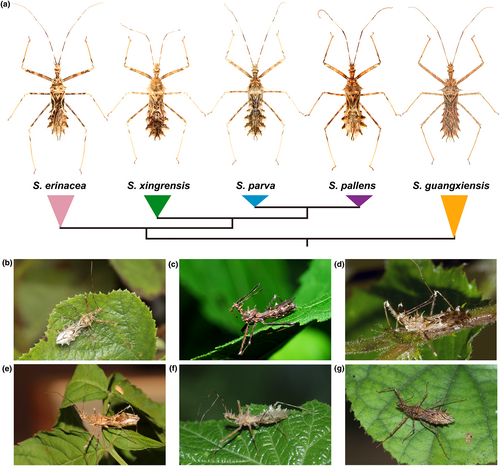
Since the mechanisms of specification lead to changes in allele frequencies in a population over time, it is challenging to identify a current example. However, research has been conducted to study bugs, in particular the genus Sclomina (Du et al. 2023). Scientists have discovered five different species of this genus and have looked into their origins. They have traced the oldest species of the genus to have lived during the Pleistocene, which is a time when ice ages were frequently happening. With this in mind, researchers hypothesize that the evolution of new species of Sclomina (seen in figure 1) could have originated as a result of allopatric speciation from environmental factors during the ice ages (Du et al. 2023). However, they have also noticed that these bugs were not isolated for very long since they could migrate. This goes against allopatric speciation. Although this theory is continuing to be investigated, it will be difficult to create a concrete idea on the evolution of these species, since scientists were not actually present during this time.
Overall, it is evident that the consequences of earthquakes can cause evolutionary changes in populations. Earthquakes not only have direct impacts on societies, but they also have repercussions that can be seen years later.
References
April, Julien, Robert H. Hanner, Anne‐Marie Dion‐Côté, and Louis Bernatchez. “Glacial Cycles as an Allopatric Speciation Pump in North‐eastern American Freshwater Fishes.” Molecular Ecology (Oxford) 22, no. 2 (2013): 409–22. https://doi.org/10.1111/mec.12116.
Chad, Harvey. 2026. “What is Evolution?” PowerPoint presentation, ISCI 1A24, McMaster University.
Du, Zhenyong, Qian Zhao, Xuan Wang, et al. “Climatic Oscillation Promoted Diversification of Spinous Assassin Bugs during Pleistocene Glaciation.” Evolutionary Applications (England) 16, no. 4 (2023): 880–94. https://doi.org/10.1111/eva.13543.
Gariano, Stefano Luigi, and Fausto Guzzetti. “Landslides in a Changing Climate.” Earth-Science Reviews (Amsterdam) 162 (November 2016): 227–52. https://doi.org/10.1016/j.earscirev.2016.08.011.
Pérez, Rodrigo N. 2026. “Earthquakes.” PowerPoint presentation, ISCI 1A24, McMaster University.


Leave a Reply
You must be logged in to post a comment.