Have you ever gone to the doctor after experiencing months of stomach pain and gastrointestinal issues, just for them to tell you to adjust your diet to eat “clean,” and to cut your favourite foods? For over 20 years, the low-FODMAP diet has been the number one suggested treatment for irritable bowel syndrome (IBS). IBS is one of the most prevalent functional gastrointestinal disorders, affecting about 9-12% of individuals globally (Peters et al. 2016), and is characterized by a recurrence of abdominal cramping, gas, bloating, and unpredictable bowel habits, including diarrhea, constipation, or a combination of both. IBS is a chronic health disorder, impacting the quality of patients’ lives considerably (Nathani et al. 2025). However, recent studies suggest a powerful alternative treatment for IBS, called gut-directed hypnotherapy (GDH).
IBS occurs when there is a disruption in the gut-brain axis, causing visceral hypersensitivity, gastrointestinal dysmotility, alterations in gut microbiota, and food intolerances. Additionally, psychosocial factors, like stress, can negatively impact intestine sensitivity and microbiota, and will heighten symptoms (Nathani et al. 2025). Disruption in the gut-brain axis occurs from the signalling between the central nervous system and the enteric nervous system. This happens across various signalling pathways, like the neuronal, endocrine, immune, and metabolic signals. Increased signaling from the central nervous system causes visceral hypersensitivity, and signalling to the intestinal track, causing abdominal discomfort, gas, and diarrhea (Nathani et al. 2025).
Altering one’s diet by eliminating known triggers can improve one’s symptoms substantially, and the low-FODMAP diet is the suggested guideline for those struggling with IBS. In the small intestine, short-chain carbohydrates do not get absorbed easily, which causes fermentation of bacteria in the colonic area. This process ultimately drives severe abdominal pain. Common high-FODMAP foods include, lactose, wheat, stone fruit, legumes, root vegetables, soy, nuts and seeds, processed foods, and much more (Figure 1) (Daley et al. 2026). A low-FODMAP diet is very strict, and for many people, unrealistic to follow for the long-term.
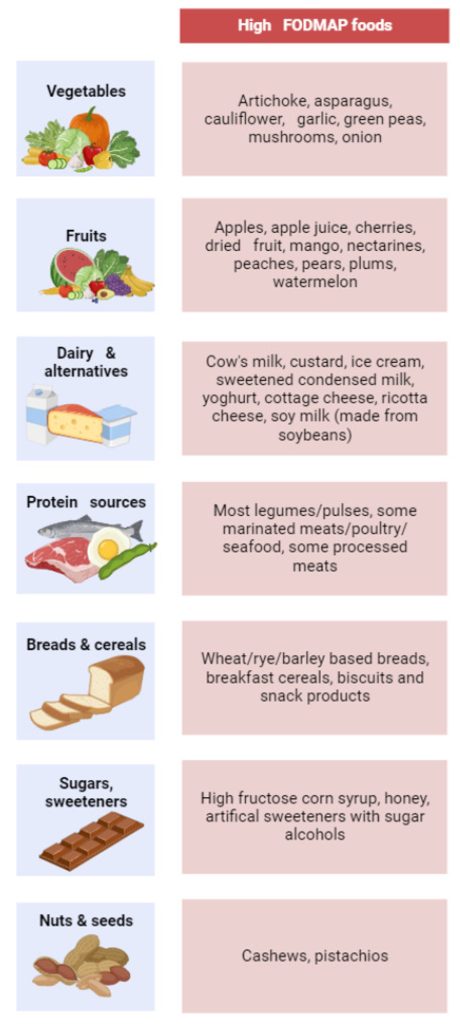
Figure 1. Chart depicting main food groups (left), vegetables, fruits, dairy, protein, breads and cereal, sugars, and nuts/seeds. The right-hand side highlights a selection of high-FODMAP foods within those categories, adapted from (Bertin et al. 2024).
Gut-directed hypnotherapy targets the brain-gut connection to mitigate symptoms, and is delivered by a trained therapist (Vasant and Whorwell 2019). GDH is employed by relaxation techniques with calming music and meditation to “induce” a hypnotic state to restore brain-gut regulation (Adler et al. 2025). During sessions, patients will be taught techniques, enabling them to gain control of their gut (Vasant and Whorwell 2019). Patient remains awake and aware, just in a deeper state of focused concentration. Then, the patient will be guided through relaxation exercises using imagery. Courses will last from 6 to 12 weeks in length (Bauzá 2018), with up to 76% of patients reporting an improvement of symptoms (Vasant and Whorwell 2019). Additionally, GDH can improve coping strategies, resilience, and self-regulation skills for those with IBS (Vasant and Whorwell 2019). The exact mechanism of GDH is still unclear. However, research suggests that it is possible that GDH can induce changes in neuroplasticity which can act as a “resetting” factor for the communication between the brain-gut axis along with decreasing visceral hypersensitivity (Vasant and Whorwell 2019).
Like all treatment for chronic disorders, GDH will not be a fix for everyone with IBS. However, GDH provides great promise for a more holistic approach to mitigating IBS symptoms without having to cut-out your favourite foods.
References
Adler, Elizabeth C., Emma H. Levine, Allison N. Ibarra, et al. 2025. “Gut-Directed Hypnotherapy for Irritable Bowel Syndrome: A Systematic Review and Meta-Analysis.” Neurogastroenterology & Motility 37 (7): e70037. https://doi.org/10.1111/nmo.70037.
Bertin, Luisa, Miriana Zanconato, Martina Crepaldi, et al. 2024. “The Role of the FODMAP Diet in IBS.” Nutrients 16 (3): 370. https://doi.org/10.3390/nu16030370.
Daley, Sharon F., Kunzah Syed, and Jennifer Goldin. 2026. “The Low-FODMAP Diet in Clinical Practice: Evidence-Based Indications, Implementation, and Interprofessional Care.” In StatPearls. StatPearls Publishing. http://www.ncbi.nlm.nih.gov/books/NBK562224/.
Margarita Bauzá. 2018. June 1. https://www.michiganmedicine.org/health-lab/how-gut-directed-hypnosis-helps-ibs-ibd-and-other-gi-disorders.
Nathani, Rohit R., Shreya Sodhani, and Eric Goosenberg. 2025. “Irritable Bowel Syndrome.” In StatPearls. StatPearls Publishing. http://www.ncbi.nlm.nih.gov/books/NBK534810/.
Peters, S. L., C. K. Yao, H. Philpott, G. W. Yelland, J. G. Muir, and P. R. Gibson. 2016. “Randomised Clinical Trial: The Efficacy of Gut-Directed Hypnotherapy Is Similar to That of the Low FODMAP Diet for the Treatment of Irritable Bowel Syndrome.” Alimentary Pharmacology & Therapeutics 44 (5): 447–59. https://doi.org/10.1111/apt.13706.
Vasant, Dipesh H., and Peter J. Whorwell. 2019. “Gut‐focused Hypnotherapy for Functional Gastrointestinal Disorders: Evidence‐base, Practical Aspects, and the Manchester Protocol.” Neurogastroenterology and Motility 31 (8): e13573. https://doi.org/10.1111/nmo.13573.

Leave a Reply
You must be logged in to post a comment.