“Why cockroaches?”
This species of insect is one of Earth’s greatest survivors, with their ancestors’ origins dating back to roughly 300-350 million years ago (Tinker and Ottesen 2021). Having outlived non-avian dinosaurs, cockroaches hold a record of Earth’s history within their biology. By studying cockroaches, we indirectly study the planet’s past through the perspective of a little pest.
To understand their high survival chances, we first must familiarize ourselves with the insect’s anatomy, dietary habits, as well as a portion of its life cycle. Based on the cockroach’s anatomy, the specific body part that aided its survival in harsh environments was its hard exoskeleton— composed of overlapping sclerites that is connected by flexible pleural membranes (refer to Figure 1). This body armor can withstand forces exceeding 300-900 times the cockroach’s body weight (Jayaram and Full 2016). With its ability to protect internal organs along with having a flattened body shape, hiding in the crevices of soil provided excellent protection from the extreme heat caused by the Cretaceous–Paleogene extinction event. (Lovett 2022).
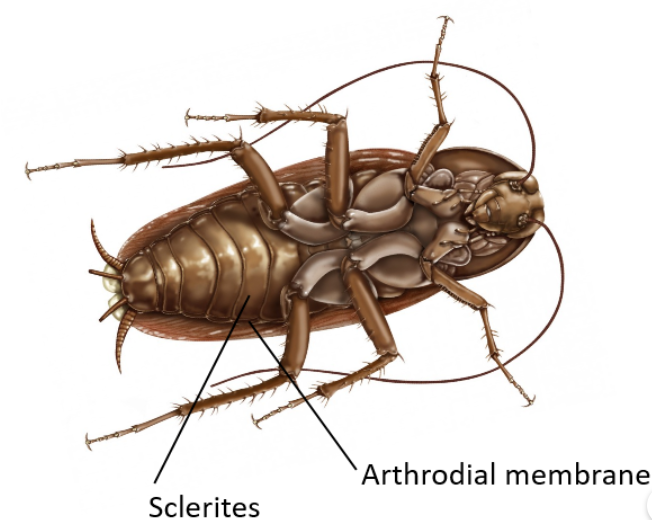
Figure 1: This image shows the sclerites, or hardened body plates, that helped increase the cockroach’s chances of survival.
Sometimes being a non-picky eater means having high evolutionary resilience. One of the effects caused by the meteor was kicking up dust high into the atmosphere, reducing sunlight and cutting off a major food source for animals: vegetation. Cockroaches, however, were able to survive these conditions. They can thrive on almost anything; whether it is decaying animal matter, fungi, cardboard, or even each other, just to survive.
Another advantage in survival is the use of a protective case called an ootheca , which contains developing cockroach eggs. Oothecae shield developing nymphs, or juvenile cockroaches, from further physical damage including floods and droughts, providing an additional protective layer for future generations (Lovett 2022).
By studying their anatomy, dietary habits, and life cycle, we can see that their survival was not accidental. From having a hardened exoskeleton provided for defense to a diet that enhances longevity through cannibalistic behavior, each trait contributed to their survival over millions of years. So, if you ever see a cockroach in your home, it would most likely survive the traps you carefully set up for pest control.
References
Jayaram, Kaushik, and Robert J. Full. 2016. “Cockroaches Traverse Crevices, Crawl Rapidly in Confined Spaces, and Inspire a Soft, Legged Robot.” Proceedings of the National Academy of Sciences 113 (8): E950–57. https://www.pnas.org/doi/full/10.1073/pnas.1514591113
Tinker, Kara A, and Elizabeth A Ottesen. 2021. “Differences in Gut Microbiome Composition Between Sympatric Wild and Allopatric Laboratory Populations of Omnivorous Cockroaches.” Frontiers in Microbiology (Switzerland) 12 (July): 703785. PubMed. https://doi.org/10.3389/fmicb.2021.703785.Lovett, Brian. 2022. “How Did Cockroaches Survive the Dino-Killing Asteroid Strike?” Livescience.Com, April 4. https://www.livescience.com/how-cockroaches-survived-dino-killing-asteroid
Tinker, Kara A, and Elizabeth A Ottesen. 2021. “Differences in Gut Microbiome Composition Between Sympatric Wild and Allopatric Laboratory Populations of Omnivorous Cockroaches.” Frontiers in Microbiology (Switzerland) 12 (July): 703785. PubMed. https://www.frontiersin.org/journals/microbiology/articles/10.3389/fmicb.2021.703785/full
Www.Terminix.Com. n.d. “Cockroach Life Cycle: How Long Do Cockroaches Live? | Terminix.” Accessed September 25, 2026. https://www.terminix.com/cockroaches/life-cycle/


Leave a Reply
You must be logged in to post a comment.