Venus, Mars, and Earth were all born from the same solar system, and yet today they are vastly different. Earth is a water and life-rich planet; Mars is a dry, windy, and cold desert, while Venus is a scorching planet in a smothering atmosphere (Patrick. 2025). These differences can be seen in Figure 1. This discrepancy begs the question – why did Earth become habitable while its planetary siblings took such different paths?
Figure 1: Venus, Earth, Mars, and the Moon shown together, demonstrating the differences in appearance, size, and planetary characteristics between Earth and its sibling planets.
David Grinspoon is a planetary scientist and astrobiologist with the Planetary Science Institute and has explored this specific question through comparative planetology—studying planets together to understand how and why they evolve differently (Voytek, 2020) . Grinspoon was one of the first scientists to describe Earth, Mars and Venus as “sibling worlds,” and he believes that comparing them can help science to better understand Earth’s evolution into the planet it is today. Comparative planetology raises a compelling argument – perhaps habitability is not simply about being the right distance from a star, but about the complexities that allow a planet to maintain conditions to susatin life. By comparing Earth’s history with the very different histories of Mars and Venus, scientists can begin to understand what may have been unique to Earth (Plitnik, 2023).
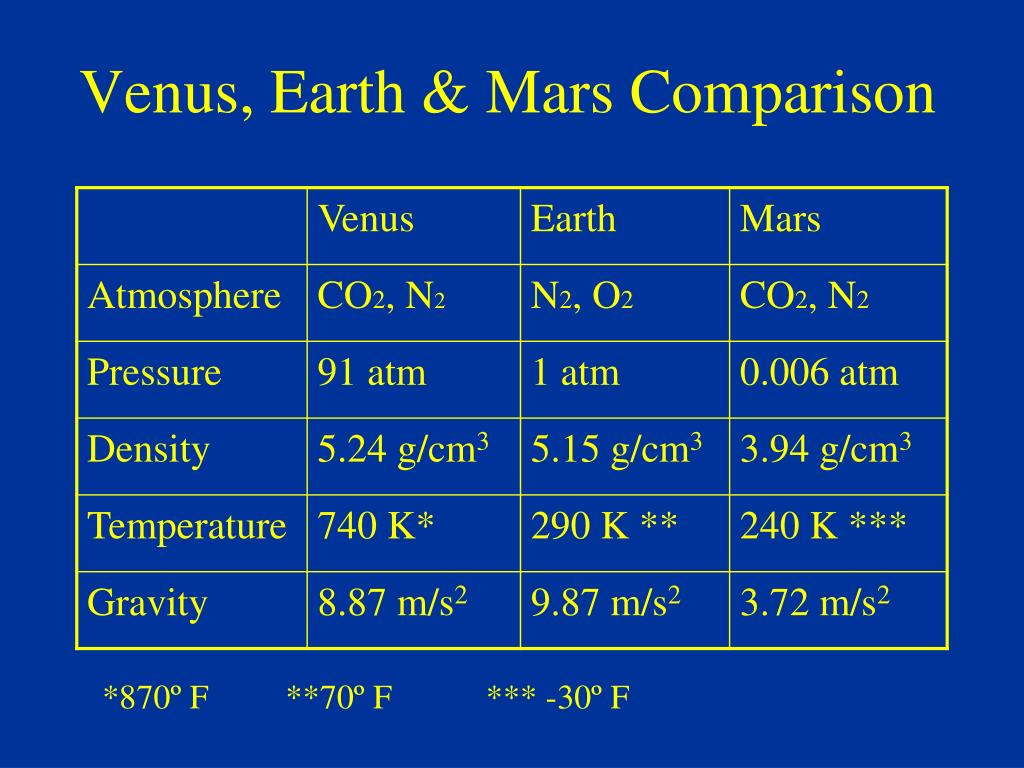
Earth, Mars and Venus were all formed roughly 4.5 billion years ago from rocky materials surrounding our young Sun. Astronomy can explain their common origins, while physics explores how gravity brought rock and dust together to build planets. All three had similar origins and experienced intense geological activity in their early days, but over time these planets evolved in remarkably different directions, as seen in Figure 2 (Jeffs, Brown, 2013).
Figure 2: Comparison of the atmospheric composition, pressure, density, temperature and surface gravity of Venus, Earth and Mars. These physical differences demonstrate how the planets, although they have similar origins, became vastly different environments.
Mars, being much smaller than Earth, evolved into a very different world. Scientific evidence shows that ancient Mars was a planet rich with lakes and rivers, but as the planet cooled quickly due to its small size, it lost its global magnetic field and much of its atmosphere due to stripping by solar winds. With a thin atmosphere and low surface pressure, liquid water, such as lakes and rivers, was near impossible to maintain. In contrast, Earth was large enough to retain internal heat and an active magnetic field, protecting its atmosphere. Today, Mars is a cold and dry planet, and with most of its remaining water being locked away as ice, it is inhabitable (Wilson, 2017).
Venus took a path directly opposite Mars. Scientists believe that Venus may have once had a temperature climate, oceans and habitable conditions, but its closer proximity to the Sun triggered an escalating greenhouse effect(Garner, 2016). Unlike Earth, whose oceans and carbon cycle assist with climate regulation, Venus became extremely hot and lost much of its water as intense sunlight broke water molecules apart and free hydrogen escaped into space. As a result, its dense carbon- dioxide-rich atmosphere produces an extreme greenhouse effect, and today, Venus’s surface temperatures reach up to 467°C, which is hot enough to melt lead. This is perhaps why Venus has been given the nickname “Earth’s evil twin” (NASA, 2024).
Earth evolved through complex and interconnected relationships between its climate, seas, and rock systems. Through processes represented by scientific domains including geology, chemistry, and climate science- such as plate tectonics, the greenhouse effect, volcanic activity and the carbon cycle- Earth has maintained conditions that have allowed liquid water to persist. While Earth’s early conditions allowed it to become habitable, it was the continued interactions between these processes that helped maintained its habitable conditions over billions of years. With time, biology joined Earth, and life itself began shaping the Earth as we know it today (Tuhin, 2026). We can examine the evolution of Earth one step further, as discussed in Grinspoon’s “Earth in Human Hands”, where he explores how Earth became habitable and then life itself became a force capable of altering Earth’s systems on a large scale. Earth has never remained a static world, and this supports the theory that life and planets influence one another in a complex and highly interconnected way.
Mars, Venus, and Earth began with many similarities, yet they evolved through dramatically different paths. Their histories showcase that a planet’s habitability over time is the result of a highly complex interplay of geology, atmosphere, climate, and life. That leaves us with many bigger questions that science should strive to answer: How rare is a living planet? How much of a planet’s future is determined at birth? Is Earth just lucky and are Venus and Mars examples of possible futures that Earth narrowly avoided? And perhaps most importantly – what are we doing to Earth’s planetary trajectory?
References
Garner, Rob. 2016. “NASA Climate Modeling Suggests Venus May Have Been Habitable – NASA.” NASA, August 11. https://www.nasa.gov/centers-and-facilities/giss/nasa-climate-modeling-suggests-venus-may-have-been-habitable/.
Jeffs, William, and Dwayne Brown. 2013. “NASA Scientists Find Similarities in Formation of Mars and Earth – NASA.” NASA, June 5. https://www.nasa.gov/news-release/nasa-scientists-find-similarities-in-formation-of-mars-and-earth/.
Muhammad Tuhin. 2026. “How Earth Formed.” Science News Today, July 20. https://www.sciencenewstoday.org/how-earth-formed.
NASA. 2024. “Venus: Facts.” Science.Nasa.Gov, NASA. https://science.nasa.gov/venus/venus-facts/.
Patrick, Glanze. 2025. “Planets Explained: Key Differences Between Mercury, Neptune, and Every World in Between.” Science Times, November 10. https://www.sciencetimes.com/articles/60733/20251110/planets-explained-key-differences-between-mercury-neptune-every-world-between.htm.
Plitnik, George. 2023. “Comparative Planetology of Venus, Earth, and Mars | Research Starters | EBSCO Research.” Ebsco. https://www.ebsco.com/research-starters/earth-and-atmospheric-sciences/comparative-planetology-venus-earth-and-mars.
tinelmis. 2024. “Comparative Planetology – Definition & Detailed Explanation – Planetary Science Glossary – Sentinel Mission.” Sentinel Mission, March 22. https://sentinelmission.org/planetary-science-glossary/comparative-planetology/.
Voytek, Mary A. 2020. “David Grinspoon.” Nasa.Gov. https://astrobiology.nasa.gov/famelab/bio/david-grinspoon.html.
Wilson, Jim. 2017. “NASA’s MAVEN Reveals Most of Mars’ Atmosphere Was Lost to Space – NASA.” NASA, March 30. https://www.nasa.gov/news-release/nasas-maven-reveals-most-of-mars-atmosphere-was-lost-to-space/.
Comments
17 Responses to “Comparing Three Sibling Planets and Exploring Why Earth Became a Living World ”
In our first Earth Sciences lecture, we learned about the different planets in our solar system and how they were created. I started wondering why modern Earth is so different from other planets if they were all created in such a similar fashion. This prompted me to reflect on why the Earth is the only planet that is habitable and vastly different from the rest. I decided to research this through seeking information from different scientific fields as well as work from a prominent scientist in this field. Learning about this topic, I realized that there are many unanswered questions that can be investigated through the practice of many scientific disciplines.
Hi Audrey!
Congratulations on your first blog post! Great job:)) I really liked how you ended your post with follow up question, leaving us as readers to think further about the topic!
I just have a few suggestions while you edit!
– Don’t forget to add a figure caption, and mention the figure in the paragraph before it!
– Along with that point, this is more stylistic but you didn’t talk about earths moon in the intro so maybe a figure that has earth, Venus, and mars would be better.
– In P6- you mention processes in geology, chemistry, and climate— which processes? Maybe name a few.
– I love your concluding paragraph, however, maybe add a few sentences before your question that wraps up the findings of your research.
– The NASA citations are good, but the rest of your references are not DOI sources, or peer reviewed. I would suggest finding some scientific articles that have a DOI and the same information as your post and change them, as they are more reliable.
Again, great work! Can’t wait to read your final version 🙂
– Hava
Hi Hava,
Thanks so much for the feedback! I definitely will add a figure caption and reference in it the paragraph above. I really like the idea of finding an image that excludes the moon as it was not discussed in my blog, unfortunately this was the best image I could find because I really like how it is labelled. I’ll add a few specific examples of the geological, chemical and climate processes I mentioned. I like the idea of adding a couple of sentences before jumping right into questions in my concluding paragraph, so it does not feel as rushed. I will definitely look at replacing some of my non-peer-reviewed sources to make my references more reliable.
Audrey
Hi Audrey,
Cool topic! I love how you wrote this blog post as a sort of timeline and talked about the formation and evolution of the planets, and then where they are now.
One thing I think you could do to make your post better is to connect your evidence about Mars and Venus back to Earth more directly. For example, you talked about how Mars lost much of its atmosphere and surface water, but you could also explain what Earth has that allowed it to retain its water.
Another example is in the Venus section – you clearly explained why Venus is so hot, but maybe you could add in something about the comparison between Venus and Earth that could tell us about Earth’s ability to maintain habitable conditions.
Overall, this was a great post and fun read but that’s the only thing I’d say!
Sincerely,
Mansi
Hi Mansi,
I really like your idea of connecting the Mars and Venus evidence back to Earth more directly. I think explaining what has allowed Earth to retain its water and ultimately stay habitatble would definitely strengthen my comparison and help answer my main question. I will definitely try to add more connecting arguements throughout the Venus and Mars sections.
Thanks,
Audrey
Hi Audrey,
Thank you for the interesting read! I like you how you compared Earth, Mars and Venus to show how planets with similar origins developed so differently.
I noticed a few small inconsistencies between the in-text citations and reference list:
1. Grinspoon is cited in the text but appears to be missing from the references. Adding this entry would help readers locate the source.
2. Does “Bolles, 2026” refer to the Venus facts page listed as “NASA, 2024”? If so, the author and year should match.
3. The 2013 citation should list Jeffs before Brown, following the order in the reference entry.
Using Zotero/Endnote/some reference manager can help a lot, because you can download exact citations from most DOI sources so that everything consistent.
Best regards,
Aarav Goel
Hi Aarav,
Thank you for catching these inconsistencies! I will definitely clean up my citations and references before the final blog post to make sure everything matches correctly. I also really appreciate the suggestion of Endnote or another reference organizer- I will look into using one to make sure my citations are kept organized and consistent.
Thank you,
Audrey
Hi Audrey!
I found this topic to be super interesting, and I really liked how you used simple yet professional language to synthesize complex scientific information! A suggestion I’d make is for you to expand more on the complex histories of Venus and Mars in comparison to Earth. I found those paragraphs to be slightly shorter than the explanation of Earth, so I think it would really enhance your overall blog! Furthermore, adding pictures of all these planets’ physical and chemical properties would be helpful for readers to visualize the differences and similarities between the sibling planets.
All in all, this was a great read!
– Swetha S
Hi Swetha,
I think potentially adding more information on Venus and Mars would help strengthen the comparison of my topic, so I will keep that in mind when editing. I love the idea of adding visuals that showcase the differences in the planets chemical and physical properties, I think this would make the differences easier to understand! Thank you for your amazing feedback.
Audrey
Hi Audrey!
This is an awesome first blog post! The title of this post immediately drew me in, and I really like how you pulled in the question of habitability from our first lesson. The references are also very thorough.
I do have some small pointers:
1. “Comparative planetology raises a compelling argument – perhaps habitability is not simply about being the right distance from a star and by comparing Earth’s history with the very different histories of Mars and Venus, scientists can begin to understand what may have been unique to Earth (Plitnik, 2023)” (Paragraph 2). This sentence has a good direction, but it is a bit choppy. When using “perhaps”, it’s usually followed up with a “but”. For example, “Perhaps ‘a’ is not about ‘b’, but about ‘c’.” By changing the format, it’ll also remove the run-on sentence issue.
2. The figure is interesting, but needs a description.
3. Currently, there isn’t much connection between your paragraphs, as informative as they are. I would add another paragraph linking your information together to explain why this information is important.
4. “Earth has never remained a static world, and this supports the theory that life and planets influence one another in a complex and highly interconnected way.” This is a really good point; I just wonder how it supports the theory. I think that cutting back on some of the descriptive information and adding more connecting points will definitely polish up the post.
Thanks so much for posting! I really enjoyed reading it, and I can’t wait to see the finished draft.
Emily Martin
Hey Emily,
I really appreciate your feedback. I agree that the sentence in paragraph two could be clearer, so i will definitely revise it for my final copy. I also agree with adding a description to the figure. I do feel that my paragraphs are connected through the comparison of Earth, Venus, and Mars, so instead of adding a new paragraph entirely, I am going to strengthen some of the transitions between them. I also think your last point is super helpful, I will definitely clarify why that point is relevant to my topic!
Thanks again,
Audrey
Hi Audrey!
I loved reading your blog. I thought that your introduction question was awesome, and it made me very intrigued to learn more about these planets’ differences.
To start, it would be beneficial to provide an explanation for your image. I like how you included it to give readers a visual idea of what you are talking about, however you should add a caption to it. Something like, “Figure one highlights three of the terrestrial planets in order from closest to farthest from the sun starting at Venus.”
I would also revise the concluding paragraph by picking one question to focus on and adding an explanation instead. An alternative version could be, “This leaves us with a much bigger question that science should strive to answer: How rare is a living planet? As of right now, we only know of planet earth being habitable, however data is being collected now more than ever in search for another planet like earth (Brennan 2021).”
Brennan, Pat. 2021. “Life in the Universe: What Are the Odds? – NASA Science.” Science.Nasa.Gov, March 9. https://science.nasa.gov/universe/exoplanets/life-in-the-universe-what-are-the-odds/.
Overall, an excellent piece and I look forward to reading the finished product!
Emma Iacobelli
Hello Emma,
Thanks for leaving some great feedback! I am glad you enjoyed my introduction. I agree providing a figure caption and context behind my image would further relate it to my topic. For the conclusion, I understand your point about focusing on one question, but I think I am going to keep the multiple questions. Personally, I feel that listing several questions emphasizes how large this topic is and how much about planetary habitability is still unknown.
Audrey
Hi Audrey,
I really enjoyed reading this blog post! I love how you ended it with some questions which allowed us readers to think about this topic further. I have two suggestions to make this blog post a bit stronger,
1. Make sure to add a figure caption.
2. It would be helpful to distinguish between what allowed Earth to initially become habitable and what has allowed it to remain habitable for billions of years. For example, Mars appears to have once had conditions more suitable for liquid water but was unable to maintain these conditions. This may help answer your main question while also showing how Earth’s long term habitability may be just as important as becoming habitable in the first place.
Happy Editing!
Kayo
Hi Kayo,
Thank you for taking the time to leave feedback. I will definitely make sure to add a figure caption! I agree that explaining why Earth has been able to remain habitable is just as important as why it was habitable intially. I hope to add more on this in my final version!
Audrey
Hello Audrey!
This was a great first blog post. I really enjoyed reading the topic you chose, and your introductory paragraph was very captivating. I just have a few suggestions to improve this further:
1. I noticed that your source in the second paragraph had no date. Websites that don’t provide this information could be a potential red flag. Ensure that your sources are peer-reviewed and/or DOI sources.
2. I believe that your last paragraph could be summarized a bit more. Instead of many different questions, this could be shortened into one finalized inquiry.
3. By removing some of the excess wording in the last paragraph, it would allow you to expand more on how Mars and Venus are inhabitable or how they lost their habitability. For instance, in paragraph four it was stated that “Mars lost its global magnetic field and much of its atmosphere.” You could add more detail on the significance of a magnetic field and how it allows life to prosper.
Overall, this was very well written. I look forward to reading the finalized version!
Lily McCormick
Hi Lily,
Thank you for your very helpful feedback! I agree with your suggestion and will strengthen my second paragraph by using a more reliable, preferably peer-reviewed source. I definitely agree with your point of making the conclusion more focused and finalized. However, I think I am going to keep the multitude of questions because I want to leave the readers thinking about the topic and contemplating the bigger questions that go hand in hand with this topic. I really like the suggestion to expand upon the significance of a magnetic field so I will definitely try to work that into the blog.
Thanks again for your feedback,
Audrey