When talking about explosions, most people talk about man-made devices such as grenades, remote explosives, or even nuclear warheads. These creations are what we tend to base our perspectives on when it comes to violent releases of energy. But the scale of explosions goes much further than human-made devices, ranging from massive celestial bodies to astounding organisms only a few inches in length.
Let’s start with the definition of an explosion. In its simplest terms, an explosion is a large expulsion of energy expanding outward from a specific source, radiating heat, light, and a shockwave. This is the most widely accepted definition, however criteria can vary (Keller et al 2014). We see these in our everyday lives, albeit at a much smaller degree, such as with a gas stove, an engine within a car, or something more obvious like fireworks.
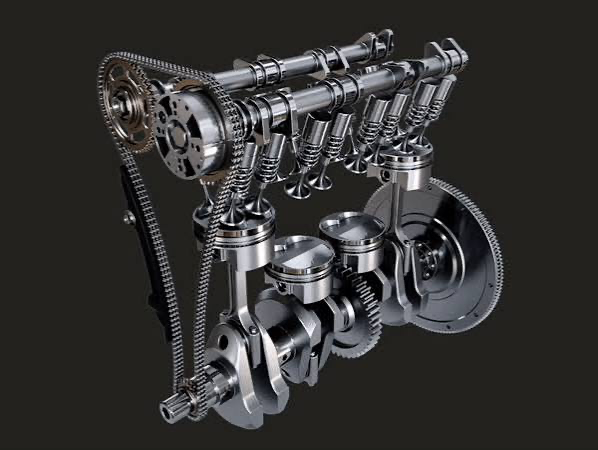
Figure 1: a standard combustion engine that uses “micro-explosions” for rotation in the wheels. These micro-explosions are caused by a system where pistons within containers called cylinders have gas pumped into them. This gas is then compressed by the pistons and ignited by a spark plug. This ignition causes a small shockwave, pushing down on the piston and in turn rotating a crankshaft, causing the wheels to spin based on other mechanisms that sadly don’t involve explosions (Colwell, 2019)
If we scale it up to the largest explosions, we get stars, some of the most fascinating objects in the universe. Imagine a power plant spanning millions of kilometres across with a fusion reactor at its core. Once a mass of hydrogen reaches a certain threshold of mass and heat, the pressure at its core will cause the atoms to fuse into helium. This process releases massive amounts of energy (NASA 2019). For example, the sun produces 4.0 x 10^26 each second by fusing around 700 million tons of material, confirmed by using Einstein’s equation of mass/energy equivalence (E=mc^2). To put this into scale, that’s close to 20 billion times the most powerful nuclear bomb ever tested on Earth (Seigel 2022). However, this is far from the largest explosion a star can have in its lifetime.
At the end of a stars life, it runs out of hydrogen to fuse in its core. Normally, this is where stars like the sun tend to die out, but it’s different for larger stars. For them, the pressure and temperature in their cores is so high they begin to fuse heavier and heavier elements, such as oxygen, neon, magnesium, and silicon (NASA 2026). The final stage within a a larger stars life comes when silicon fuses into iron. As the end all be all of stars, Iron has one of the most stable nuclei in the universe. An attempt to fuse heavier elements from it would only consume energy instead of releasing it. Because of the lack of radiation, the outer layers will collapse onto the core due to its immense gravity. Figure 2 shows the aftermath of this event and the expelled materials in the cloud around it. This process has enough energy and heat to fuse electrons and protons into neutrons, creating up to 10^44 J of energy. This process will either create a neutron star, a star basically made of neutron soup, or, with a star with more than 15 times the mass of the sun, a black hole (Nave 2000).
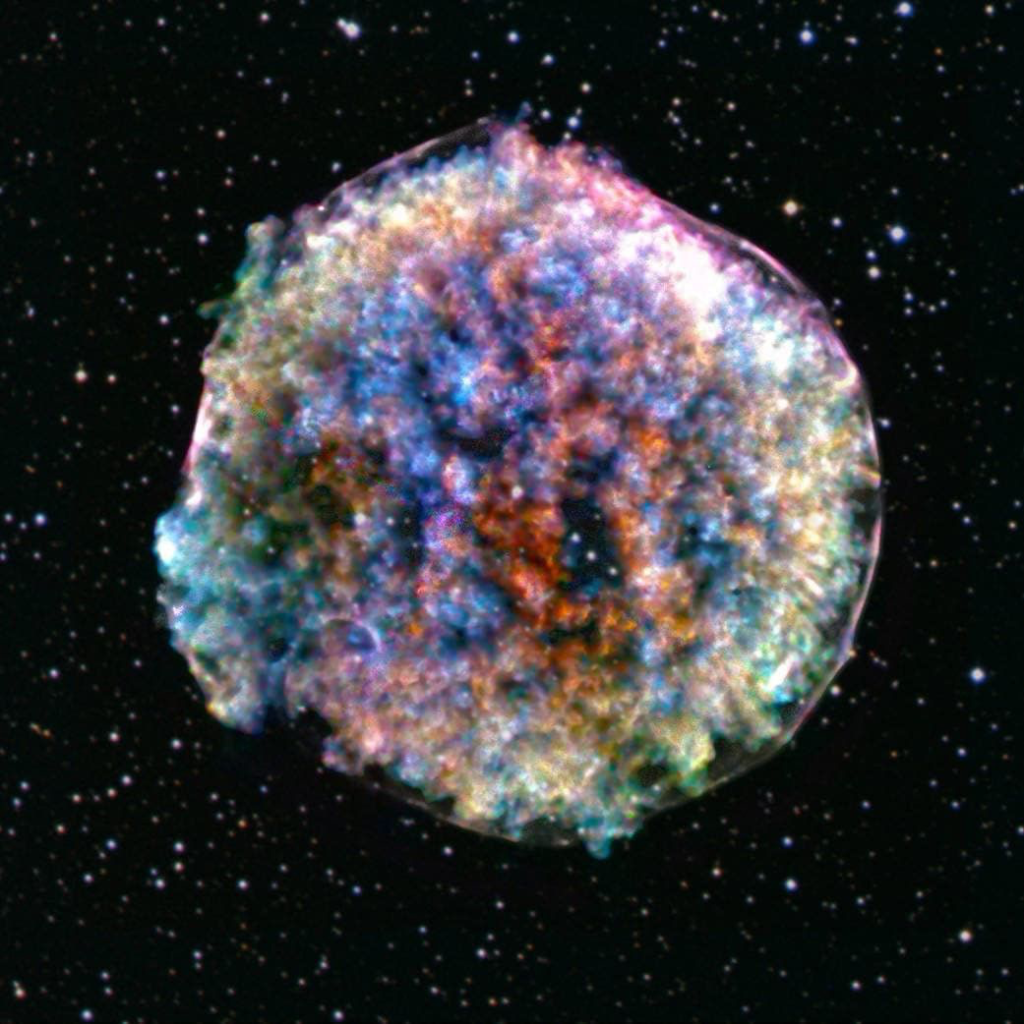
Figure 2: The remnants of a supernova first seen in 1537 from a star approximately 13,000 light years away. As seen in the image, the different coloured stardust is made up of all of the fused elements prior to its explosion. This is one of the main ways different elements are formed and dispersed throughout a star system (NASA 2026).
Although these violent cosmic events are some of the most impressive explosions out there, we can find even more interesting ones down here on Earth. Scaling it down, we find that the smallest explosions in nature are caused by the hands of a crustacean that spans only 4-10 inches in length. The mantis shrimp (Order: Stomatopoda) and their varying species have extremely interesting features, but none of which outclass its world class punching and spearing power. As most arthropods, the mantis shrimp has something called raptorial appendages, but instead of pincers or claws, they’re fitted with something called a dactyl club, a club like striking appendage that is entirely unique to the mantis shrimp. Figure 3 shows the actual mechanism and the process behind the actual punch. The club acts similarly to a spring loaded hammer, where the shrimp has the ability to latch its clubs into place, storing massive amounts of energy before releasing it as kinetic energy (Spence 2025).
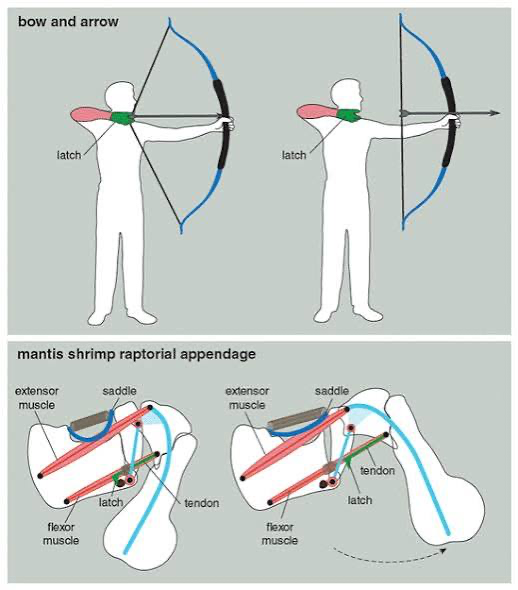
Figure 3: a diagram of the punching mechanism of a mantis shrimp and its similarities with a human hand. The latch within a mantis shrimp’s club is used to store large amounts of potential energy before distribution, similar to if a human drew back a bow. When the mantis shrimp releases a punch, the stress is distributed not just by the muscles and tendons themselves, but by something called a saddle, which distributes the force across the appendage(Lynch 2021).
When a mantis shrimp releases one of its punches, it comes in two stages. The punch itself occurs when the latch releases the club, causing it to accelerate to 22 m/s within 3 milliseconds. This speed, comparable to a .22 caliber bullet, hits the target with around 1500 newtons of force, which is used to crack or break open shells of crabs or snails. The second stage is caused by something called a cavitation bubble, a region of space is basically a vacuum caused by the speed of the punch itself. This superheats the water around it to temperatures similar to the surface of the sun. This destructive force can be seen in Figure 4 seen with the collapsing cavitation bubble. Once the cavitation collapses, it sends out an extremely powerful shockwave that, when combined with the damaged exterior of the target, normally stuns or kills it(National Geographic 2019).
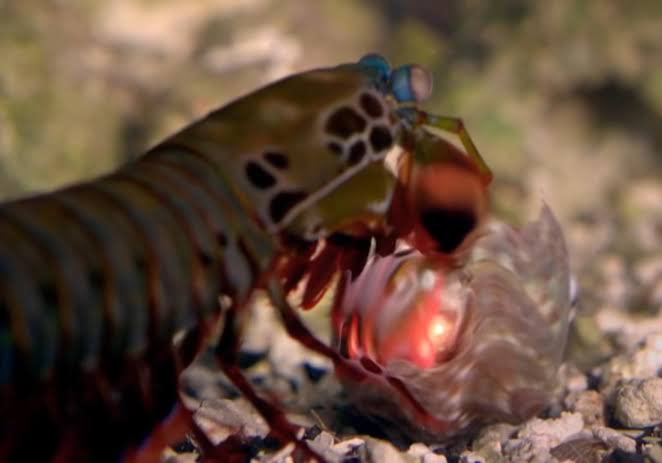
Figure 4: An image of the cavitation caused by the a peacock mantis shrimp’s punch. As seen, there is a flash of red light within the bubble, and heat radiating outward from the impact cite. This also creates a cavitation bubble, which collapses and sends out a shockwave that causes lethal damage to many of the species that the shrimp preys upon.
Although explosions themselves are violent and catastrophic to those around them, they can also be used for the to make leaps in scientific research. Whether it be about gaining insight on what happened early in the universe from stars that formed in the in its early stages. Or witnessing and recording astounding works of nature on this very planet, like a shrimp with the power of the sun in the palm of its hand. The very explosions that shake the world on the daily could very well lead to scientific breakthroughs like no other.
References
Colwell, KC. 2019. “Here’s How Your Car’s Engine Works.” Car and Driver. https://www.caranddriver.com/features/a26962316/how-a-car-works/.
Keller, J., M. Gresho, A. Harris, and A. Tchouvelev. 2014. “What is an explosion?” ScienceDirect.com. https://www.sciencedirect.com/science/article/pii/S0360319914012890.
NASA. 2019. “Chapter 1 – A Star is Born.” NASA Science. https://science.nasa.gov/exoplanets/resources/life-and-death/chapter-1/.
NASA. 2026. “Stars.” NASA Science. https://science.nasa.gov/universe/stars/.
Sartore, Joel, NAT GEO, and GREG LECOEUR. 2019. “Mantis shrimp, facts and information.” National Geographic. https://www.nationalgeographic.com/animals/invertebrates/facts/mantis-shrimp.
Siegel, Ethan. 2022. “Ask Ethan: How Can A Nuclear Bomb Be Hotter Than The Center Of Our Sun?” Forbes. https://www.forbes.com/sites/startswithabang/2020/03/28/ask-ethan-how-can-a-nuclear-bomb-be-hotter-than-the-center-of-our-sun/.
Spence, Katie. 2024. “Mantis shrimp: The crustacean that packs a punch.” Natural History Museum. https://www.nhm.ac.uk/discover/mantis-shrimps.html.
Comments
14 Responses to “Explosions: From Stars, To Shrimp?”
Hey everyone! Apologies in advance for the 800 word essay that I just wrote, I’d really appreciate any feedback
Hi Aaron,
This was a very well written blog post! It was interesting to learn about both the big explosions and the little explosions. Below are a few suggestions to help with your editing process:
– Make sure to refer to your figures in text so the reader knows what part of your blog is related to the figure.
– In the first sentence of paragraph four, I think “stars” should be “star’s”
– In the fourth sentence of paragraph four, there is a type and you repeated the word “a” twice
– In the fifth sentence of paragraph four, I don’t think “Iron” should be capitalized
– Try to use peer-reviewed sources where possible. When you are citing journal articles, you should have the DOI as the link rather than the science direct version of the link
Happy editing!
Julianna
Hey Julianna!
Thank you for all the comments. I’ve taken into account all of the suggestions you’ve made and incorporated them appropriately. Thank you very much again.
Good luck with yours!
Aaron Ling
Hi Aaron,
That was a very fun read about explosions! I didn’t know a mantis shrimp could replicate temperatures similar to our sun’s.
1) In paragraph 3, you mention that the energy released from a mass of hydrogen at a certain mass and heat causes nuclear fusion, turning the atoms into helium. Perhaps shortening the nuclear reactor metaphor would improve the flow in that section.
2) The mantis shrimp portion was very well written! If you could find a before/after figure of its prey being hit with a punch, I feel it would punch up that section!
Can’t wait for your next post,
Praise
Hey Praise!
I’ve shortened the third paragraph as much as I could. Also I’ve added a 4th figure with a peacock mantis shrimp mid-strike if you want to check it out!
Thank you so much!
Aaron Ling
Hi Aaron,
What an intriguing topic! I had no idea that the size of explosions could vary so drastically. I loved how Figure 3 compares the mantis shrimp’s raptorial appendage to the use of a bow and arrow, and how you compared the speed of its punch to a bullet. It made the raptorial appendage’s function easier to understand.
I just have a couple of notes for you to consider:
– In paragraph two, sentence two, you wrote:
“In its simplest terms an explosion is a large output of energy radiating outward from a specific source, radiating heat, light, and a shockwave”.
I suggest adding a comma after the word “terms” to improve the flow of the sentence. Try reading it out loud to see how it sounds to you!
In addition to that, try avoid sounding repetitive by replacing the second “radiating” with a different word. For example, you could say: “…emitting heat, light, and a shockwave”.
– Your in text citations are formatted (Author, date), but I believe the Chicago style that we follow in this course does not require a comma to separate the two. For example, in paragraph five when you cite, “(Spence, 2025)”, you can simply replace it with “(Spence 2025)”.
Similarly, when you cite “(Keller, Gresho, Harris, & Tchouvelev, 2014)” in paragraph two, you should instead only include the first author (in the in text citation) and write “et al.” to signify that there are others.
– I appreciate all of the images that you have included, but I think adding an image of the mantis shrimp would help us readers further envision how tiny these species are, or how they would look releasing one of these epic punches!
Overall, super fun read! It really made me aware that there is so much going on around me that I simply can’t see, both above my head and below it.
Happy editing!
Zara
Hey Zara!
I’ve tried to structure paragraph two a little better than before to make it a little more legible. Also, thank you for noticing the citations, I don’t think I would have caught that without someone point it out. I have also incorporated a new figure to show a peacock mantis shrimp while striking its prey. Hope your blog goes well!
Aaron Ling
Great blog Aaron! I really like your title and the topic you chose. Here are some suggestions which might improve your blog (I know it looks like a lot but these are super easy fixes!):
P1S1: “manmade” to “man-made”
P1S3: “human made” to “human-made”
Figure 1: format like “Figure 1: A standard…”
P3S5: what is the unit of measure for 4.0X10^26
P3S5: “Einsteins” to “Einstein’s”
P4S3: as Julianna mentioned, you repeat “a” twice
P4S4: also as Julianna mentioned, “Iron” does not need to be capitalized
Figure 2: same notes as for Figure 1. Change “13’000” to “13,000”
P5S2: the sentence “…the smallest explosions we can in nature are caused by…” doesn’t read smoothly. Maybe try ” the smallest explosions observed in nature…”
Also, make sure to reference your figures in-text.
Overall great blog and I’m looking forward to reading the final thing!
Hey Olivia! Thank you for all the advice, I’ve incorporated as much as I could in the post. Thank you very much for your help!
Aaron Ling
Hi Aaron!
I really liked this post: it’s interesting to consider how so many parts of life (and species) use a similar mechanism for different purposes!
A few things:
1. Remember to explain why you wrote about your topic in your comment.
2. I believe that you should cite the research article rather than ScienceDirect in your citations. Maybe cite it as an article rather than a website?
Other than those two things, the article is very well written, especially since it’s so early in the year!
Emily Martin
Hey Emily! Thank you for all the advice that you’ve given! I couldn’t really find any way to outsource the original document that I cited from Science Direct. Otherwise Thank you again for the comments. I look forward to what you end up writing
Aaron Ling
Hi Aaron!
I clicked on this post because of the title, so awesome job at making it engaging. I liked a lot about this post and found it very well written.
The variety of examples used throughout the post made it interesting and showed how the same concept can occur on different scales which I thought was super helpful for understanding the topic.
Make sure to reference your figures somewhere in the text, it allows the readers to know how it relates back to your main idea, and will make them more useful for assisting in explaining.
I also think that in the conclusion if you could connect the examples discussed in the post more to the main idea it would make it much stronger!
Overall great post!
Sydney
Hey Sydney! Thank you for your advice! I would’ve forgotten to actually reference the figures without that. I’ve used most of my refences within the text to make it more fluid when reading. Hope your blog goes well!
Aaron Ling
Hi Aaron,
Great job on your blog post, I found it to be a very interesting read! Here are a few pieces of feedback:
– Add a period to your last sentence in your first figure caption
– Ensure you are using peer reviewed cites with a DOI
– P2S1: I would reword this sentence to “The definition of explosion in its simplest terms is a large output of energy radiating outward from a specific source, radiating heat, light, and a shockwave” to increase readability and formality of your writing.
– Make sure you reference your figures in text
Overall great work! Happy Editing!
Maya Kumar