On the morning of Saturday, September 19th, 2026, I woke up to pray the morning prayer, Fajr, at around 6:00 AM. After praying, I went back to sleep for an hour and a half, knowing I had to get up again to run some errands. After waking up again, I noticed that the dream I had in that short time was so vividly clear that it didn’t feel like a dream at all. It felt like it happened right now, as a part of my actual life. I didn’t remember a single thing from my dreams the night before, but this one felt like part of my memory. It was a dream of two TV shows I’d watched some years ago, their storylines mixed perfectly into one story that somehow made sense but also didn’t. In it, I was a character, perfectly synced into the story, as if I was supposed to be there all long. It was quite the weird phenomenon.
The reason any dreams I had overnight didn’t stick, while the one during my 1.5-hour nap did, is that my sleep cycle happened to be in the REM stage at that moment (Dement and Kleitman 1957). Sleep is essentially divided into two stages: rapid eye movement (REM) and non-rapid eye movement (NREM). Most vivid, story-like dreams occur during REM sleep, while NREM sleep is associated with memory consolidation and recovery. NREM sleep itself progresses through three stages, N1 through N3, of increasingly deep sleep, before the cycle moves into REM. REM periods occur roughly every 90 minutes and get longer as the night goes on, which is why people are more likely to wake up during or right after one in the second half of the night, when dreams are freshest in memory (Stickgold 2005).
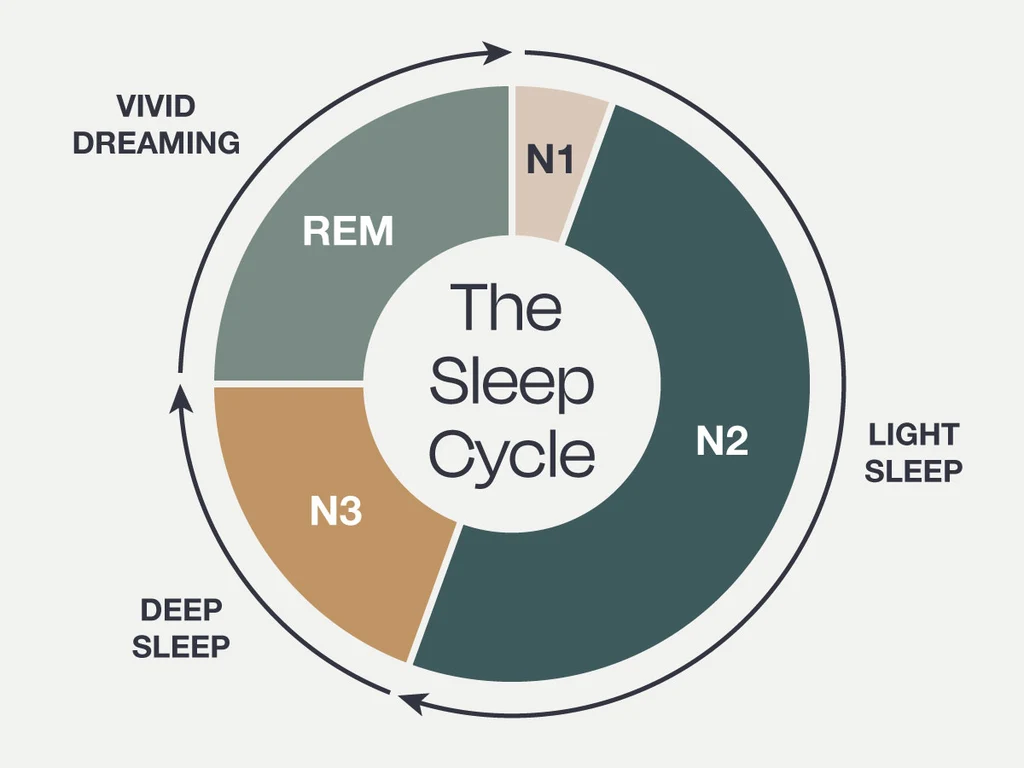
Ironically, describing this dream is itself a reconstruction, not a factual replay of what actually happened. Essentially, it’s my biased view of my own dream. As I mentioned, the storylines of the two TV shows blended into one story that made sense but also didn’t. This is because the brain takes the chaotic, mixed-up ideas formed during the REM stage and blends them into something that feels coherent, filling in the gaps. This process is called confabulating: the act of unconsciously creating false memories to fill in gaps in memory. It’s similar to how you’d give an AI model pieces of fragmented information for it to create a perfectly smooth narrative linking it all together. The study of dreams, oneirology, relies mainly on someone’s personal account, which can’t be taken as fully accurate on its own. However, with proper measures put in place, standardized collection can make a person’s account reasonably reliable (Domhoff 2000).
From this, we can understand that self-reported accounts of an experience, dream or otherwise, more often than not carry some bias, which is why it’s always worth asking how much of a recounted story is factual and how much is a reconstructed, biased point of view.
References
Alaskan King Bed Company. 2023. “What Does the Sleep Cycle Look Like: Overview of the Different Stages of Sleep.” Bedtime Reading (blog), June 13, 2023. https://alaskankingbeds.com/blogs/bedtime-reading/what-does-the-sleep-cycle-look-like-overview-of-the-different-stages-of-sleep.
Dement, William, and Nathaniel Kleitman. 1957. “The Relation of Eye Movements during Sleep to Dream Activity: An Objective Method for the Study of Dreaming.” Journal of Experimental Psychology 53 (5): 339–346. https://www.semanticscholar.org/paper/The-relation-of-eye-movements-during-sleep-to-dream-Dement-Kleitman/7a17858ad40a01e462907ce961a3346fdb51d848
Domhoff, G. William. 2000. “Methods and Measures for the Study of Dream Content.” Dream Library, University of California, Santa Cruz. Accessed September 20, 2026. https://dreams.ucsc.edu/Library/domhoff_2000a.html
Stickgold, Robert. 2005. “Sleep-Dependent Memory Consolidation.” Nature 437 (7063): 1272–1278. https://doi.org/10.1038/nature04286
Comments
21 Responses to “Why Most Dreams Vanish, and Why the Ones That Don’t Might Be Lying to You”
Hi Naafe,
This is an interesting approach regarding dreams and memory reconstruction when recalling dreams before they fade. However, there are a couple spots that are hard for me to compensate. There are some run-on sentences clustered in the second paragraph.
The first sentence of the second paragraph is wordy. It contained too much information. You wrote “the reason why…was because…”. This is redundant. It can be more concise by simply rephrasing it to ” this is because…”. The end of that sentence stated “at that moment”, which is unclear and unnecessary. You used the numeric number “2” in the second sentence, which I recommend to replace with “two”.
You also did not define REM and NREM sleep. I would not assume that the audience who was not familiar with the concept would be able to follow. You could have written “Sleep is divided into two major types, REM and NREM sleep. Most vivid and story like dreams occur in REM sleep, while NREM sleep is associated with memory consolidation and recovery”.
Lastly, I have learned that REM sleep only lasts for a couple minutes in the full 90 minutes cycle. I think it would be a good idea to clarify that. The “especially right before a person wakes up” is misleading, as REM sleep tends to be long in the second half of your sleep. So one would be more likely to wake up during or right after REM sleep.
Best Regard,
Edgar Lee
Hi Edgar, thank you for such a thorough comment, it really helped me clean up paragraph two!
Naafe
Hey Naafe,
Your topic is super interesting, and I like how you connected your own personal experience to the science and theory behind dreams! One of my favourite parts of the blog was your allusion to AI models, which is quite relevant in this day and age. However, certain paragraphs were rather wordy and hard to follow. For example, when you wrote, “As I said before, the storylines of the two TV shows being mixed into one story that made sense but also didn’t proves that ….”, this was a bit confusing and might need grammatical polishing. There are a lot of run-on sentences that might need to be split in order to improve the overall flow of the read. Moreover, I suggest that you add an image or two in order to enhance the read.
Overall, great work!
– Swetha S
Hey Swetha, thanks so much, glad the AI comparison stood out to you!
Naafe
Hi Naafe,
I really enjoyed reading your take on REM and the way our brain reconstructs our memories during our dreams. I found adding a personal example into your introduction to be very captivating. It would be helpful to go into more depth of REM and NREM, since I did not get a full understanding of those concepts within your blog. Furthermore, I also think your sentences are sometimes quite long. For example, “But ironically, me describing this dream is itself a reconstruction, not a factual replay of what my dream actually was; essentially, it’s my biased view of my dream.” This sentence can be written more concisely. I would recommend reading your work out loud to help better see when to separate your sentences. Moreover, adding some photos would help make the blog more eye-catching. Overall, great work! I really liked this concept and I believe you executed it quite well.
Kind regards,
Vanessa Salazar
Hi Vanessa, thank you so much, glad you liked the concept!
Naafe
I chose to write about this after waking up from a dream that felt more real than any I’ve had in a while, right after a short nap following the morning prayer, Fajr. It connects to what we covered in SciLit about finding bias in a data source, since the study of dreams, oneirology, runs into exactly that problem, there’s no way to study a dream except through someone’s account of it afterward which can lead to some biases. Hope you enjoy reading it!
Hi Naafe, I enjoyed reading your blog, and the way you linked it to bias! Here’s some advice I have:
1. When introducing an acronym, it is proper format to write out the full term first, followed by the acronym in parantheses. eg. Instead of REM (Rapid Eye Movement), it should be: rapid eye movement (REM). Also since rapid eye movement is not a common noun, the words should not be capitalized.
2. In paragraph 3, saying “a bunch” can be informal, instead I would say “pieces” of fragmeted information…
3. I found the first sentence of paragraph 4 is difficult to read due to the amount of commas. To improve the flow, here’s what I would do: From this, we can understand that self-reported accounts of expriences, which may not necessarily be a dream, generally have a bias.
Happy editing!
– Hafsah S
Hi Hafsah, thank you! Really appreciated the specific line edits.
Naafe
Hi Muhammad!
What an awesome and unique topic to be writing about!
Here are a few of my observations.
You don’t have a intext citation for your first citation.
I fell that there is a need for a more cohesive prose, there is a lot of switching of levels of formalities which really screws with the flow of your writing, it does not need to be formal but it should also be professional.
There is no figure, I understand that this topic is not easily portrayed visually, but this can be used as an opportunity to expand your topic. This brings me to my next point which is that a blog post should synthesis/integrate two or more scientific topics and turn them into a new interesting perspective on a topic, here however you are just explaining what REM and NREM is, which although an interesting topic, should be developed and built upon.
Your second to last paragraph is very confusing and the second sentence is run-on.
All in all, this topic has a lot of potential and I look forward to how you develop your blog post!
Happy editing!
Rasmus
Hi Rasmus, thanks for the honest feedback, gave me a lot to think about in developing the topic further!
Naafe
Hello Muhammad!! I loved your blog post on dreams and bias!
Here are a few suggestions:
– Your blog post doesn’t currently have a figure, I could be wrong and the rules may have changed but I believe every blog post requires at least one figure.
– P2S1: You write “According to Dement and Kleitman’s study in 1957, the reason why any dreams I had during the night didn’t stay while the one I had during the 1.5 hour nap did was because my sleep cycle was going through the REM stage at that moment.” I would rewrite that as “According to a study done by Dement and Kleitman’s in 1957 (intext citation), the dreams I had had during my nap may have differed from my night’s rest because I had entered a REM stage rather than the alternative NREM stage.” Then I would define REM and NREM in more detail in the sentence right after.
– P3S1-2: This is a fairly convoluted two sentences that kind of run on, so I would look to break those up.
I feel like you are trying to use human experience, a story, to explain a scientific idea. This is a great way to share complicated ideas, however, I would try to create a more cohesive tone, formal or informal.
Overall, amazing job!! – Ava Petteplace
Hi Ava, thanks for such a detailed comment, it helped a lot with cleaning up paragraph two!
Naafe
Hi Muhammad,
What a wonderfully written blog post! I absolutely loved the title as it captured my attention right away. I have a few suggestions for you to consider:
– I really like the storytelling-feel of your introductory paragraph. I don’t come across many blog posts that use this technique, and it definitely peaked my interest. I would try to condense the bottom portion however; there are a few run on sentences (such as the TV show one) that I got lost in.
– When doing in-text citations, they are more commonly written as “…according to Dement and Kleitman (1957)” with the year in parentheses.
– If possible, it might be nice to include a graph or figure explaining the relationship between the REM vs NREM stages during sleep.
– Don’t forget to unlink your citations in the references section!
Overall, I really enjoyed your post as I’m quite the dreamer myself. I can’t wait to read the final version 🙂
Happy editing,
Chloe
Hi Chloe, thank you so much, really appreciated the specific pointers on the citations!
Naafe
Hi Muhammed,
Great job on your blog post, I found it to be a very interesting read!
– I would recommend adding in a figure to aid your post, it would be great to have a visual of the various sleep stages that can be referred to while reading.
– P2S3 – This sentence is a bit long, I would recommend splitting this up into two separate sentences.
– P4S1- I would recommend rewording this sentence to increase clarity. I suggest something like “All in all, we can understand that self-reported accounts of an experience such as dreams more often than not have a bias.”
Overall great job! Happy editing!
Maya Kumar
Hi Maya, thanks for the feedback, I ended up adding a figure like you suggested!
Naafe
Hi Muhammad,
I love this blog post!! You chose a super interesting topic, and I didn’t know there was an actual term for the study of dreams!
Your writing style hooked me in. I also like how you started by recalling a personal experience to then transition into talking about the studies you read.
A few suggestions:
Second paragraph, “the one I had during the 1.5 hour nap did” — I think the “1.5 hour” could be deleted, since you mentioned it recently enough that it’s a bit redundant.
Last paragraph first sentence is pretty wordy. I wouldn’t call it a run-on sentence necessarily — like, it works as is, and it’s grammatically correct as far as I can tell — but it would be easier to read if you cut some of the extra words down.
Very last sentence — there doesn’t need to be a comma after “asking”.
I also think you could add a short explanation of REM and NREM sleep (just a sentence or two). It might help readers understand a bit more about how dreams work.
Overall this is really nicely written though. Super cool 🙂
Ella
Hi Ella, thank you! Your suggestions helped me tighten things up a lot, especially that last paragraph.
Naafe
Hi Muhammad,
I really enjoyed reading your post, and I found your topic to be very interesting. Your writing style is engaging, and I think using your personal anecdote in the beginning is a great hook to draw readers in. Here are a few suggestions that you may want to consider in your editing process:
– Your introduction paragraph is an engaging hook, but you may want to shorten it and make it more concise, as blog posts have a word limit and your story is fairly long compared to other parts of your post.
– Your sentence beginning with “It was a dream of two TV shows…” is quite lengthy, so you may want to break it up or condense it.
– Maybe use a different word than “weird,” as it is repeated in your first paragraph.
– For your sentence “Sleep is essentially divided into 2 stages, REM (Rapid Eye Movement) and NREM (Non-Rapid Eye Movement,” consider rewriting it as “Sleep is essentially divided into two stages, Rapid Eye Movement (REM) and Non-Rapid Eye Movement (NREM).
– Instead of “across the night,” you can phrase it as “throughout the night”
– You can start the third paragraph without the “But” at the beginning.
– Your second sentence of your third paragraph was a bit difficult for me to follow when reading, and I think it can be rewritten to split it up into two sentences.
– The first sentence of your last paragraph is a bit awkwardly phrased and I think can be more concise.
– Your last sentence is just a fragment (no subject), but I’m not 100% sure this is an issue as blog posts are not very formal.
Overall, you had so much great information in your blog post and I think you write in a way that makes complex ideas and facts easy for readers to digest and interpret for themselves. I’m looking forward to reading the edited version!
Regards,
Isabel
Hi Isabel, thank you so much for the thoughtful feedback, it really helped me clean up the flow of my post!
Naafe