Disease outbreaks have destroyed civilizations since the beginning of time. In the past, diseases have spread, but not as rapidly as they are travelling today. As climate change worsens, new deadly viruses will have greater opportunities to form, grow, and infect populations.
One of the main issues associated with changing weather patterns is their effect on the spread of diseases. Researchers are linking the outbreak of global illnesses to the rise in extreme weather events (Otten et al. 2022). Conditions including irregular periods of precipitation and heat waves provide a better environment for viruses to develop and transmit.
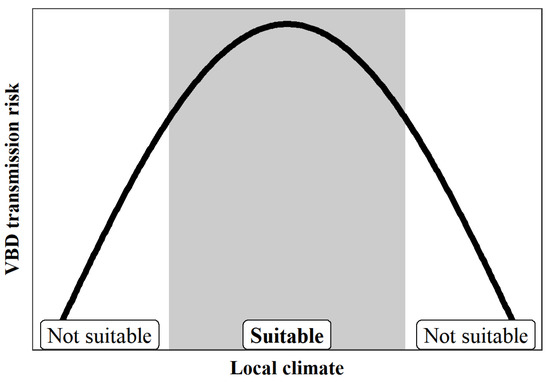
It is estimated that there are 150,000 global deaths annually due to diseases influenced by irregular weather conditions (Ma et al. 2022). These patterns are being observed more frequently as the number of vector-borne diseases (VBD) continue to rise. VBDs are harmful illnesses and are easily transmitted when one is bitten by a vector such as a tick, lice, or mosquito. Figure one highlights the environments required for VBD transmission. If suitable conditions for VBDs are met, which are caused by global warming, it creates a more ideal environment for the diseases to spread. When climate is regulated, the amount of VBDs are kept to a minimum.
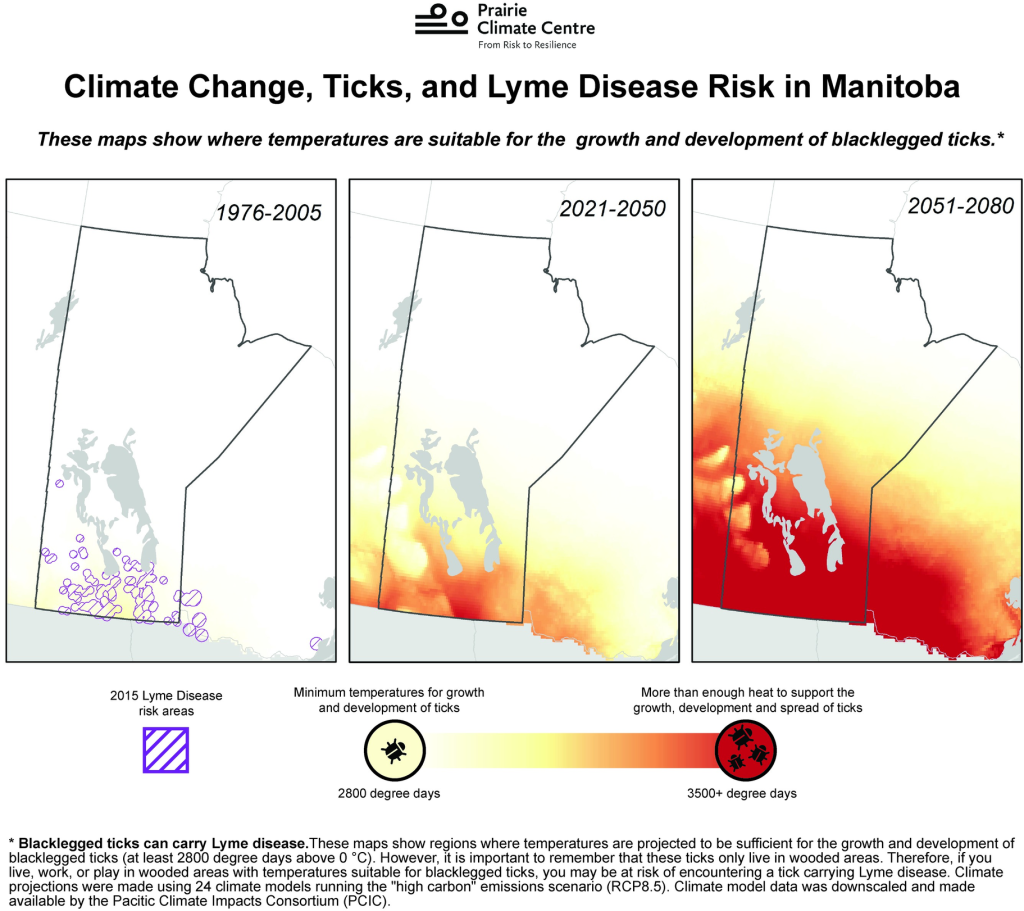
The spread of Lyme disease is a growing concern for communities in Manitoba, Canada. Increasing temperatures due to climate change create an optimal habitat for the blacklegged tick population to breed and thrive (Cameron et al. 2021). This has caused a surge in the number of Lyme disease cases in the region, and this number is only expected to grow. In 2023, Manitoba experienced a 53% increase in the number of people contracting Lyme disease compared to the year before (Public Health Agency of Canada 2025). Figure two showcases the amount of ticks that will invade Manitoba in the near future if global warming continues.
Pakistan has also been heavily impacted by the effects of global warming. An increase in heavy rainfall resulting in flash floods is taking a toll on their population’s health and environment. In 2022, the country experienced several monsoons and torrents which created a gateway for waterborne diseases to travel (Iqbal et al. 2022). A surge in cases of malaria and diarrhea were seen in patients linked to these extreme weather events. If climate change continues, more water transmissible diseases are likely to spread and harm several communities.
To stop the spread of viruses due to global warming, countries must unite and make change. Switching to renewable energy sources, eliminating pollution, and making chemical processes more efficient are all steps in the right direction of action (Shu 2019). If nothing is done soon to mitigate the effects of climate change, extreme weather will continue to worsen along with the growth of new, deadly diseases.
References
Ainsley, Otten, Aamir Fazil, Anna Chemeris, Patrick Breadner, and Victoria Ng. 2020. “Prioritization of Vector-Borne Diseases in Canada Under Current Climate and Projected Climate Change.” Microbial Risk Analysis 14 (April): 100089. https://doi.org/10.1016/j.mran.2019.100089.
Cameron, Laura, Rhéa Rocque, Kailey Penner, and Ian Mauro. 2021. “Evidence-Based Communication on Climate Change and Health: Testing Videos, Text, and Maps on Climate Change and Lyme Disease in Manitoba, Canada.” PLOS ONE 16 (6): e0252952. https://doi.org/10.1371/journal.pone.0252952.
Iqbal, Maham, Azkah Rabbani, Fatima Haq, and Sunaina Bhimani. 2022. “The Floods of 2022: Economic and Health Crisis Hits Pakistan.” Annals of Medicine and Surgery 84 (November): 104800. https://doi.org/10.1016/j.amsu.2022.104800.
Ma, Jian, Yongman Guo, Jing Gao, et al. 2022. “Climate Change Drives the Transmission and Spread of Vector-Borne Diseases: An Ecological Perspective.” Biology 11 (11): 1628. https://doi.org/10.3390/biology11111628.
Public Health Agency of Canada. 2025. “Annual Report: Lyme Disease and Other Tick-Borne Diseases Surveillance in Canada — Canada.Ca.” Canada.Ca.https://healthinfobase.canada.ca/zoonoses/ticks/archive/2023/#geo.
Shu, Frank H. 2019. “Stopping and Reversing Climate Change.” Resonance 24 (1): 51–72. https://doi.org/10.1007/s12045-019-0758-8.
Comments
18 Responses to “Is Climate Change Directly Impacting Disease Transmission?”
My topic directly correlates to content we are learning in iSci as I am connecting two different disciplines of science including life science and earth science. In my blog, these topics connect as I am highlighting the effects that climate change is having on the spread of diseases. In RP3, I know that we are researching difficult environments, so I wanted to begin looking into global warming. I also know that RP4 is about cancer science and that an abundance of biology is about understanding genetic mutations. This topic was very interesting for me to study as I love learning more about environmental science and how it connects to human health. I look forward to learning more about these topics in the research projects.
Hi Emma,
I really enjoyed learning more about the transmission of diseases and the impact that our changing climate has on this. It was interesting to learn about the increasing concern for Lyme disease in Manitoba and I wonder if this too will become a concern in Ontario in the future. Below are a few suggestions to help with your editing process:
– Consider making your title more descriptive for the topic you are writing about. For example, I think you should include disease transmission in the title rather than human health
– I think you can edit your post to make it more concise as there are some sentences that are saying essentially the same thing. For example, you do not need this sentence “There is an abundance of research being done to investigate the connection between extreme weather and the spread of diseases” since you have previously said “One of the main issues revolving around changing weather patterns is how it is affecting the expansion of diseases”
– You can also consider removing the sentence “What drives an abundance of these inquiries are the quantities of lives lost each year as a result of climate catastrophes” as it is a bit awkward and your next sentence in this paragraph would be a much stronger introduction sentence to your next point.
– Make sure to add a figure caption and when referring to your figure in text you should say “Figure 1” rather than “The figure down below”. The same applies for your Figure 2.
Happy editing!
Julianna
Hi Julianna!
Thank you for your feedback. I fixed the title, made the sentences more concise, and added figure captions.
Best,
Emma
Hi Emma!
I enjoyed reading this piece! I particularly like how the topic you chose is relevant considering the growing severity of climate change and its prevalence in the media. I have a few minor suggestions.
– The pronoun “it” is singular, but what you are referring to, changing weather patterns, is plural. Therefore, you should replace “it is” with “they are.”
– “Abundance” is used in two sentences back-to-back. Maybe use a synonym to minimize repetition.
– Instead of writing “The figure down below highlights important information,” I would name the specific information the figure highlights right away. If your next sentence already does this, consider removing the first sentence entirely and going straight into what the figure highlights about VBDs.
Overall, great work!
Regards,
Sofia
Hi Sofia!
Thanks for your reply. I changed “it is” to “they are”, removed “abundance”, and talked about what figure one highlights right away.
Best,
Emma
Hi Emma, I enjoyed reading your blog, and liked that you used examples from different areas. Here’s some feedback on how you can improve:
1. I noticed that your figures lack a description. Make sure to label them Figure 1. and Figure 2. as well as write a short description for each. You can also review more guidelines for figures in pressbooks under the ‘Tables and Figures’ sections. *this way you can also change the wording from “The figure down below” to “Figure 1″/”Figure 2” in paragraph 3 and 4.
2. Instead of saying ‘abundance’ 2 sentences in a row at the start of P3, you could say ‘elevated’ or ‘increased’ amount instead.
3. In P3S3, I would switch some of the wording, instead of “annually 150,000 global deaths,” I think it would flow better as “150,000 global deaths annually”
4. In P3S5, I would avoid saying ‘important information,’ as I find that can be vague. Instead, you can change the wording to: “Figure 1 demonstrates the impacts of climate change on disease transmission.
Happy editing!
– Hafsah S
Hi Hafsah!
Thanks for your feedback!
I fixed my figure captions, removed “abundance”, and switched my wording for P3S3 and P3S5.
Best,
Emma
Hey Emma!
First of all, I really enjoyed learning about the correlation between climate change and the increase in disease transmission!
I would like to include a minor suggestion to your piece, if the word count permits:
In the paragraph discussing Lyme disease (“The spread of Lyme disease is a growing concern…”), I feel that adding some statistics which reflect this increase in the black legged tick population/number of Lyme disease cases would be strengthen the piece.
Overall, this was a very fun read! Hope to see more posts from you
Happy editing!
Cynthia
To clarify, I feel that the figure underneath does a wonderful job of showing the risks of climate change in creating a suitable environment for ticks to thrive. However, the inclusion of specific values (number of people affected) which would represent the increase in Lyme disease cases would be beneficial.
Hi Cynthia!
Thank you for the feedback! I added a statistic and included the reference.
Best,
Emma
Hi Emma,
I really enjoyed reading your post! It is very interesting to learn how climate change has exacerbated disease transmission. I found it especially nice that you brought up examples of cases in Canada and Pakistan as well. I just have a few suggestions for you:
– I noticed that you did not add a figure caption to either of your figures. It would be good to add a figure caption that summarizes the figure and explains some of its components. For example, in Figure 1, you could give it a brief descriptive title in the figure caption, and you could also add information about some of the variables shown in the graph. For Figure 2, I noticed you kept the information from the figure caption from the original paper. However, since you are adapting the figure into your post, it would be best to also adapt the content from the figure caption and make your own, including information that might be relevant for the person reading your post. In both figure captions, you should also add an in-text citation from the article you took the image from.
– The first line in P3 feels a bit vague. Rather than just stating that there is an abundance of research on this topic, you could briefly explain what aspects of the effect of climate change on the spread of diseases are being investigated.
– In the first sentence of P2, the expression “revolving around” feels a bit redundant. Perhaps instead of writing: “One of the main issues revolving around changing weather patterns is how it is affecting the expansion of diseases” you could reword it as: “One of the main issues associated with changing weather patterns is their effect on the spread of diseases”. I also believe the use of the word “spread” instead of “expansion” fits better for what you are trying to communicate.
Great job overall!
Best,
Carolinna
Hi Carolinna,
Thank you for the reply!
I added figure captions and included in-text citations. I also removed the first line in P3 and fixed the first sentence in P2.
Best,
Emma
Hi Emma, I really enjoyed your blog post of climate change and human health!
Here are a few suggestions:
P3S2: You write, “What drives an abundance of these inquiries are the quantities of lives lost each year as a result of climate catastrophes.” This is quite a bit wordy and I feel like it can be really simplifed. Like “What drives most of these inquiries are the many lives lost each year in climate catastrophes.”
P3S4: You should maybe define vector-borne diseases.
P3S5: You should clarify what figure specifically. As well, you need to number your figures and write a figure caption.
Overall, amazing job Emma!! – Ava Petteplace
Hi Ava,
Thanks for the feedback.
I removed the second sentence in paragraph three and I added numbers and captions to my figures. However, I do not feel a need to define vector-borne diseases since the article is directed at iSci students and iTeach instructors.
Best,
Emma
Hi Emma,
The connection you made between climate change and human health was interesting to read about and I thought that your call to action was a nice touch as well. Overall, I really enjoyed reading your post!
I would like to include a suggestion to your piece which may amplify your connection between the two scientific concepts. To elucidate, more context as to what vector-borne diseases are and what they specifically impact in the human body can allow the reader to better understand how it affects human health. Since the types of vector-borne diseases are diverse, an idea is to share what traits and characteristics they may share or how it differentiates from other types of diseases. Ultimately, it can help solidify the readers’ knowledge on this concept.
As for the the figures, a description on what the graph represents for Lyme disease can help reinforce why you chose that specific example to share to the readers. For example, expanding on what a suitable local climate is can be valuable as it aids the reader to understand all of its data and why the figure is relevant to your message.
Your piece was fun to read, l am looking forward to reading more posts from you!
Happy editing!
– Euna
Hi Euna!
Thanks for the feedback. I have included more about what a vector-borne disease is and how it enters the human body. I also explained my figure on Lyme disease.
Best,
Emma
Hi Emma! I love that you made such a creative connection between two things I never thought were linked before I read your blog! You included a lot of solid evidence and statistics to support your ideas, and you did a great job at choosing interesting facts to share. Here are a few very minor suggestions for your blog:
P1S3: I think the wording might flow better if it was phrased as “have better opportunities” or “have greater opportunities” (making opportunity plural since there is not only a singular opportunity).
P2S3: “better environment for viruses to design and transmit,” the use of the word design is a bit confusing/unclear here. An alternative could be to say “develop” or “form”.
P4S2: Instead of saying “a more ideal” again, you could say “an optimal” to reduce repetition.
Overall, I seriously enjoyed reading your writing on this topic.
Kind regards,
Puneet Deol
Hi Puneet!
Thank you for your suggestions.
I have made all of the word changes.
Best,
Emma