The medicinal use of bee products, known as apitherapy, has existed for thousands of years. In Ancient Greece, Egypt, and China dating back 3000-5000 years, honey was applied to cuts and sores to prevent infection, and prescribed for coughs and illness (Khalil et al. 2021). Documented by Greek and Roman physicians, Hippocrates and Galen, the use of apitherapy was referenced as a treatment for the sick. (Kim 2013). Much later, in the 1800’s, research was published on the use of bee stings to treat rheumatism, reduce inflammation, and treat skin cancer (Kim 2013). The past couple decades have revealed the extent of uses for bee products, markedly, the use of honey bee venom in the treatment of human immunodeficiency virus (HIV).
HIV targets CDT4 white blood cells, attacking the immune system and making it vulnerable to disease and infection (Fauci et al. 1996). The virus replicates chronically in the body and can be held at a low level with drugs on the market (Fauci et al. 1996). Untreated, it leads to acquired immunodeficiency syndrome (AIDS) which can be fatal (Fauci et al. 1996). Several drugs exist to manage and extend life expectancy for individuals with HIV, including nucleotide analogue reverse-transcriptase inhibitors, protease inhibitors, and fusion inhibitors. However, there is yet to be a cure for the disease (Memariani et al. 2020). Additionally, current treatment options can lead to virus mutational resistance in as little as 2 weeks (Hood et al. 2013).
European honeybee (Apis mellifera) venom contains metabolites and peptides, one of which is melittin, composing 40-60% the dry weight of bee venom (Sleman et al. 2026; Yaacoub et al. 2023; Wehbe et al. 2019). It shows antimicrobial property against gram positive and gram negative bacteria, and antiviral activity against herpes simplex virus 1 and 2, influenza, HIV, SARS CoV-2, as well as anti-cancer abilities (Wehbe et al. 2019; El-Seedi et al. 2020; Zhang et al. 2024).
Melittin is an amphipathic peptide, meaning it possesses both hydrophobic and hydrophilic properties, composed of 26 amino acids shaped into two connected alpha helixes (Memariani et al. 2020). It is a membranolytic agent causing cell lysis by triggering pore formation on the cell membrane which disrupts cell function in several viruses, including HIV (Memariani et al. 2020). Using the maximum free melittin dose which is not harmful to healthy cells (2 µM/L), the ability of the CCR5 strain of HIV to infect cells was reduced to less than 10% and to 0% using >6 µM/L dose (Hood et al. 2013). To avoid harming healthy cells, melittin was loaded onto blank nanoparticles which have size selectivity for HIV infected cells which are smaller than healthy cells (Figure 1).
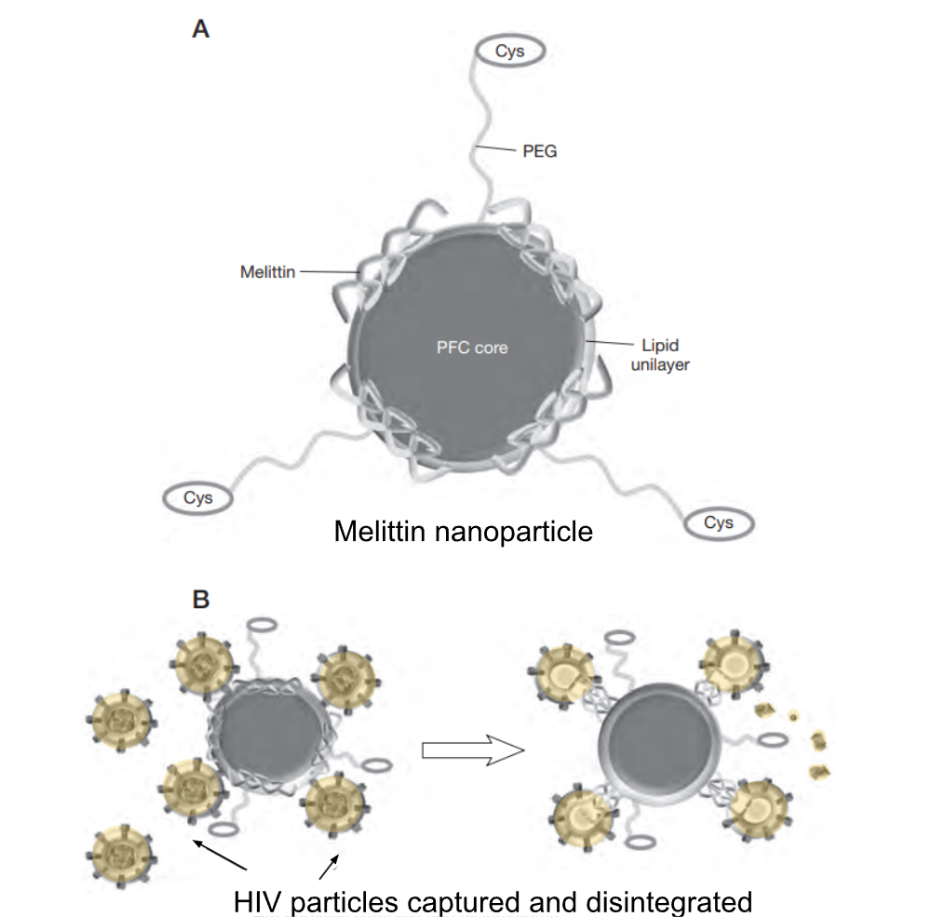
Using nanoparticles, in vitro human vaginal epithelial cell viability was not decreased at any melittin concentration tested, including ones found harmful using free melittin (Hood et al. 2013). Additionally, melittin physically targets the virus’s double membrane, making HIV resistance unlikely—highly relevant given the potential for virus mutational resistance with current market drugs (Hood et al. 2013).
Though apitherapy has been used for thousands of years, its credibility in today’s scientific landscape is relatively young and the medicinal uses of honey bee venom exemplifies the importance of studying science of the past.
References
Comments
7 Responses to “How the ancient medicinal use of honeybee venom can cure HIV”
Hi iSci!
My post was inspired by something that William Roman from Rosewood Estates said in his Wine Sci ISS about bee venom being able to kill HIV virus. I decided to incorporate the history of medicinal use of bee products to illustrate the importance of studying historic practices for modern applications.
Looking forward to hearing your feedback!
Hey Olivia!
Your post was well written and interesting to read! I appreciated the visual and well-labelled figure caption as it added necessary context to the writing. I enjoyed your ability to transition between evidence and reflection, as well as a good message in the conclusion mentioning the importance of scientific history.
Some small edits to make, you wrote “The past couple decades has revealed”, the plural would mean “has” turns to “have” (tedious, I know, I’m sorry). Edit your sentence “Documented by Greek and Roman physicians Hippocrates and Galen who referenced the use of apitherapy for treating the sick (Kim 2013)” to flow a bit better. For example, “The Greek and Roman physicians, Hippocrates and Galen, referenced the use of apitherapy for treating the sick”. or “Documented by Greek and Roman physicians, Hippocrates and Galen, apitherapy was referenced as a treatment for the sick.”. Again, super minor issue.
Generally, the consensus of the text is a bit vague, as to whether honey is a medicinal solution to HIV. Regardless, the answer wouldn’t be clear cut or guaranteed (as for anything), so edit your title to be a little less misleading (despite it being very captivating).
Really well done!!
Regards,
Gurleen
Thank you Gurleen for your thoughtful comment. I implemented both the writing edits you suggested. Since the title references bee venom specifically, not honey, I don’t think it’s misleading so I will leave that as is.
Hi Olivia, I found your blog very interesting. I was not aware just how useful bee venom can truly be! Here are small things I noticed:
P1S3 it is unclear what was documented by Hippocrates and Galen
P1S5 you use the HIV acronym before you introduce it.
P4S2 I think this would flow better if there was some sort of transition between S1 e.g. It is also OR Additionally, it is…
P5S2 I found the section after the dash unclear, not sure if there is a missing part to it
Other than that, I found your blog very well written and enjoyed reading it. Happy editing!
– Hafsah S
Thank you for your comment, Hafsah. I appreciate that you read my work thoroughly and suggested thoughtful edits. I made changes in accordance with your first, second, and fourth suggestion (though your third comment makes sense, I’m alright with how it reads as is).
Hi Olivia!
I really enjoyed your blog post! I never knew that honey used to be a treatment for cuts and sores. It was very interesting to read how melittin is such a powerful peptide.
There are some small revisions that could be made to polish your blog.
In your first paragraph you state, “Documented by Greek and Roman physicians Hippocrates and Galen who referenced the use of apitherapy for treating the sick (Kim 2013).” This sentence feels like an incomplete thought. Instead, try writing, “This process was documented by the Greek and Roman physicians Hippocrates and Galen who reference the use of apitherapy for treating the sick (Kim 2013).”
Additionally, in paragraph three your last sentence is missing a period.
Finally, in your fourth paragraph, the first sentence, “melittin” is spelled incorrectly.
Overall, your blog was written very well with an abundance of references to support your information. I look forward to reading the final version.
Emma Iacobelli
Thank you, Emma, for your comment. I made changes according to all your suggestions and you caught several mistakes which I appreciate!