“Seeing is believing.” It is one of those phrases that feels almost too obvious to question. If a glass falls off a table, we do not need someone to explain that gravity exists. If we step outside and feel freezing rain, we know the weather is cold. Much of what we understand about the physical world stems from concrete experiences like these. But what happens when we apply that same intuition to climate change? Climate change is happening all around us, yet much of it unfolds across decades and enormous geographic distances. If seeing is believing, how are we supposed to “see” a global phenomenon that operates far beyond the limits of everyday human experience?
In behavioural science, common sense can be understood as using knowledge gained from daily life to make flexible, intuitive judgments about familiar situations (Poth 2026). Repeated interactions with our environment allow us to build mental models and expectations without consciously analyzing every encounter. We learn that dropped objects fall, dark clouds often precede rain, and touching a hot stove causes pain. Direct experience gives us information that feels immediate and unquestionable. However, perception is far more complex than a camera recording reality. Predictive processing models propose that the brain uses prior experience and expectations to interpret incoming sensory signals, particularly when information is ambiguous (Walsh et al. 2020). What we have experienced before shapes what we expect to see, and how we interpret what we actually encounter.
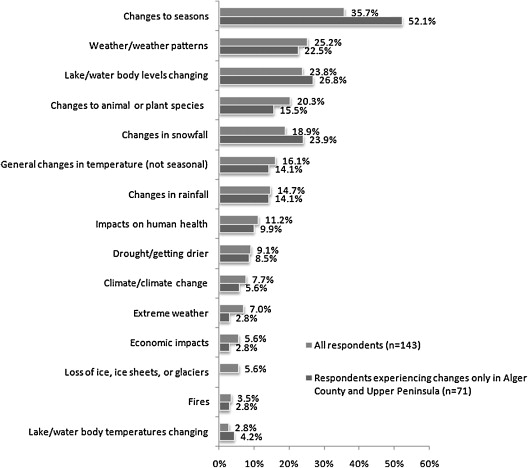
This dynamic creates a mismatch for climate change. Weather is something we experience directly: we feel a scorching afternoon, watch a winter storm, or notice an early spring. Climate, however, describes patterns in weather over much longer timescales, with climatologists commonly using 30-year averages to describe typical conditions (World Meteorological Organization 2025). A single memorable summer cannot tell us, by itself, what has happened to global temperatures over several decades. Yet personal experience remains influential. In a survey of adults in Alger County, Michigan, 27% reported personally experiencing global warming. Among those participants, the most frequently reported experiences involved changes in seasons (36%), weather (25%), lake levels (24%), animals and plants (20%), and snowfall (19%) (Akerlof et al. 2013).
At the same time, existing beliefs can influence how people interpret these experiences, meaning the relationship between experience and perception operates in both directions (Myers et al. 2013). This is where climate science provides what individual perception cannot. Scientists combine measurements from land-based weather stations, ships, buoys, satellites, and other instruments to identify patterns across large regions and long periods. They track variables such as surface temperature, ocean conditions, sea level, and ice loss, while evidence from ice cores, tree rings, and sediments can provide information about past climates (NASA 2022). A global temperature record is therefore not the result of one thermometer, but the combination of many independent observations that reveal patterns too large or slow for one person to observe.
“Seeing is believing” is useful for navigating our immediate surroundings, but climate change reminds us of the limits of direct observation. Sometimes, seeing the bigger picture means looking beyond what any one person can see.
References
Akerlof, Karen, Edward W. Maibach, Dennis Fitzgerald, Andrew Y. Cedeno, and Amanda Neuman. 2013. “Do People ‘Personally Experience’ Global Warming, and If So How, and Does It Matter?” Global Environmental Change 23 (1): 81–91. https://doi.org/10.1016/j.gloenvcha.2012.07.006
Myers, Teresa A., Edward W. Maibach, Connie Roser-Renouf, Karen Akerlof, and Anthony A. Leiserowitz. 2013. “The Relationship Between Personal Experience and Belief in the Reality of Global Warming.” Nature Climate Change 3 (4): 343–347. https://doi.org/10.1038/nclimate1754
NASA Science. 2024. “What Types of Data Do Scientists Use to Study Climate?” NASA.https://science.nasa.gov/climate-change/faq/what-kinds-of-data-do-scientists-use-to-study-climate/.
Poth, Nina. 2026. “Common Sense and the Limits of Inferential-Role Intuitive Theories in the Advent of AI.” Minds and Machines. https://doi.org/10.1007/s11023-026-09785-w
Walsh, Eoin, et al. 2020. “Evaluating the Neurophysiological Evidence for Predictive Processing as a Model of Perception.” Annals of the New York Academy of Sciences 1464 (1): 242–268. https://doi.org/10.1111/nyas.14321
World Meteorological Organization. 2025. “WMO Climatological Normals.” https://wmo.int/wmo-climatological-normals


Leave a Reply
You must be logged in to post a comment.